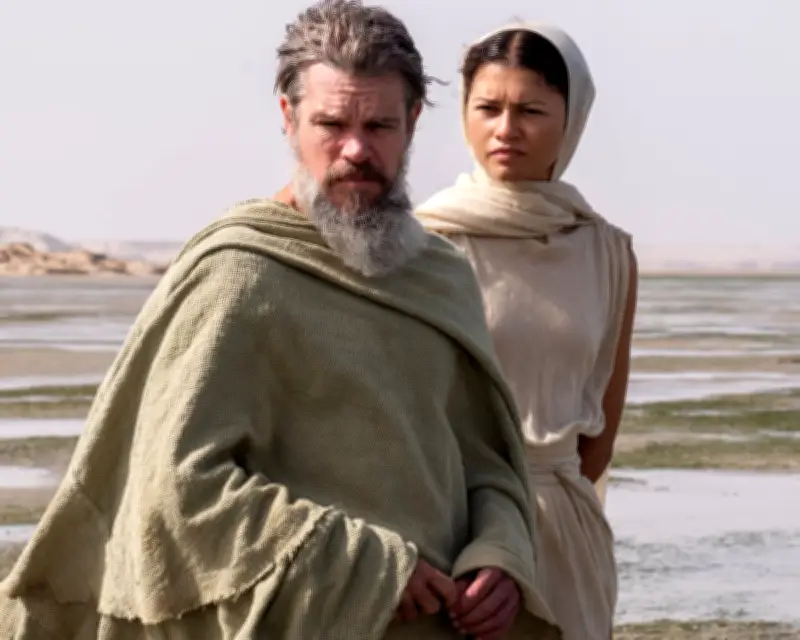
Christopher Nolan's latest film, 'The Odyssey', has been met with critical acclaim, but classicist Dr. Emily Hauser offers a nuanced verdict, arguing that while the film captures the epic's visual grandeur, it fundamentally reshapes Homer's hero for modern sensibilities, often at the expense of the poem's female characters and moral complexity.
A Hero for Our Times
Matt Damon portrays Odysseus as a sensitive, remorseful leader, a stark contrast to Homer's cunning and often prideful hero. Hauser notes that Nolan's Odysseus is 'a man who seeks redemption and solidarity among men, recognition from women, and absolution for a civilisation’s fall.' This interpretation, she argues, reflects a modern Hollywood desire for a flawed but ultimately empathetic protagonist, reminiscent of Nolan's 'Oppenheimer'.
In Homer's epic, Odysseus is a 'complicated man'—a liar, a storyteller, and a pragmatist who mourns his lost men but moves on. Nolan's version, however, spends much of the film grappling with guilt over the deaths of his crew and the destruction of Troy, even undertaking a final journey not found in Homer to seek their forgiveness.
What's Lost: Women and Moral Ambiguity
Hauser points to significant omissions and alterations concerning female characters. Notably, the princess Nausicaa, who helps Odysseus return to Ithaca, is entirely cut. The goddess Calypso, with whom Odysseus spends seven years, is portrayed as drugging him with lotus to make him forget his home—a simplification of her complex role in Homer.
Penelope, Odysseus's wife, is also diminished. In Homer, she tests Odysseus with the famous bed-test, demanding mutual recognition. In Nolan's film, she is more passive, and in a troubling change, she becomes the executor of the enslaved woman Melantho, pushing her into the slaughter—a role Homer assigns to Telemachus. 'Where is the challenge we see in Homer to whether she really wants him home or not?' Hauser asks.
The film also omits Odysseus's hubris that brings a curse on his men, his slaughter of unarmed suitors (Nolan arms them), and the near-civil war that follows his return. Instead, the focus remains squarely on Odysseus's inner turmoil.
Epic Cinema vs. Homeric Complexity
Nolan's film, shot with IMAX cameras, delivers stunning visuals—the smashing of waves, the crunch of bones in the Cyclops' jaws—that evoke Homer's 'enargeia', or vividness. Yet Hauser argues that the epic's moral ambiguity is traded for a straightforward redemption arc. 'Every reworking of Homer says what it wants to the people it is speaking to,' she writes.
For audiences seeking a blockbuster, Nolan's 'Odyssey' offers spectacle and a hero's journey. But for those familiar with Homer, the film's choices reveal a modern preoccupation with trauma and leadership that flattens the original's rich tapestry. As Hauser concludes, 'Make of that, in the current climate, what you will.'