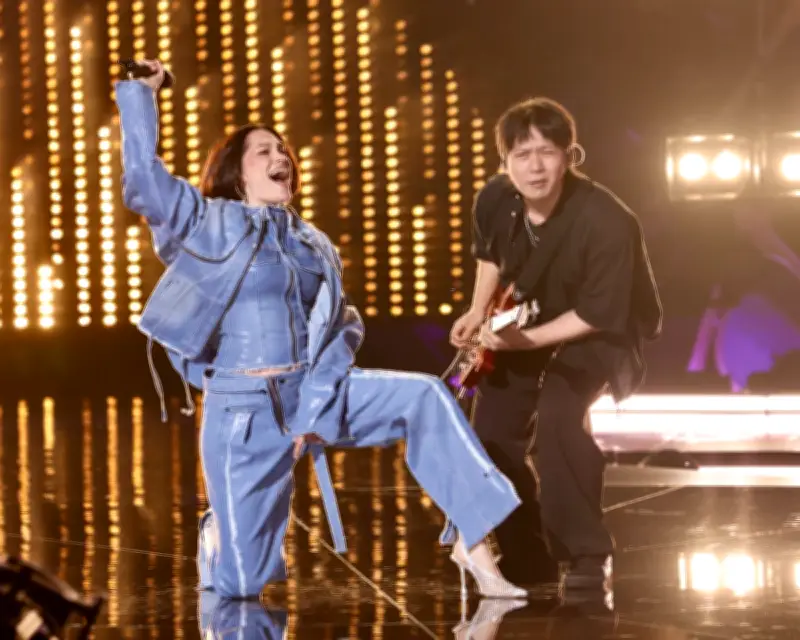
One week after announcing she was cancer-free, British pop star Jessie J traveled thousands of miles to perform for an audience of over a billion people in China. On May 29, the singer-songwriter, whose real name is Jessica Cornish, delivered a powerful rendition of Frank Sinatra's "My Way" on the stage of "Singer," a hugely popular Chinese singing competition similar to "The Voice." She also performed her new song "California," briefly adapting the lyrics to change "California" to "Changsha," the Chinese city where the show is hosted.
A Nostalgic Return
Returning to China was "nostalgic," Cornish wrote to her 821,600 followers on Weibo, a Chinese social media platform. "The fact that I'm still so widely recognized and loved by everyone means more to me than people can imagine." She says she was "instantly hooked" on China. "I just think in life you should go where you're celebrated and I feel so celebrated there," she told The Guardian. One fan wrote on Weibo: "In China, everyone thinks no one in the world can sing better than you."
In a country of 1.4 billion people, having less than a million followers does not make one a household name. But Cornish's pivot to China, at a time when her Western career seemed to be floundering, has allowed her to tap into a lucrative market—and other Western pop stars are trying to follow suit.
The Chinese Music Market Boom
Cornish first burst onto the Chinese scene in 2018 when she entered and won that year's series of "Singer," a show that can garner over 20 billion views for a single episode. Back then, the potential of the Chinese market was already evident. Hundreds of millions of digitally savvy and culturally hungry young music fans had created an energetic music scene that was rapidly growing. The government had recently cracked down on illegal music streaming, strengthening copyright protections and earning potential for musicians. Since 2018, the Chinese recorded music market has climbed from seventh to fourth globally, recently overtaking Germany.
Chinese stars have always been dominant, a trend that intensified after the COVID-19 pandemic. COVID "raised the bar for how interesting you have to be to the Chinese music consumer in order for it to be lucrative," says Alex Taggart, founder of Isle Of, an artist management and music consultancy who worked for several years in China. "With no foreign artists able to come into China, the domestic music industry massively raised its game." He adds: "Before COVID, it was much easier to be a random Western artist in China doing well."
International Acts Adapting
Now, international acts have to work increasingly hard to win over Chinese fans. Perhaps no act has worked harder than Westlife. The Irish boyband first performed in China over 20 years ago and have steadily built a following since. "We've performed in China more than 20 times, and it's become one of the most special relationships we have anywhere in the world. The scale of the support still amazes us," says Shane Filan, one of the band's members. Kian Egan, another member, says Chinese fans "know every lyric, every album track, every harmony, sometimes better than we do ourselves."
In 2023, the band performed a song entirely in Mandarin at a show in Wuhan, a cover of "The Ordinary Road" by Mandopop star Pu Shu. For a country with a strong sense of national pride, few things impress Chinese fans more than learning the language. This year, the foursome performed at China's flagship Spring Festival Gala to an audience of over 650 million. Charli XCX, before she became Brat-famous, impressed Chinese fans when she collaborated with Chinese electronic musician Howie Lee to produce a Mandarin version of her hit "Boys."
The Appeal of Ballads and Vocal Prowess
Part of the appeal of Westlife and Jessie J is their penchant for ballads, a musical style adored in China. "The thing that Chinese music listeners really care about is, one, melody over everything, and two, they really respect pure singing ability," says Taggart. "They love somebody with pipes. That is a big part of the reason why Chinese fans love Jessie J so much." Cornish says part of what she enjoys about performing in China is "how much they respect and celebrate voices and technique … I really miss people just listening."
Challenges and Opportunities
Performing in China has its challenges. As well as navigating the language barrier, Cornish says the rules on showing tattoos on television have tightened since she first appeared on "Singer"—it was officially banned in 2018. She had to plan her outfits to ensure none of her tattoos were visible. Several mid-tier British indie bands have also found unexpected success in China, including alt-rock ensemble Sea Power, who garnered a large following after scoring a popular video game.
Although the Chinese market may be harder to break into post-COVID, China hopes to attract more international stars to help boost its flagging economy. In 2024, Ye, the artist formerly known as Kanye West, announced a surprise show in the tropical south Chinese island of Hainan, which sold out within minutes. The controversial rapper, widely criticized in the West for racist and antisemitic comments, was not an obvious choice to perform in China, where all performances are subject to censorship review and explicit content is generally discouraged. But the show reportedly generated 373 million yuan (£41.2 million) in tourism revenue, and other cities soon clamored to host their own version. West performed again in Shanghai last year.
For all West's tirades, he has never publicly crossed Beijing's red lines. A music industry professional who asked to remain anonymous due to professional links to China says: "It's not necessarily about explicit lyrics. Those are allowed on Chinese platforms … it would be more of a political thing. If someone was outspoken against the Chinese government, they would struggle to build a career in China." Before the show in Hainan, West abruptly canceled a scheduled performance in Taiwan. Perhaps his team had learned from Katy Perry's mistake. The "Hot N Cold" singer was reportedly banned from China after she performed in Taiwan wearing the Taiwanese flag as a cape. But, perhaps mindful of the consumer spending Perry could generate, Chinese authorities apparently forgave her last year when she was allowed to enter the country to perform five sold-out shows. On returning to the stage in Shanghai, Perry said the Chinese were her "best fans."