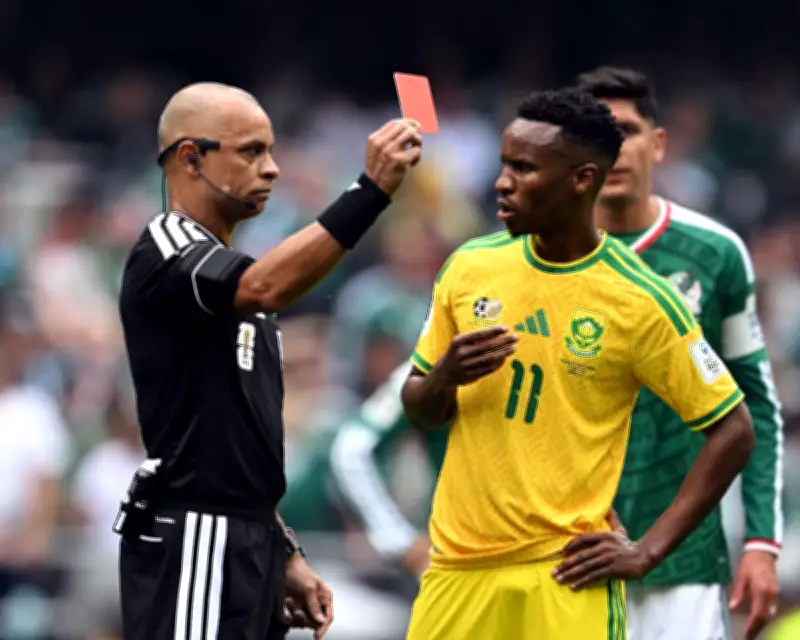
FIFA's insistence on implementing annual law changes at the World Cup, rather than after the tournament, has turned refereeing into a chaotic free-for-all, with officials enforcing tweaks that have barely been tested in any widely broadcast competition. The result has been drama, mistaken identities, and widespread confusion among players, coaches, and fans.
Calvinball on the world stage
The comic strip Calvin and Hobbes featured a fictional game called Calvinball, where rules were amorphous and constantly changing. The term has been used to describe the World Cup, where FIFA's hasty rule changes create an unpredictable environment. For example, the 2022 World Cup saw the implementation of five substitutions, but other changes have been more controversial.
This year, the laws officially changed on 1 July, but FIFA applied them at the World Cup, which technically started before that date. According to the International Football Association Board (IFAB), competitions starting before 1 July may delay implementation until the start of the next competition, but FIFA chose not to wait.
Mistaken identity and simulation
One significant change involved the mistaken identity clause, which now allows VAR to review yellow and red cards when the wrong player is penalized. In Paraguay's opener against the USA, Miguel Almirón fell after minimal contact with Tim Ream, and Ream was booked. Replays showed Almirón had simulated, so Ream's yellow was rescinded and Almirón was booked for diving. According to FIFA, this was the first use of the revised rule.
In the quarter-finals, Switzerland's Breel Embolo was also affected when a yellow card initially given to Argentina's Leandro Paredes was reversed, leaving Embolo with a second yellow and a sending-off. Switzerland played with 10 men and lost 1-1 in extra time.
New sending-off offense
Another change approved in April made it a sending-off offense for a player to cover their mouth when communicating with an opponent in a provocative manner. Paraguay's Almirón did exactly that in his team's second match, resulting in a red card and a subsequent rant from a commentator who lost his World Cup credentials.
Confusion over substitutions and injuries
The law requiring substituted players to leave the field within 10 seconds has also caused confusion. Players may feign injury to delay, leading to disputes with referees. Meanwhile, the rule on injuries—allowing play to continue for minor injuries but stopping for serious ones—has left players lying on the ground while play goes on, baffling both teams.
Unenforced protocols
Despite clear laws against homophobic chants, no action has been taken at this World Cup, even though chants have been audible. Similarly, the rule mandating a yellow card for removing a shirt during goal celebrations has been ignored; Egypt's Mostafa Ziko did not receive a yellow after scoring against Argentina.
Hair-splitting VAR decisions
Technology has led to extreme precision. Croatia's equalizing goal against Portugal was disallowed because the ball's sensor detected the slightest contact with Igor Matanovic's hair, putting Josko Gvardiol offside. According to analysts, if Matanovic had been bald, the goal would have stood.
Such calls have fueled criticism of VAR, but the issue lies in unclear communication from FIFA and IFAB. The handball rule, rewritten multiple times, has become incomprehensible. FIFA should reconsider implementing changes when the whole world is watching in bewilderment.