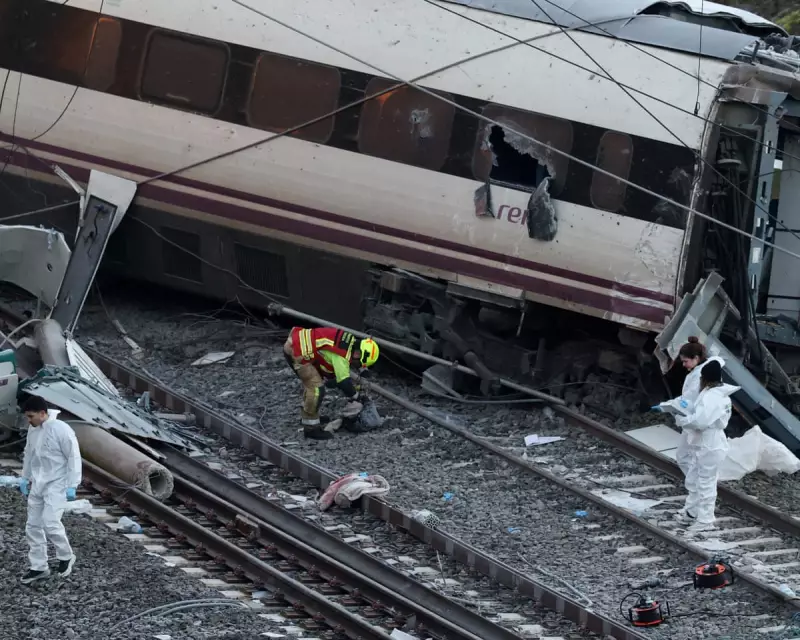
Spanish Rail Crash Investigators Focus on Damaged Rail Theory
A preliminary investigation into Spain's catastrophic train collision in Andalusia has revealed compelling evidence pointing toward a damaged section of rail as the potential cause of the deadly derailment. The accident, which claimed 45 lives and left dozens injured, occurred when a privately operated Iryo high-speed train derailed and collided with an oncoming Renfe service near the town of Adamuz.
Forensic Evidence Points to Rail Fracture
The Rail Accidents Investigation Commission (CIAF) published findings indicating distinctive nicks in the right-hand-side wheels of three front carriages on the Iryo train. These marks are consistent with impact against the top of a rail, suggesting the train encountered a fractured section of track.
The report explains the mechanics behind this theory: When a rail fractures, the section before the break initially bears the full weight of a passing wheel, causing slight sagging. Since the section after the fracture doesn't act in unison, a momentary step forms between the two sides of the break, striking the wheel rim with considerable force.
Based on current evidence, investigators hypothesize that the rail fracture occurred before the Iryo train passed over it, meaning the damage existed prior to the derailment. However, the CIAF emphasizes this remains a provisional theory requiring further rigorous testing and examination.
Safety Concerns Spark Industrial Action
The Andalusia tragedy was followed just two days later by another serious incident in Catalonia, where a retaining wall collapse near Gelida derailed a train, killing the driver and injuring 37 people. These consecutive disasters have intensified concerns about Spain's railway infrastructure safety.
In response, Semaf - Spain's largest train drivers' union - has announced a three-day strike scheduled for February. The union states this industrial action represents the only legal avenue remaining for workers to demand restored safety standards across the railway network, aiming to protect both railway professionals and passengers.
Political Fallout and Accusations
The tragedy has become a focal point for political criticism, with opposition parties accusing Spain's socialist-led coalition government of chaotic crisis management and transparency failures. Conservative People's party leader Alberto Núñez Feijóo declared the railway system's condition reflects the nation's state, asserting Spain currently has the worst government in its history rather than the best rail network.
As investigations continue, these developments highlight mounting pressure for comprehensive safety reviews across Spain's rail infrastructure, with profound implications for transport policy, industrial relations, and political accountability.