Strikes Have No Place in a Competitive Market Economy, Argues Tom Harwood
Thursday 23 April 2026 5:56 am | Updated: Wednesday 22 April 2026 4:16 pm
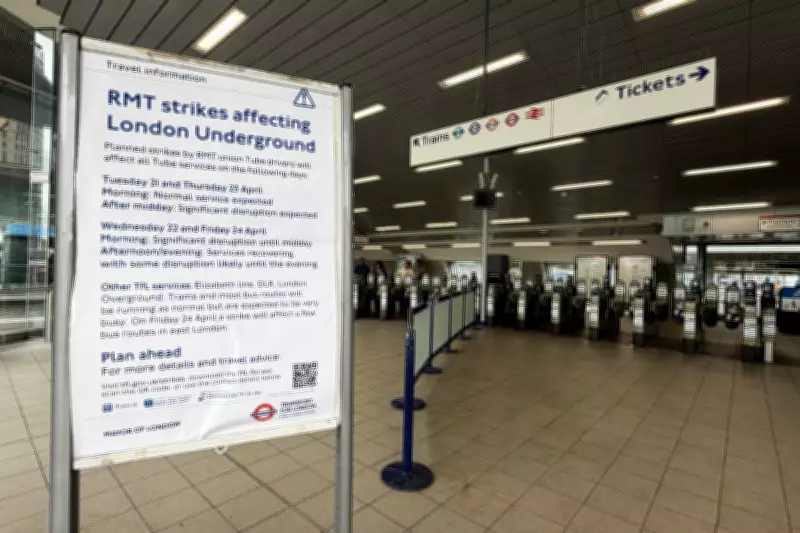
LONDON, ENGLAND - APRIL 20: A sign warns travellers at Stratford underground station of the upcoming industrial action by the RMT union, on April 20, 2026 in London, England. A series of 24-hour strikes by London Underground workers will start tomorrow, causing widespread disruption to the city's transport system. Members of the Rail, Maritime and Transport (RMT) union recently voted for strike action in relation to a plan for a 4-day work week, citing concerns about shift lengths, working time arrangements and the impact of fatigue on safety.
Tom Harwood, deputy political editor of GBNews and a City AM columnist, has boldly declared that strikes are dumb, antiquated, and anachronistic, utterly out of step with the modern world. He emphasizes this stance not merely due to the RMT's actions disrupting his week, but as a fundamental critique of union practices in today's economy.

The Automation Revolution Above Ground
While the Tube network grinds to a halt, a quiet revolution is unfolding on London's streets. Harwood notes the increasing presence of Google's autonomous Waymo vehicles navigating the city's winding medieval roads. He points out the irony that autonomous cars are operational before full automation of one-way trains in dedicated tunnels, attributing this delay not to technological limitations but to unionised resistance.
Remarkably, only the Piccadilly, Bakerloo, and Waterloo & City lines remain mostly unautomated. On other lines, automation has reduced the driver's role to opening and closing doors and pressing a departure button. Harwood criticizes the situation where a small gilded elite of tube drivers, often earning over £80,000 for a four-day week, can hold the city ransom with minimal taxing duties.
Overmanning and Underautomating: A Union Legacy
Harwood argues that trade union action consistently leads to overmanning and underautomating, driving up costs and reducing efficiency. He describes strikes as relics from an era when entire communities depended on a single employer, such as steelworks or mines, with no alternative employment options.
In contrast, today's competitive market economy offers employees the liberty to seek other jobs if dissatisfied. Harwood questions why tube drivers with high incomes and favorable conditions can force employers to demand fewer hours and more pay, while laws prevent hiring replacements who would accept existing terms. He laments how this entrenches incumbents and stifles efficiency.
A Thought Experiment on Union Logic
Citing American journalist Richard Hanania, Harwood presents a thought experiment: imagine customers boycotting a store until it lowers prices, with government mandating negotiations on products and hours, potentially leading to a shutdown. Applying this logic to employees instead of customers highlights the absurdity, as employees, like customers, can seek alternatives elsewhere.
Harwood challenges why the law allows workers to hold employers ransom and forbids replacement of those refusing employment terms. He advocates leaving this sclerotic system of restrictions in the past, where it belongs.
Conclusion: A Call for Modernization
In a 21st-century city with a semi-automated transport system, Harwood deems it absurd that well-remunerated incumbents can shut down the city while legal barriers block replacement, reform, and automation. He calls for a shift away from outdated strike practices to embrace efficiency and innovation in a competitive economy.