Italian Renaissance: Does 'Home-Ice' Give Winter Olympic Hosts a Competitive Edge?
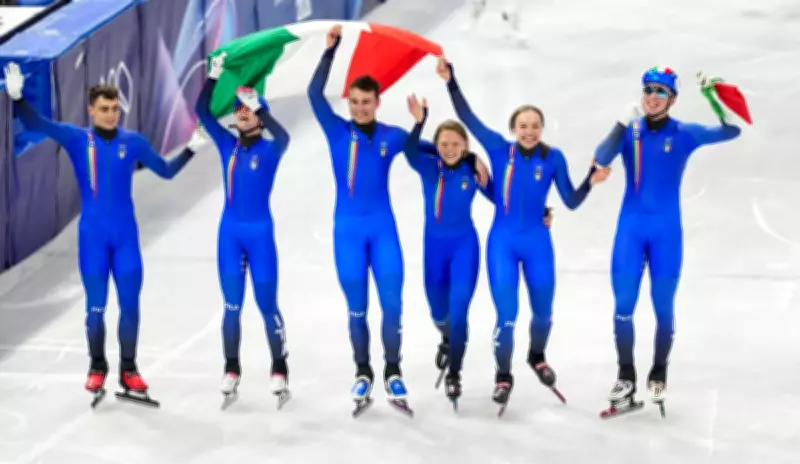
Members of the Italian team erupted in celebration after clinching gold in the mixed short-track speedskating relay event on Tuesday. This victory was just one highlight in a stunning performance by the host nation during the first week of the Milan-Cortina 2026 Winter Olympics.
A Surprising Medal Surge for Italy
With an impressive haul of 13 medals through the initial five days of competition, Italy has already surpassed their total from the Turin 2006 Games. This achievement positions them as the unexpected stars of these Olympics, raising questions about what factors are driving this success.
The electric celebrations began on Saturday in Bormio, near the Swiss border, with silver and bronze medals in the men's downhill skiing event. Just hours later, the excitement shifted to Milan, where Francesca Lollobrigida set an Olympic record in the women's 3000m speed skating, securing the host country's first gold medal.
On Sunday, the celebrations spread across diverse sports and venues throughout Italy. These included snowboard bronze in Livigno, biathlon silver in Antholz, and luge bronze in Cortina. In Milan, figure skater Matteo Rizzo sank to his knees after completing his free skate, sobbing tears of joy on the ice. He leaped over the barrier to join his compatriots in celebrating their bronze medal, marking Italy's first-ever medal in the figure skating team event.
Historical Context and Host-Country Trends
In just two days, Italy accumulated nine medals, exceeding their totals from Sochi 2014 (eight medals) and Vancouver 2010 (five medals). The host nation was nearly halfway to its record Winter Olympic tally of 20 medals achieved in Lillehammer 1994.
While Monday passed without additional medals, Italy resumed their success on Tuesday with achievements ranging from mixed doubles curling bronze to the frenetic mixed short-track speedskating relay gold. Wednesday brought further triumphs with doubles luge medals in both men's and women's events, elevating Italy's gold-medal count to four. Thursday added another gold in the women's super-G skiing event.
To some extent, a host-country boost is typical in Olympic history. The United States shattered their medal records at Salt Lake City 2002. Canada set a record for gold medals in a single Winter Olympics edition when they hosted in 2010, though Norway has since broken that record. South Korea and China both won more medals as hosts in 2018 and 2022 than in any previous edition. The 2014 Games in Russia present a complicated comparison due to pervasive doping issues involving the host nation.
The Nature of Home Advantage in Winter Sports
Home advantage in the Olympics, particularly the Winter Games, differs significantly from team sports like basketball or football, where fans can directly intimidate opponents and officials. Sports like curling actively discourage heckling, and home fans aren't shouting to disrupt opposing biathletes during their shots. While cheering can provide an emotional lift, its impact varies across disciplines. A downhill skier leaving the start gate is unlikely to be affected by cheers from the bottom of the slope.
However, "home ice" can offer literal advantages. American bobsleigh, skeleton, and luge racers delivered stellar performances in 2002 on their familiar Utah Olympic Park track, where they knew every turn intimately. Olympic committees and sponsors recognize the unique opportunity when the Games come to their country. Canada, after failing to win a single event when hosting the 1976 Summer Olympics and 1988 Winter Olympics, launched the "Own the Podium" campaign five years before the 2010 Vancouver Olympics. China initiated an ambitious effort to increase citizen participation in winter sports ahead of their hosting duties.
Long-Term Benefits and Italian Redemption
These strategic investments can yield benefits extending beyond a single host Games. The United States has maintained its status as a winter sports power, continuing to utilize the world-class facilities constructed in Utah that will host the Olympics again in eight years. Canada has demonstrated remarkable consistency since their 2010 success.
The country that largely failed to capitalize on hosting the Olympics in the 21st century is now making up for lost time. In 2006, when the Games were in Turin, Italy fell short of their best-ever performance from Lillehammer 1994. While they won 20 medals (seven gold) in 1994, they managed only 11 medals (five gold) as hosts in 2006. Even if Lillehammer is considered an aberration due to Manuela Di Centa's five-medal haul in cross-country skiing, Italy's 2006 total still lagged behind their 13 medals from Salt Lake City 2002.
The enduring image of Italy's 2006 efforts came in ice dance, where 2002 bronze medalists Barbara Fusar-Poli and Maurizio Margaglio tumbled near the end of their program. Fusar-Poli stared at her longtime partner in despair and exasperation for an uncomfortable 30 seconds before they finally took their bows.
What's Different This Time for Italy?
General improvement represents one significant factor. After reaching a low point with just five medals in 2010 and no gold medals in 2014, Italy rebounded strongly in 2018 and came close to their record with 17 medals in 2022.
The current surge may also reflect increased national enthusiasm. Turin never fully embraced the Olympic spirit in 2006, but this year's Games feel distinctly different. Italy's early success, highlighted by vivid celebrations, should help maintain momentum throughout the competition.
Momentum remains difficult to quantify scientifically. Did Italy's figure skating team inspire ice hockey goaltender Damian Clara to stop 46 Swedish shots during Wednesday's near-upset before his injury exit? Probably not in a direct causal sense.
Winter sports often involve precise numerical measurements—thousandths of a second in luge, minute adjustments to execution scores in figure skating. Yet many of sports' most memorable moments defy straightforward explanation. When crowds roar for Matteo Rizzo or the short-track relay team upsets traditional powers, can we deny the presence of something approaching magical?