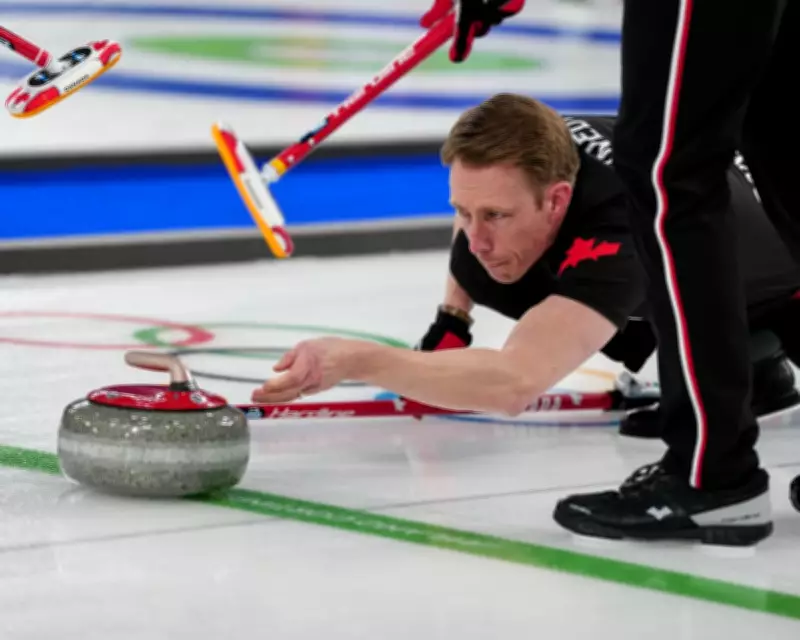
Canada Escapes Punishment After Curling 'Fomb' Sparks Olympic Controversy
Canada's men's curling team has narrowly avoided punishment at the Winter Olympics despite allegations of rule-breaking and the use of abusive language during a tense and bad-tempered victory over Sweden. The dramatic 8-6 win on Friday was marred by accusations of cheating and a heated exchange that culminated in a Canadian player uttering an expletive, leading World Curling to issue a formal warning and implement emergency spot checks to ensure future compliance with the rules.
Cheating Allegations and Heated Exchange
The match was temporarily halted after Sweden's team claimed that their Canadian rivals were improperly touching the stone following its release, a violation of curling regulations. Swedish curler Oskar Eriksson specifically accused Canada's Marc Kennedy of double-touching the stone, a charge that prompted Kennedy to respond with a curse word. "It's sport. It's the Olympics. Both teams are trying to win. Oskar was accusing us of cheating. I didn't like it. I've been curling professionally for 25 years," Kennedy explained after the game, defending his reaction as part of the competitive intensity of the event.
Nolan Thiessen, the chief of Curling Canada, acknowledged that Kennedy's choice of words was unfortunate but attributed it to the heat of the moment. "I think heat of the moment, I would allow for as well," Thiessen stated. "Something was said in his ear which got him going. Head games get played in a lot of sports and things get said in competitive sport and I think this was one of those situations. Do I wish Mark didn't drop an F-bomb? Yeah."
Rule Violations and Technological Limitations
World Curling has introduced electronic handles on the stones for these Games, designed to flash red if players maintain contact beyond the hog line, the point where curlers must release the stone. However, the Swedish team argued that Kennedy was touching the granite part of the stone rather than the handle containing the sensor, meaning the red lights did not activate. Video replays appeared to support Eriksson's claim, but officials did not intervene during the match.
"We told the officials," Eriksson revealed. "They came out and they misread the rules, sadly. Because they thought double-touching any part of the rock is OK. And then they found out that was wrong. You can only touch the electronic part of the handle."
World Curling's Response and New Measures
In a statement released on Saturday, World Curling confirmed that the result of the game would stand, emphasizing that decisions made during play are final and that video replay is not used to re-umpire games. "World Curling does not currently use video replay to re-umpire game decisions. Decisions made during a game are final," the organization declared.
However, in response to the incident, World Curling announced the introduction of emergency spot checks to better enforce the rules. "It is not possible for World Curling to have game umpires positioned to observe all hog lines for every stone delivery," the statement explained. "However, beginning with the Saturday afternoon session, two officials will move between all four sheets and observe deliveries."
Additionally, the world body sent an email to all teams at the Winter Olympics, reiterating that touching the granite part of the stone during delivery is illegal. "A stone must be delivered using the handle of the stone," the email clarified. "Touching the granite at any time during the forward motion is not allowed and considered a touched moving stone which results in the stone being removed from play."
Warning and Future Implications
Canada's team received a stern warning from World Curling, with the organization making it clear that any recurrence of abusive language would lead to sanctions. This incident highlights the intense pressure and competitive spirit of Olympic curling, while also underscoring the challenges of enforcing rules in real-time during high-stakes matches.
The controversy has sparked discussions about sportsmanship and regulation in curling, a sport known for its tradition of fair play. As the Winter Olympics continue, all teams will be under increased scrutiny to ensure that such incidents do not overshadow the competition.