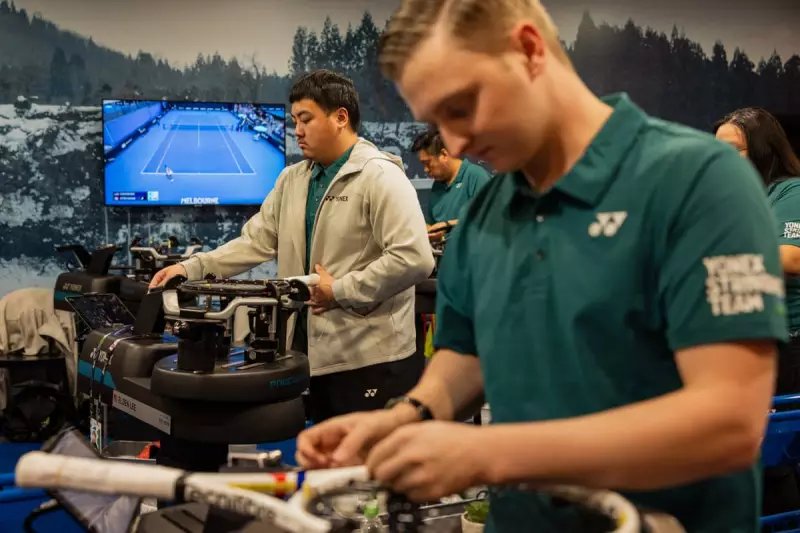
While the world's finest tennis stars battle for glory on the blue courts of Melbourne Park, a critical supporting act unfolds in an unassuming underground room. Here, a team of specialists works with intense focus, their craft essential to every serve, volley, and smash witnessed above. This is the domain of the racket stringers, the unsung technicians without whom the Australian Open could not function.
The High-Demand Craft Behind Every Shot
Led by Yonex string team leader Jim Downes, a veteran with three decades of experience, a squad of 22 experts services the exacting needs of roughly 800 tournament athletes. Downes describes the role as a "high demand job," far removed from casual shop stringing. At this elite level, players are "very particular" about string tension—the precise tightness of the fibres crisscrossing the frame. A higher tension offers more control but sacrifices power, while lower tension does the opposite, making consistency and speed paramount.
British stringer Sarah Bloomfield, at her second Australian Open, notes that environmental factors like Melbourne's heat significantly influence player requests. "They all arrive in Australia and up their tension because it's hotter so the ball travels faster," she explains, highlighting how stringers must adapt to provide players with the necessary control.

Precision, Process, and Paint Sticks
The process begins when a player or coach delivers rackets, specific tension instructions, and their chosen strings to the dedicated room. Old strings are swiftly cut out and removed, with frames then assigned to a stringer. Downes tries to maintain consistency, often pairing top-ten seeded players with stringers who will remain for the entire tournament. As the event progresses and players are eliminated, the team shrinks, leaving the most experienced hands for the finals.
In the main room, a focused calm prevails, broken only by the mechanical whirrs, clicks, and snips of the craft. An empty frame is secured on a machine, the tension dialled in, and the meticulous work begins. The main strings are threaded, clamped, tensioned, and knotted by hand before the cross strings are manually woven under and over them. The final, surprisingly low-tech step is stencilling the sponsor's logo using a simple fluffy paint stick.
From Gut to Polyester: The Evolution of String
The materials themselves have a rich history. For a century, natural gut from animal intestines was the standard. Polyester strings revolutionised the game in the early 1990s, offering more spin and durability. "It provided more spin and more durability, but it can have some negative effects on the body," Downes notes, citing wear on wrists, elbows, and shoulders. This led to a resurgence of natural gut, with most modern players now opting for a hybrid setup combining gut's power with polyester's control and strength.
The job entails long hours of repetitive motion, punctuated by urgent mid-match restringing requests. "Always the adrenaline starts pumping a little bit," admits Bloomfield, though consistency remains the watchword. The physical toll is real, resulting in calloused hands and aching feet from hours standing still. "The more you string the easier it gets because your hands harden up," she says.
Despite crafting a perfect instrument, stringers must watch as their handiwork is often smashed beyond recognition in moments of high emotion. Downes takes it in stride, suggesting sponsoring companies might feel worse about the racket abuse than the stringers themselves. "It's just an angry outburst. They need to release it somehow," he says philosophically.
For Bloomfield, a former player, watching tennis now comes with a profound appreciation for the entire support crew. "I feel like part of that team. There's always a bit of a sense of pride," she reflects. It's a pride earned in the hum of an underground room, where tension is perfectly measured, and every weave of the string contributes to sporting history.