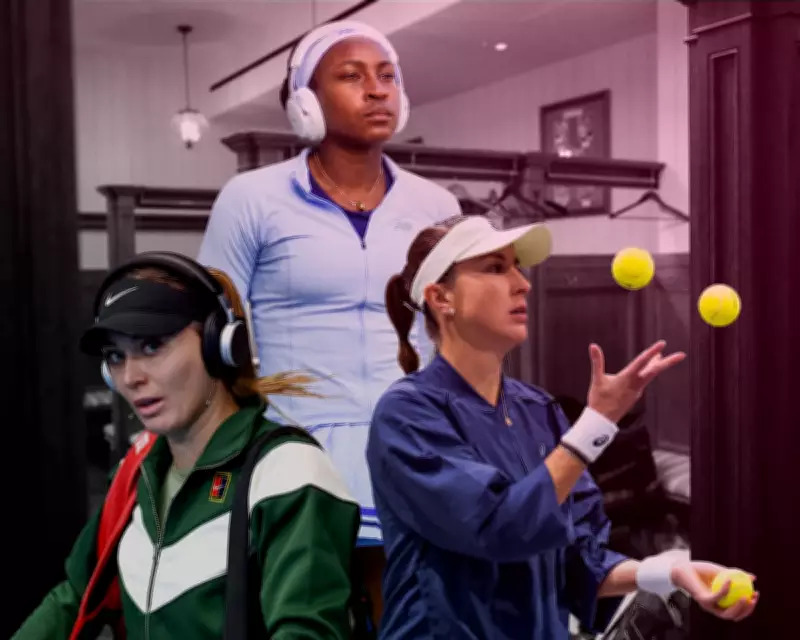
Inside the Loneliest Communal Space in Professional Tennis
After a successful first-round performance at the Australian Open in January, Coco Gauff returned to the locker room and spotted a fellow player across the space. The athlete was consuming sweets immediately following her match, prompting Gauff to joke that things must have gone well on court. The laughter was not returned. The player was actually stewing after a miserable day of competition.
"They were, like, 'No, this is depression candy,'" says Gauff, wincing at the memory. This revealing moment highlights the complex emotional landscape that professional tennis players navigate in their shared locker rooms.
The Awkward Dance of Avoidance and Interaction
Part of the professional tennis job description involves sharing locker rooms worldwide with the same individuals they are tasked with defeating on court. This arrangement frequently leads to profoundly awkward interactions for everyone involved. For many players, including Paula Badosa, match preparation involves deliberately avoiding eye contact at all costs.

"That's the thing we do, I think, all of us," Badosa explains with a smile. "We try to avoid it and just say hi. That day you avoid the conversation and eye contact for sure."
Gauff concurs with this assessment, noting that interactions vary dramatically depending on relationships: "[With] the people I know really well, it's not really that awkward. We'll talk and be, 'OK, see you out there,' and that's fine. But always with people you don't know, you don't know whether to say hi to them or not. I'm someone who usually always says hi, but the responses vary. And I understand – get in the moment."
Beyond the Locker Room: Uncomfortable Proximity
For Belinda Bencic, situations where she and her opponents are grouped closely together create even more discomfort than sharing locker room space. Transport arrangements, such as sharing golf carts en route to competition courts, present particular challenges. Still, even Bencic cannot escape the inherent strangeness of some pre-match scenarios.
"Sometimes you are doing your hair or getting ready for the match and your opponent is right there," she reveals. "You don't know if you should make small talk or not. Everyone is different. Some players are very relaxed – we are talking – and some players don't want to talk to you before the match."
Navigating Emotional Minefields
The awkwardness extends far beyond interactions with that day's specific opponent. As Gauff's Melbourne faux pas demonstrated, dozens of players pass through locker rooms daily following their matches, creating a veritable minefield of human emotion. Some athletes weep openly after excruciating defeats while others rage silently. Sometimes it proves impossible to determine exactly what transpired on court.
"The worst thing about sharing a locker room is seeing someone, knowing they played, but not knowing how the score went," Gauff explains. "You don't know what mood they're in. I always find that hard to navigate."
Community Versus Isolation
After spending substantial portions of their lives in communal locker rooms since their junior days, players gradually become accustomed to these complex interactions. Madison Keys actually appreciates certain aspects of the arrangement: "I quite enjoy it because even though you're sharing a locker room with your opponents, you're also sharing a locker room with friends," she says.
"There have been moments where I know that either myself or other players have had really tough moments and you always have someone around you who can give you a hug and talk you through it. There is that immediate support. I guess other sports have that, but it's your own teammates. It's nice there's an immediate sense of community versus [being] isolated."

The Art of Strategic Avoidance
One obvious method for minimizing awkward locker room interactions involves spending as little time as possible in the environment. Jannik Sinner has perfected this particular art form: "When I started to come on tour, I was on-site a lot," he recalls. "I would spend a lot of time in the locker room, a lot of time in the restaurant area. Now I'm a bit different. Especially on training days, I come here [and] when the training is over or I eat something very fast here, then I leave or I leave straight away."
Egos, Attitudes and Changing Personalities
Stefanos Tsitsipas believes most players maintain reasonably good relationships with each other, though he observes that some become less willing to exchange greetings as they cross paths. He expresses particular disappointment with athletes who transform their interpersonal behavior after achieving modest success.
"One thing I don't understand is how they develop a bit of an attitude and a bit of an ego once they make one or two good results. Their whole personality changes. I wouldn't say arrogant – perhaps some of them," Tsitsipas notes. "I just wish more weren't attached to their results and to what they do that determines who they are. I love humble people. That's one of the reasons I admire Giannis Antetokounmpo a lot. He's achieved so much through basketball. He's one of the most humble athletes I've ever met and spent time with. I wish more tennis players were like that."
From Toxic Past to Peaceful Present
Other players experience minimal problems with their professional peers. Daniil Medvedev reports that his coaches, Rohan Goetzke and Thomas Johansson, frequently share stories about how dramatically messy player relations used to be in previous eras.
"I heard from them that 20 years ago it was as toxic as it could be," Medvedev reveals. "I was shocked. I was, like: 'But that's why you guys finish your careers early because it's constant pressure.' He told me some stories where from when you wake up you're already under pressure. Going to the locker room, you're under pressure."
According to Medvedev, contemporary locker rooms have become far more peaceful and largely drama-free environments. The sport represents a genuine melting pot of diverse cultures, customs and backgrounds, but according to Bencic, alongside powerful serves, consistent groundstrokes and composure under pressure, a crucial quality for elite players involves tact and discretion.
"It can be a little bit awkward if someone has had a bad day or just lost or something, then someone else comes in and is all happy," Bencic acknowledges. "It's a shared space, so you have to really also be a little bit respectful to everyone else. Just be respectful and normal."