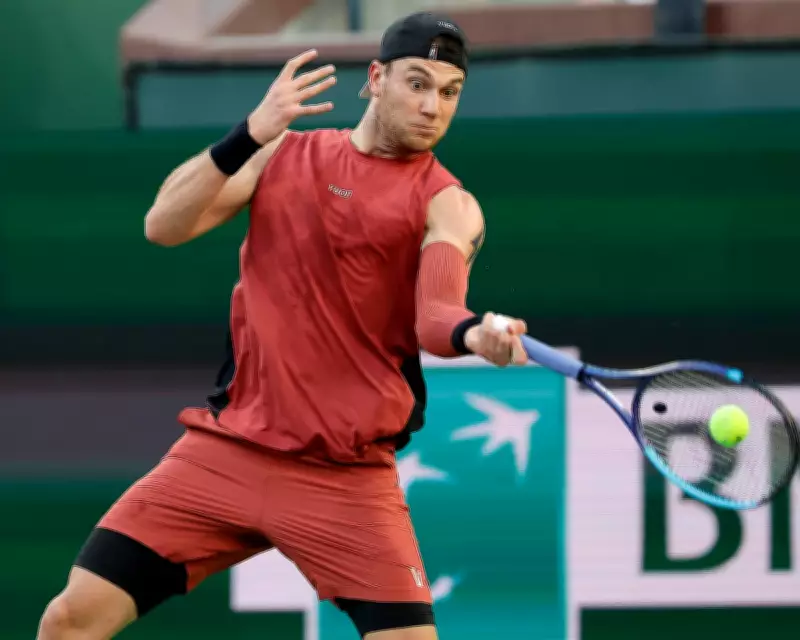
Jack Draper's Injury-Driven Transformation: New Strings, New Serve, New Success
Injury has compelled Jack Draper to fundamentally alter his game, including the strings on his racket. The British No. 1 has implemented changes to both his equipment and his serve, reaping immediate rewards with a victory over Novak Djokovic at Indian Wells.
A Decisive Moment of Attack
Two and a half hours into one of the most memorable battles of his career, Jack Draper resolved to attack without hesitation, regardless of the outcome. On two pivotal points in his Indian Wells fourth-round match against Novak Djokovic, at 4-4 in the tie-break and then on match point at 6-5, Draper forced himself inside the baseline and unleashed two powerful backhands, driving him to a stunning victory.
It would have been understandable for Draper to play passive tennis in those decisive moments. Not only did Indian Wells mark his second ATP tournament back after sustaining a bone bruise to his left arm that forced him off the tour for seven months, but the injury has necessitated dramatic changes to his playing style.

The Switch to Natural Gut Strings
Draper has returned to the circuit using natural gut strings in a hybrid setup. Until this year, the 24-year-old had spent his career playing with synthetic polyester strings in his mains and crosses, but he and his team decided it was appropriate to switch to natural gut in his mains.
Natural gut strings are made from cow intestines and were the primary option for elite players throughout much of the 20th century. However, the modernization of professional tennis has been driven by the introduction of poly strings. While natural gut strings are softer and more elastic, offering more power and feel, firmer poly strings enable modern players to hit with greater spin and control.
At 6ft 4in, Draper generates significant power, and his spinny forehand is one of the heaviest in the game. These changes do not naturally suit his aggressive style. However, the elasticity of natural gut strings is far friendlier to the arm and body. Given his history of left-arm injuries, he viewed this as a necessary adjustment.
"It was to do with doing anything to help my injury be better," Draper explains. "Look, it's still a great string, the gut. But in the way everyone's playing now, hitting the ball quite hard, and usually it goes in—that's what poly does for the racket—so the gut's a bit of an adjustment. But it was the decision for my body; it wasn't a decision for performance."
Hybrid Setups and Mental Adjustments
Although full natural gut setups are nearly extinct in the modern era, gut strings remain common on the tour in poly-gut hybrid setups, as players seek to blend the best qualities of both. Half of the current top 10, including Djokovic, Alexander Zverev, Alex de Minaur, Taylor Fritz, and Daniil Medvedev, use such hybrids, typically for performance enhancement. Draper, however, admits he still has reservations about the change.
"The string is a hell of a lot softer, you can't take full swings, sometimes you have to adapt to the conditions," he says. "The string, obviously being softer, it flies a hell of a lot more. So for someone who's always hit the ball the way I do, sometimes you have to adjust your mindset a little bit and almost play within yourself because the string does a lot of work for you. That's the biggest adjustment—it's a mental one to decide what shot you're going to play, when you're going to play it, because it sometimes comes off a bit different."
Overhauling the Serve
The past seven tumultuous months have taken Draper on a similar journey with his serve. He spent much of his time away working tirelessly on changing his service motion, now executing it with a slightly simplified motion and a changed stance. Previously using a pinpoint stance, where he dragged his legs close together before launching into his serve, he has switched to a platform stance, with a wider, more stable base and feet separated.
His serve has always been a strong asset; last year, he won 86.1% of service games, ranking 11th on the tour. The reasons for this change mirror those for his string switch: the platform serve reduces stress on the upper body.

"I definitely looked into how I can make my serve a bit more stable, a bit less going on," Draper notes. "When you have to step up, especially being a lefty, you can get the ball tossed too far out in front and not use your legs properly. My serve has always been a weapon but probably not using my chain well enough. I think the platform gives me more stability and I'm able to protect my body better, so I'm still early days with that and hopefully it makes a big difference in the long run."
Proving His Mettle at the Highest Level
Draper's performances at Indian Wells provided crucial evidence that he can continue to excel at the highest level while adapting to this new normal. His victory over Djokovic underscores his resilience and strategic evolution, demonstrating that injury-driven changes can lead to unexpected success on the court.