On the Pevensey Levels, marshland first drained in 772, the ground is pocked with endless impressions of horseshoes. "It's almost as if an army came this way," one hiker remarks, laughing because they missed that army by 959 years. The group—Annie, Mike, Fflos the dog, and the author—are on the first day of following the 1066 Country Walk across East Sussex, beginning at Pevensey and ending in Rye. At the midpoint is Battle, where they have rented an outbuilding conversion for three nights. Battle is known as the probable site of the Battle of Hastings, where about 2,000 Normans, 4,000 Anglo-Saxons, and 700 horses died on one day in October 1066, according to various sources, leading to William the Conqueror defeating King Harold for the crown of England.
History commands immediacy outdoors
History commands an immediacy outdoors that it doesn't in books. On the Levels at the same time of year as the Normans—September—the group wonders: did the Normans note the blackthorn heavy with sloes? Spot blackbirds feasting on blood-red hawthorn berries? Hear the wind in the rushes alongside the River Pevensey? The contradictions of war-making in such a gentle place—gentle light, gentle breeze, birdsong and river currents—make an impression. The landscape offers the same russet, sage, and ochre hues as the Bayeux tapestry.
The 31-mile route over four days
The 1066 Walk covers 31 miles over four days: Pevensey to Herstmonceux (6 miles), Herstmonceux to Battle (11 miles), Battle to Icklesham (9 miles), and Icklesham to Rye (5 miles). The second day is the longest and steepest but establishes a pattern that continues throughout. The route passes through Wartling Wood, carpeted in acorns and lined by blackberries, then around sunny fields, into the village of Boreham Street, down a holloway guarded by beeches, and out into more fields with windswept horizons. Morning tea is taken at the Ash Tree Inn in the hamlet of Brownbread Street.
A temporal quilt of past and present
With every shift of scene, there is a slippage of time. One moment walking down a contemporary street passed by speeding cars, then slipping through a small opening in a hedge into fields or woods, out of the present into time immemorial. There is a constant weaving in and out of darkness and light, wildness and cultivation, close-grown tunnels of greenery and wide-open windy spaces. The effect is of a temporal quilt sewn with footsteps. Few other walkers break the spell.
Elasticity of time on Tent Hill
Elasticity of time is most apparent on Tent Hill, where, as Mike puts it, "the reward to effort ratio is quite good." Sources suggest one army or the other camped here, hence the name. Instead of troops, the group discovers an ancient horse chestnut with branches so immense they have touched the ground and put down roots of their own, creating a family of trees around a living central ancestor. Joining their company is occupying past and present at once.
From Battle to Rye with mushroom tutorials
On day three, the group sets forth from their accommodation at Abbey View Cottages, which offers a view of Battle Abbey's towers. Another plunge off a country lane lands them on a bridle path in Battle's Great Wood, where Mike announces: "My fungi sense is twitching." He gives a mushroom tutorial on fly agarics, edible boletes and parasols, and great penny buns, which he calls "the Rolls-Royce of mushrooms."
Bayeux tapestry-inspired sculptures and medieval towns
The temporal hopscotch continues across a golf course into deep countryside with venerable oasthouses tucked into hill folds. Shortly before arriving at the Three Oaks pub, the group encounters one of artist Keith Pettit's 10 Bayeux tapestry-inspired sculptures: six hollow, Celtic-carved oak pillars planted inside with hawthorn, forming a circle of growing wonder on a hillcrest. The final hike brings them to medieval Winchelsea, rebuilt by Edward I in the 1280s after the original town was washed away. They traverse apple orchards in mellowness reminiscent of Dutch landscape paintings. The modern stained glass windows of St Thomas church, created by Douglas Strachan as memorials after the First World War, bloom on the route like colour-saturated rainbows.
Detour to Camber Castle and arrival in Rye
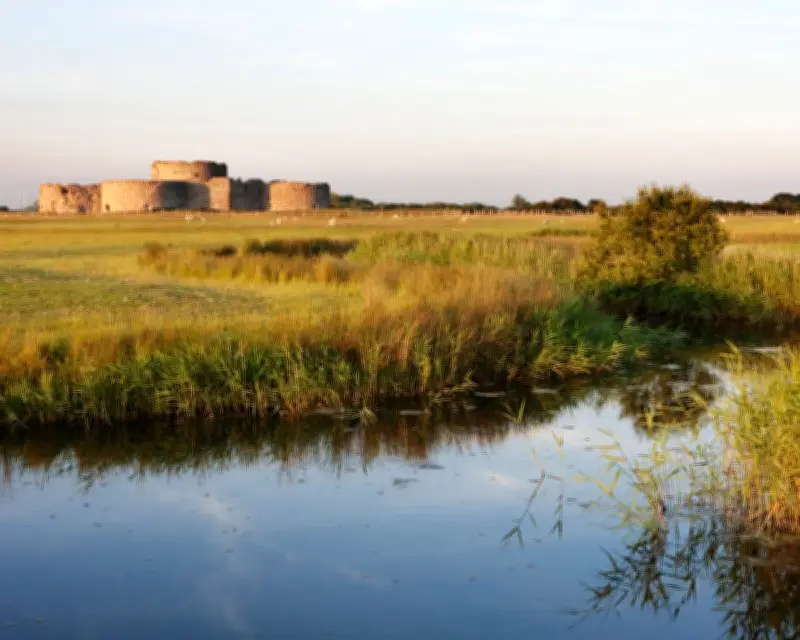
From Winchelsea, the group heads to Rye across the silted-in coastal lowland that would have been underwater in Edward's day. With Rye in eyeshot, they depart from the official 1066 Country Walk to detour past the ruin of Camber Castle, pressed into the flatland by a big, heavy sky. Begun in 1512, finished in 1544, and demolished in the 1640s by parliamentary forces in the English civil war, it is a reminder of vulnerability and hubris. With a final shift of perspective from pastureland to townscape, they fetch up in pretty, comfortable Rye, town of Henry James, antique shops, and good food. They are more energised than exhausted, grateful they didn't have to conquer this place with anything more than their imaginations.