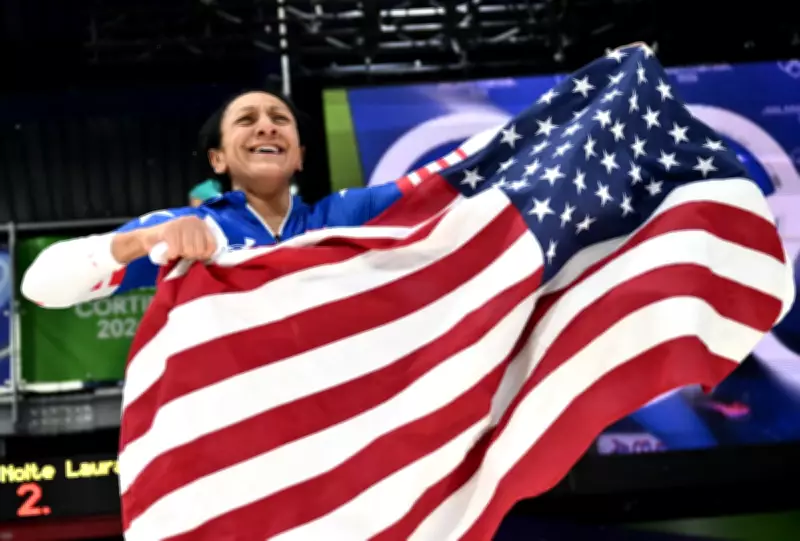
Elana Meyers Taylor Achieves Dream Gold in Historic Monobob Victory
Elana Meyers Taylor celebrated a monumental triumph on Monday night, waving the US flag after securing gold in the women's monobob at Cortina d'Ampezzo. This victory marks her first Winter Games title at the age of 41, capping a career dedicated not only to athletic excellence but also to advocacy for Black athletes, mothers, and the deaf and Down's syndrome communities.
A Legacy of Persistence and Advocacy
Long before this golden moment, Meyers Taylor had already etched her name in Olympic history. She competed against men to help integrate women's monobob into the Winter Olympic program, surpassing speed skater Shani Davis as the most decorated Black athlete in Winter Games history. With medals from Vancouver, Sochi, Pyeongchang, and Beijing, she holds more Olympic podium finishes than any female bobsledder ever.
Despite challenges including a bad back, concussion history, and the demands of motherhood, Meyers Taylor never relinquished her dream of standing atop the podium. Her goal was realized in Località Gilardon, where she edged out Germany's Laura Nolte by a mere 0.04 seconds—the closest women's bobsleigh finish in Olympic history. This gold in her fifth Games, following three silver and two bronze medals, also set a new record as the oldest Winter Olympic gold medalist in an individual event, surpassing Benjamin Karl.
Overcoming Adversity and Balancing Family
The path to this cathartic victory was fraught with obstacles. Meyers Taylor faced a difficult World Cup season without a single podium finish, battling injuries, chronic pain, self-doubt, and a severe crash in St Moritz. Additionally, she managed the logistics of raising her two young sons, Nico and Noah, who are both deaf, with Nico also having Down's syndrome. They traveled the European circuit with her and a nanny, supported by her husband, former US bobsledder Nic Taylor, who often went months without seeing the boys due to work commitments.
"I don't think I'm going to process this for a while," Meyers Taylor reflected on her gold medal. "There were so many moments during this entire season, during this past four years, that we just thought it was impossible—or I thought it was impossible." She emphasized that the hardest part was the daily balancing act of motherhood and elite athletics, made possible only by a robust support network.
Gold with Greater Purpose
Meyers Taylor's win resonates far beyond the sliding track. She has become a beacon for families navigating disabilities, particularly within deaf and Down's syndrome communities. Her consistency across four runs, avoiding mistakes while rivals posted faster splits, secured her long-sought prize. She reached a top speed of 78.3 mph in her third heat, matching the track record, showcasing her skill and composure.
Her advocacy extends to broader social issues: she has interned with the International Olympic Committee, served as president of the Women's Sports Foundation, and spoken out on gender equality and racial discrimination. Many see her as a future leader in the Olympic movement.
In the end, Meyers Taylor's gold symbolizes more than personal achievement; it represents hope and inspiration for marginalized groups worldwide. As she celebrated with her sons by her side, she highlighted the importance of visual memories for her deaf children, hoping they will one day understand their mother's champion status.
"I don't think I needed it. I wanted it," she said of the gold medal. "And that's what allowed me to keep going. If I'd needed it, I don't think I'd have been able to have done it." Her victory is a testament to resilience, passion, and a commitment to making a difference both on and off the ice.