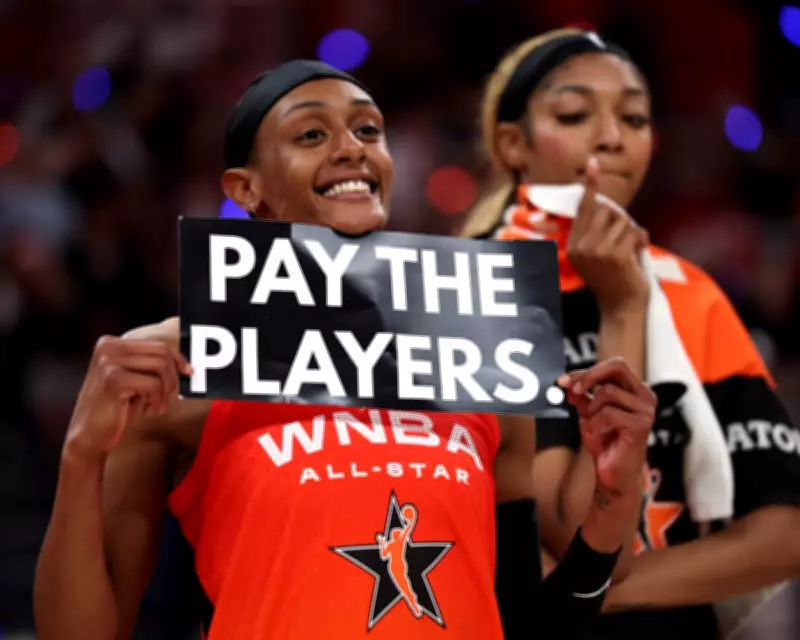
The WNBA is entering its 30th season, a milestone worthy of a grand celebration, and this year, players have much to celebrate. The Women's National Basketball Players Association (WNBPA) negotiated a landmark collective bargaining agreement (CBA) with the league, introducing a revenue sharing system and an estimated average salary of $583,000.
Salary Increases and Financial Freedom
This season, all players will earn a minimum of $270,000, up from $66,000, with some making as much as $1.4 million. Veteran forward Alysha Clark of the Dallas Wings, also vice-president of the WNBPA, describes the deal as 'amazing.' She emphasizes the ability to pave the way for future generations.
'This isn't only going to enhance the superstars and rising rookies, but it's going to change the lives of the heartbeat of the league,' says Clark, whose salary rose from $110,000 two years ago to $277,500. 'And that's the majority of players, players like me, that fill in the gaps.'
Clark adds, 'The generations before us fought for us to ensure that not knowing a world without the WNBA would never exist. Now our job was to carry that torch. The players coming in not only don't know a world without the WNBA, but they won't know a world where they have to scrape by as professional athletes.'
Supporting Families and Future Planning
Minnesota Lynx guard Courtney Williams, whose salary jumped from $180,000 last season to $1.19 million, plans to take care of her mother. 'I'm getting my mama a new house,' she says. 'She's in a trailer right now. We've been in it for my whole life. So I'm able to put her in a new house, pay off our cars, retire her.'
The new CBA allows players to invest in their futures, both financially and physically, and to support their families without the need to play overseas during the offseason. Previously, many WNBA players spent offseasons abroad in countries like Russia, Turkey, and China, where salaries dwarfed those in the US. However, playing overseas carried risks, including injuries and navigating unfamiliar countries. Brittney Griner's 10-month detention in Russia in 2022 highlighted these dangers.
'We want players in future generations to be able to stay at home,' Clark says. 'We don't want them to sacrifice time away from family during holidays. We want them to make a living here year-round, work on their craft, and take time to heal.'
Changing Perceptions and Retirement Planning
Dallas Wings' Maddy Siegrist, drafted in 2023, acknowledges the shift. Her salary rose from $83,781 last year to $501,180. 'I was probably at the tail end of where everybody was going overseas,' she says. 'Now, with so many opportunities here and the salary increase, it's no longer something you have to do if you don't want to.'
Alanna Smith, who will earn $1.19 million with the Wings, says the deal changes her retirement planning. 'Future planning, retirement-wise, was always on my mind,' Smith says. 'But now with these salaries, it's easier to plan for the future without thinking about a massive career outside basketball.'
Respect and Compensation
Both Williams and Clark acknowledge that the fight for the new CBA was about more than money. For Clark, feeling respected by the league's leadership was crucial. 'That includes respecting our craft and compensating us for doing such,' she says.
Williams adds, 'The details of what it took to get to the new deal can get lost. We were on our last CBA making maybe almost 9% in revenue sharing, and they had to pay us back $8 million. If we were losing money, how can you pay somebody back?'
In February 2026, the league announced that for the first time in its history, it made enough money to trigger automatic revenue sharing with players, distributing $8 million among all 13 teams. This came as players refuted claims that the WNBA couldn't meet their revenue sharing proposals.
Williams notes that the NBA didn't become profitable until its 40th season, while the WNBA is in its 30th. 'I just need everybody to sit back, do a little research and understand what's going on,' she says. 'If y'all are talking about it, it's a good thing. Keep helping us grow it.'
The fight doesn't stop here. 'We made history. We're the first league that made this big of a jump on our own salaries,' Williams concludes. 'Everybody can see what's going on.'