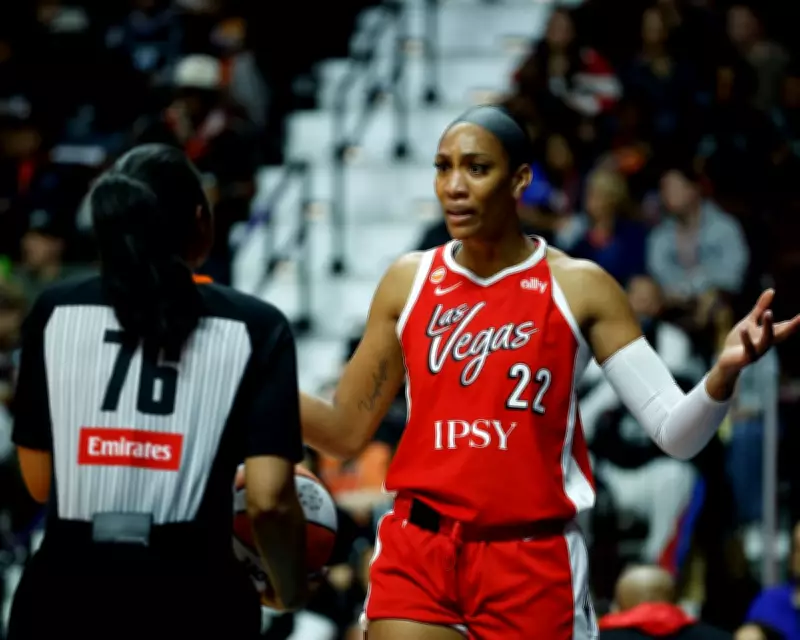
The moment Rickea Jackson went down during the Chicago Sky’s game against the Minnesota Lynx is difficult to watch, even days later. Jackson, who had just brushed off physical contact right before she was hurt, was driving to the basket about halfway through the second quarter when she suddenly lurched backward and fell, pointing toward her left knee.
The Sky announced Tuesday that Jackson will miss the remainder of the 2026 season with a torn ACL, tough news to receive when she was only a handful of games into her first campaign with Chicago after an offseason trade.
“We’re devastated that Rickea suffered this injury, but we are confident she will make a full recovery,” Sky general manager Jeff Pagliocca said in a statement. “Rickea was playing at an All-Star and All-Defensive level early in the season. We are certain she was primed for a career year.”
Jackson’s injury renewed a conversation about physicality and fouls that dominated the 2025 WNBA season. Last year, much of the focus was on Caitlin Clark, who suffered a series of injuries that ultimately curtailed her second year in the league, but several players ended up missing some or most of the season. That list included Clark’s teammates Aari McDonald, Sophie Cunningham and Sydney Colson, and many others.
After one especially volatile game last season, Los Angeles Sparks star Kelsey Plum told reporters, “I got scratches on my face, I got scratches on my body, and these guards on the other team get these ticky-tack fouls, and I’m sick of it. I get fouled like that on every possession.”
In response to outcry over inconsistent calls and increased physicality, a taskforce was assembled during the offseason, a move that appears to have been spearheaded by coaches, including Cheryl Reeve and Stephanie White. While the players were negotiating terms of a new collective bargaining agreement, coaches were in negotiations of their own, in a sense.
The result: consistent enforcement of the existing league rules, especially as they pertain to freedom of movement. So far, there’s been a sharp uptick in whistles, with teams averaging about 22 calls per game (each). Last season, there was an average of 17.5 fouls per team per game.
Alex Sarama, head coach of the Portland Fire, wasn’t a part of the taskforce, but he watched a lot of those offseason conversations from afar and complimented the increased communication he’s had with the league. Already this season, he has emailed with the WNBA’s head of referee performance and development to get clarification on calls.
“I understand there’s always a lot said in the media about officiating and all of that, but I do really feel like the league’s doing some good things to work together collaboratively to figure this out, and I think the communication’s been great,” he told reporters before Portland played Indiana on Wednesday.
Coaches and the league working together has made the conversation surrounding fouling different this season, White told reporters Wednesday. “Including coaches in the conversation, in evaluation, going through some of the scenarios together … I had not been part of those conversations before, [but] I do think that there’s a concerted effort from everyone in our league that we want our game to look different, and I think there’s also an understanding that it’s going to take time to get there.
The topic hits a little differently for players who are giving and receiving those fouls. When asked about fouling, responses from players run the gamut. After Jackson’s injury, her Chicago teammate Natasha Cloud put the blame on the referees. “On top of the points of emphasis that were emphasized at the beginning of the season, their ultimate job is to control and protect the players in this game,” she said, “and I think that this group today failed to do so.”
Myisha Hines-Allen, who spent last season with the Dallas Wings and now plays for Indiana, was anything but reticent when addressing the topic. “I mean, fouls happen in the game,” she said this week. “People foul. We foul! We do foul. And the refs are just trying to minimize all of the fouls – they’re trying to do their job, and we’re just trying to do ours.”
The solution will be to “find that common ground,” she added.
Monique Billings missed parts of the Golden State Valkyries’ 2025 season with injuries. Now with the Fever, she says the greater enforcement presents a challenge, but the good kind – something players can rise to. “I see it as a good challenge for us to learn how to play without fouling,” she said. “You have to be more disciplined. We know how it’s getting called … it’s ticky-tack. So, having that in mind, knowing that you just have to be a lot sharper, just more on point.”
Emily Engstler, who joined the Fire this season, agreed that the changes have a purpose. “That’s a good way to put it,” she said of Billings’s comments. “How can you, IQ-wise, not find yourself fouling exactly how they tell you not to foul?”
“You know, it’s a challenge,” she added. “It’s not a bad or good thing. It just is what it is. So we kind of have to do our jobs, and to figure that out, and hope that they can also do their jobs.”
But, she cautioned, referees may need to adjust, too. “We were prepared on how they were going to call things this year, and I think a lot of us are still trying to adjust to it,” she said. “But I do think one of the issues is now referees have to get used to people who are baiting them because of the way that they changed calls.”
Ultimately, Engstler said, players are relying on referees to keep them safe. “Don’t get me wrong: we’re all going to complain, we’re human,” she laughed. “But I do think there’s a level of protection we do look for from them, that maybe they don’t understand.”