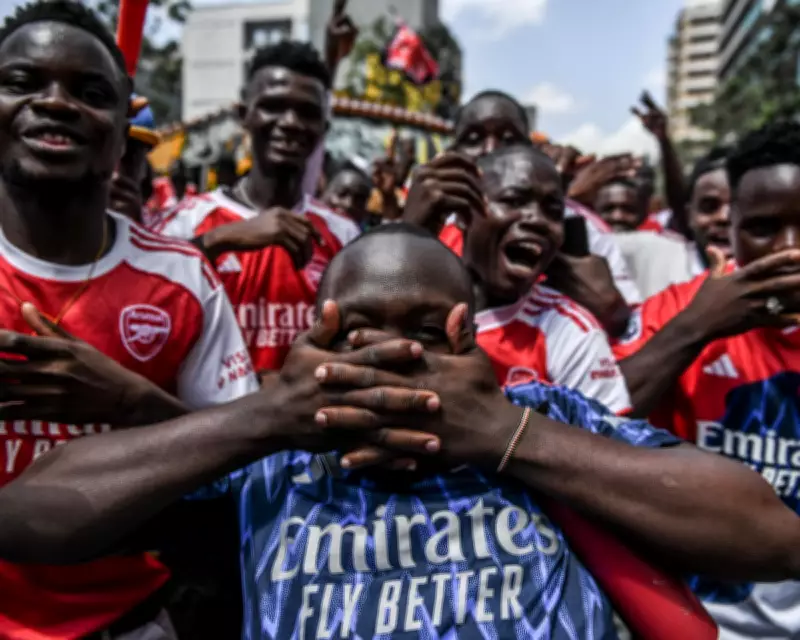
More than 150 million people will watch tonight's Champions League final between PSG and Arsenal. For Africa, the match carries extraordinary significance. If Arsenal wins, euphoria will erupt across the continent, building on scenes from last week's Premier League title win—their first in 22 years. Boisterous fans flooded city centers in Nairobi, Addis Ababa, Kampala, and Lagos. In Nigeria's Zamfara state, people celebrated despite rising insecurity from Boko Haram.
A Unique Bond
How did a north London club become so deeply woven into African popular culture? The most dramatic scenes may come in Kenya, where tens of thousands—some estimate up to a million—poured onto streets in a sea of red Arsenal shirts, a sight never witnessed before. Fans climbed lamp-posts, waved flags, sang club songs in local languages, and brought traffic to a standstill. One supporter described the title as a victory that had "overcome the hatred of the entire world." Jubilant fans also made a celebratory pilgrimage to the grave of the late Kenyan opposition leader Raila Odinga, a keen Arsenal supporter.
Pan-African Celebrations
Kenya was hardly unique. Across Ethiopia, fans turned Addis Ababa into a site of car parades and chanting crowds. In Uganda, thousands gathered in Nsambya for an all-night concert called "vimbisa Arsenal" after watching the match on giant screens. Worshippers heading to church or mosque wore Arsenal-themed tunics, thanking God for the victory. No one in Africa was surprised by the spontaneous energy.
Historical Roots
One reason lies in the spread of Premier League broadcasting in the 1990s. After the league's 1992 launch, clubs like Manchester United, Liverpool, and Chelsea built African fanbases. But the decisive shift came in 2000, when South African satellite network DStv acquired Premier League rights and began showing live matches across sub-Saharan Africa through SuperSport channels. Football bars became ritual gathering places, and fanclubs emerged everywhere, complete with elections and annual meetings. SuperSport and DStv fostered a kind of non-political Pan-Africanism built around shared spectatorship.
Arsène Wenger's Legacy
When Arsène Wenger joined Arsenal in 1996, African players were rare in English football. Wenger transformed that landscape. His first African signing was Liberian striker Christopher Wreh, a cousin of George Weah. More than two dozen African-born players represented the club under Wenger, including stars like Lauren, Patrick Vieira, Kolo Touré, and Nwankwo Kanu. This identification helped cement Arsenal's image as open, cosmopolitan, anti-racist, and forward-looking—values many supporters feel are in short supply in their own political systems.
Political Release
Football celebrations also provide a kind of political release. In countries where politics feels like elite horse-trading, spontaneous occupations of public space feel organic and genuinely collective. The streets belong, briefly, to ordinary people. While authoritarian figures like Rwanda's President Paul Kagame are Arsenal supporters, and the club's sponsorship with Rwanda has complicated its image, that does little to diminish the popular energy Arsenal evokes as a symbol of continental and diasporic Black pride.
Digital Amplification
The internet has amplified this culture. Social media became the preferred outlet for young Africans' political and cultural voice. Black British and African diaspora supporters dominate influential Arsenal fan media spaces. On YouTube, personalities from Arsenal Fan TV are now recognizable celebrities across Africa. Kelechi, a Nigerian migrant scientist and Arsenal fan, sings over Afropop songs before match analysis. He and other AFTV personalities tour African countries, where their watchalongs resemble national events.
This week, I called my cousin Leon in Cape Town. A civil servant who grew up in a township, he began supporting Arsenal in 1999 because of his older brother, precisely when Wenger's teams became visibly more African. For him, Arsenal was never just a football club: it was style and flair, but also, as a South African growing up under apartheid, it offered something approximating "non-racialism." If Arsenal wins tonight, that feeling will erupt once again onto the streets of Africa—a joy accumulated over decades through television, migration, fandom, and memory.