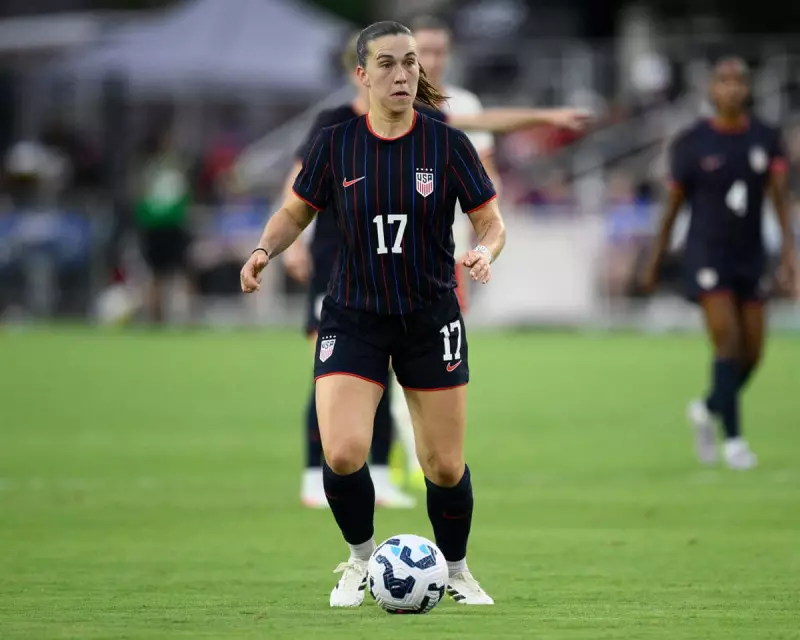
The departure of US international Sam Coffey from the Portland Thorns to Manchester City represents a significant moment for women's football on both sides of the Atlantic. This high-profile transfer means that more than half of the US Women's National Team (USWNT) starting lineup that won Olympic gold in 2024 will now be playing their club football in Europe.
A Dramatic Shift in the USWNT Landscape
Should free agent forward Trinity Rodman also sign for a European club, only four players from that victorious Olympic XI would begin the upcoming domestic season in the National Women's Soccer League (NWSL). This marks a profound change in the ecosystem of American women's football, a shift that has accelerated under the stewardship of USWNT head coach Emma Hayes.
Hayes, formerly of Chelsea, has had to publicly deny encouraging players to leave the NWSL, insisting she supports her athletes' personal ambitions. The statistics are stark: of the seven USWNT players with the most minutes in 2025, only two – Emily Sonnett and Claire Hutton – currently play in the United States.
Coffey's move is particularly symbolic. The 27-year-old defensive midfielder and Portland Thorns captain accrued more minutes for the national team in 2025 than any other player. Her transfer fee, reported to be around $800,000 (£600,000), signals that European clubs are prepared to invest heavily for prime American talent across all positions, not just for globally recognised forwards.
From Federation Control to a Global Free Market
The current exodus contrasts sharply with the NWSL's origins. The league was initially created and managed by the United States Soccer Federation (USSF), which once paid the salaries of two dozen national team players to keep them stateside. For years, this policy was effective; nearly every player on the 2015 and 2019 World Cup rosters played in the NWSL.
The philosophy began to change after Jill Ellis left the head coach role in 2019. The federation stepped back from its managerial role in 2021 and ceased directly paying USWNT players' NWSL salaries. The appointment of Emma Hayes in 2023, a coach renowned for her global outlook from the English Women's Super League, cemented the USSF's new embrace of the international game.
Now standing independently, the NWSL finds itself competing with European clubs that possess significant advantages. The historical legacy and prestige of clubs like Arsenal and Manchester City hold immense appeal. "For as long as I've kicked a ball, I've always dreamed of playing professional soccer in Europe, and it's something I simply have to pursue," Coffey stated in her farewell video.
Financial Muscle and Structural Hindrances
Financial power is the other key factor. European giants can leverage profits from their men's teams to offer salaries that far exceed the NWSL's restrictive salary cap. While not all European clubs spend lavishly, the willingness of top teams like Chelsea and Lyon to pay record-breaking transfer fees has fundamentally altered the market.
The NWSL's recent attempts to adapt have been controversial. Commissioner Jessica Berman's intervention to block a forward-thinking contract for Trinity Rodman, followed by the introduction of the "High Impact Player Rule," have been criticised. The rule, which raises the cap only for players meeting criteria seemingly biased towards European-based stars, has been opposed by the NWSL Players' Association. Critics argue it inadvertently validates Europe as the superior destination.
This is not to say the NWSL lacks quality or appeal. The league continues to attract top college prospects and international talent, and the return of former MVP Lindsey Heaps from France is a positive sign. It remains a crucial development ground for the US national team pool. However, it is now just one tool in the toolbox for the USWNT, rather than the toolbox itself.
The emergence of a robust global market, where elite players can choose leagues that offer different sporting and financial benefits, is a sign of the sport's growth. The ultimate challenge for the NWSL is to shed its residual constraints and decisively shape its own future in this new competitive landscape.