
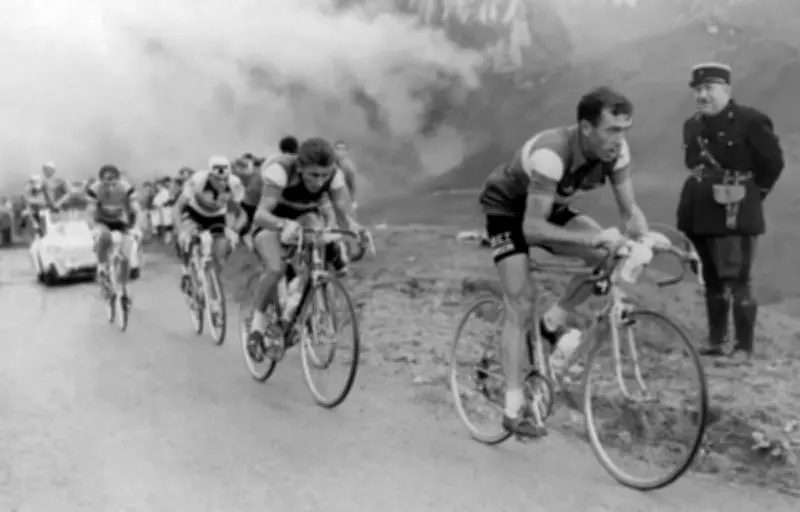
The Tour de France in 1966 had become a grim, scientifically controlled commercial operation, far removed from its early days as a picturesque jaunt in knickerbockers from Paris to Nice. While the French nation remained excited by the race, it was now saturated in commercialisation and marked by the retirement of cycling legend Jacques Anquetil and the introduction of a new anti-doping law.
Commercial Saturation and National Prestige
The Tour was heavily commercialised, with cycling teams resembling mobile advertising hoardings, branded on chest, arms, and back, racing through towns festooned with ads for Pelforth beer, BP petrol, Peugeot and Ford cars. The race served practical functions in French life, second only to the national Sunday horse racing gamble as a means of distracting the country from politics. On 20 June 1966, a minister was overheard telling a colleague he could relax until after the national holiday, as nobody would be making political demands.
The Tour also carried national sporting prestige and set an example to youth. Since its modest beginnings, the race had developed into a monstrous test of human endurance, with increasingly sophisticated mechanical and training techniques. The French Alps on the 18th day remained one of the vital tests.
Anquetil's Retirement and Doping Controversy
The 1966 Tour was notable for two reasons: it marked the retirement of Jacques Anquetil, and for the first time, drug use was an offence under a law hurriedly passed through the Assembly a couple of weeks before the race began. Anquetil, a 34-year-old Norman, had a status in cycling equal to that of Stanley Matthews in football or Babe Ruth in baseball. He won the Tour in 1957 and then four years running from 1961 to 1964.
Francoise Sagan told a story of running in her new Jaguar near her Normandy estate and being overtaken by a cyclist. Presuming her speedometer was faulty, she accelerated to 80 mph, but the cyclist drew alongside and passed her. However, on 3 May 1966, Anquetil won the Belgian Liège-Bastogne-Liège race, was requested to submit to a medical examination, refused, and was fined 100,000 Belgian francs and disqualified. The effect on the French was described as consternation, while the Italians were jubilant.
Premeditated Massacre and New Drug Law
Anquetil was later reinstated, but he was not the only one to fall before what looked like a premeditated Belgian massacre. In another race, Italian Dancelli inexplicably agreed to an examination that returned a result described as "gravely positive." German Altig refused and was fined and disqualified; a number of other placed racers were "declassed" after examination.
It was considered unlikely that someone of Anquetil's capabilities and long career could have kept going on dope; a judicious use of "biological aids" was probably the limit of his chemical use. However, other cases made it clear to the French government that a law they had been considering for a couple of years needed to be rushed through. Some time earlier, a dozen French cyclists collapsed along the Pyrenees stretch, victims of alleged "food poisoning," though the only food they could have had was a light breakfast. The French sporting press uncovered macabre stories, including that of Italian Eugene Tamburlini, who confided to a journalist that he had taken a drug that made him temporarily blind; he committed suicide shortly after.
In prewar years, sportsmen took risks with ether, strychnine, and alcohol, but by 1966, refined forms of amphetamine drugs used by the RAF to help pilots during the Battle of Britain were generally used. The pressure of vast financial interests had transformed the Tour into a grim, scientifically controlled commercial operation, where the cyclist was often hardly more than a busy cylinder working for big business. With the new law rigorously enforced, including spot checks along the route, the character of the Tour was likely to change. Already, sports writers complained that the 1966 race was too "tame."
Outcome: Aimar Triumphant
On 15 July 1966, Lucien Aimar, a 25-year-old Frenchman who started the race as a support rider, won the Tour de France by just over a minute. His only serious challengers, Janssen of Holland and Poulidor of France, both outpaced him in a final time trial from Rambouillet to the Parc des Princes stadium, but Aimar never looked in danger of surrendering the race leader's yellow jersey.