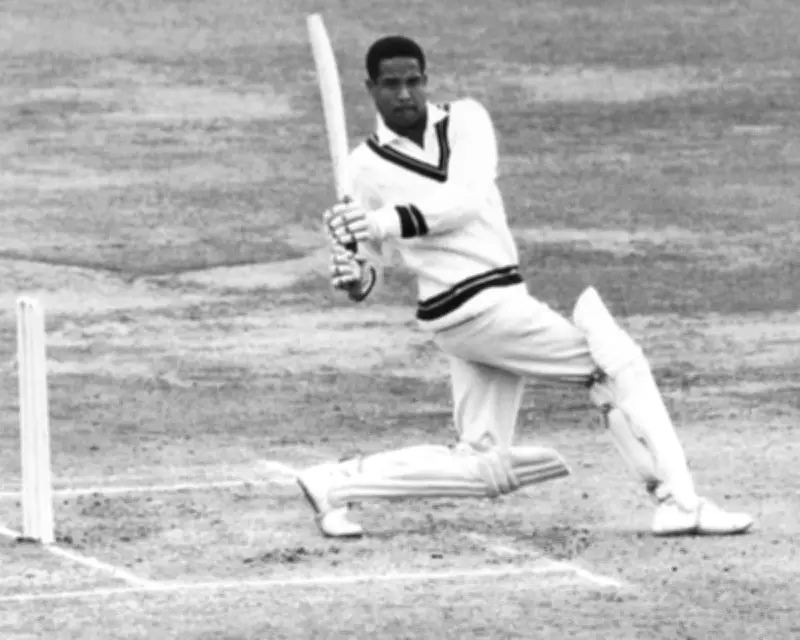
Sir Garfield Sobers, the great West Indies cricketer widely regarded as the finest all-rounder in the sport's history, has died aged 89. His death at his home in Barbados, only 11 days shy of his 90th birthday, was announced by Cricket West Indies on Friday with the simple line: “A great innings has come to an end. In our hearts, now and forever, Sir Garfield Sobers.”
Record-breaking career
Sobers was the first batter to hit six sixes in an over when playing for Nottinghamshire at Glamorgan's St Helen's ground in Swansea in 1968. But it was just one of many feats in an illustrious career featuring 93 Test matches for West Indies – including 39 as captain – from 1954 to 1974.
The late, revered broadcaster and former Australia captain Richie Benaud once described Sobers as “the greatest all-round cricketer the world has seen”. Benaud wrote: “Sobers was a brilliant batsman, splendid fielder, particularly close to the wicket, and a bowler of extraordinary skill, whether bowling with the new ball, providing orthodox left-arm spin or over-the-wrist spin.”
Early life and debut
From a humble background, Sobers first caught the eye playing club cricket, before turning out for the Barbados police aged 15 and making his first-class debut a year later against India at Kensington Oval, Bridgetown. His Test debut for West Indies aged 17 followed in 1954 against Len Hutton's England at Sabina Park in Jamaica.
His maiden Test century against Pakistan at the same ground in 1958 secured his place in history early: an unbeaten 365 that set the record for the highest individual Test score. It stood for 36 years until Brian Lara's 375 against England in Antigua broke it in 1994, with Sobers at the ground to congratulate him.
“I had to be there for Brian,” Sobers told the Guardian in 2002. “There was a lot of pressure on him, people telling him not to break the record, to preserve it for the legend. So I spoke to him in the dressing room during his innings and said: ‘Go out and do it, man.’ Records are there to be broken. I don’t cling to the idea that nobody else can do that.”
Statistical achievements
Overall, the left-handed Sobers scored 8,032 Test runs at an average of 57.78 – the fourth-highest average in history among players with over 5,000 runs – and took 235 wickets at 34.03. In 383 first-class matches, including time with South Australia and Nottinghamshire, he scored more than 28,000 runs and took more than 1,000 wickets.
On his record six sixes in an over for Notts, hit off the bowling of Malcolm Nash, Sobers said: “It was only about the fifth six that I thought: ‘Here’s something that hasn’t been done, why not try it?’ Records have never meant a lot to me. If I have ever broken records, they have come in the stride of my duty to my team.”
Nash, who died in 2019, said: “He hit them all pretty cleanly except one. The second ball was pretty dramatic. It nearly destroyed the [nearby] pub after hitting the guttering. It went like a tracer bullet and was still going up when it hit the building.”
Honours and legacy
Sobers was knighted for his services to cricket by Queen Elizabeth II in 1975, with the investiture taking place at the Garrison Racecourse in Barbados – a mile from his childhood home in the parish of St Michael. One of seven children, Sobers was raised by his mother after his father, a merchant seaman, drowned when his ship was torpedoed by a German U-boat in 1942 during the second world war. Sobers was five at the time.
He was awarded the status of National Hero of Barbados in 1998 and two years later named one of Wisden's five cricketers of the century, second to Sir Don Bradman and sitting ahead of Sir Jack Hobbs, Shane Warne and Viv Richards in the voting. He also sits No 1 among all-rounders in the International Cricket Council's historical rankings.
Kishore Shallow, president of Cricket West Indies, wrote: “In the story of cricket, there are great players. There are champions. Then, there are those rare individuals who redefine the very meaning of greatness. Sir Garfield Sobers was the greatest cricketer the world has ever seen. He emerged from the Caribbean at a time when our region was finding its voice and asserting its place on the world stage. Through his excellence, he gave millions across our islands and in the diaspora, a renewed belief in what was possible. He showed that greatness was not confined by the size of our nations, the geography of our islands or the circumstances of our beginnings. Sir Garfield Sobers became more than a sporting icon. He became a symbol of Caribbean excellence, resilience and possibility. His achievements brought pride to Barbados, inspiration to the West Indies and admiration from every corner of the cricketing world.”
Final years
In his later years Sobers was often seen watching West Indies' matches at Kensington Oval in Bridgetown, sitting on a wicker chair at the top of the Worrell, Weekes and Walcott Stand next to the pavilion that bears his name. He is also immortalised in a statue at the same end of the ground, playing a straight drive with a flourish to denote his swashbuckling approach with the bat.
David Rudder, the legendary calypsonian from Trinidad who wrote the anthem Rally 'Round the West Indies, told the Guardian: “The great man has left the round table with blade, flannels and ball. Perhaps he has seen enough of a difference in these young men who now hold the flame. So on this fine day, with collar up, arrogant stride, the man we call THE GOAT, has joined the ancestors. Farewell.”