
Premier League Grappling Crisis Intensifies as Referees Battle Penalty Area Chaos
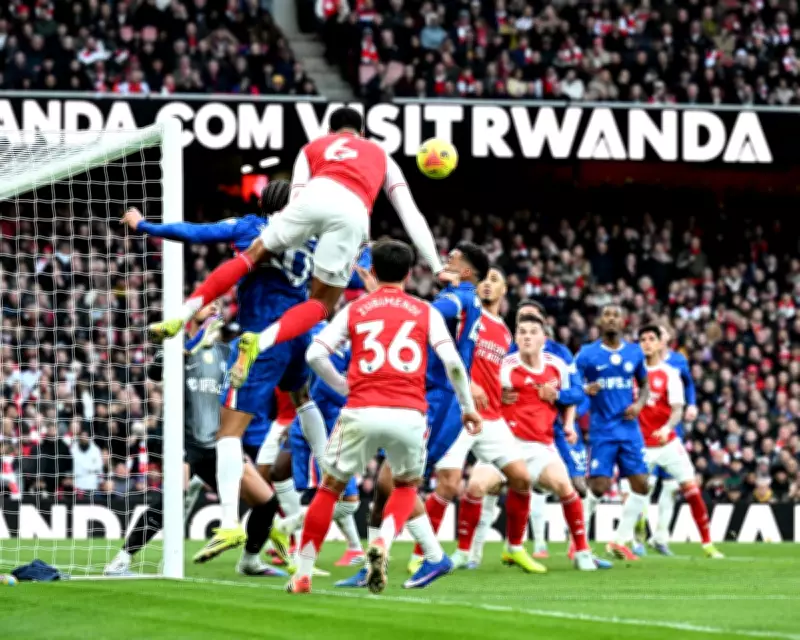
The recent Arsenal victory over Chelsea served as another stark illustration of how grappling in the penalty area has escalated dramatically throughout this Premier League season. What was once occasional holding has transformed into systematic, organized chaos during set pieces, creating unprecedented challenges for match officials.
The Arsenal-Chelsea Example: A Case Study in Penalty Area Anarchy
During one particularly chaotic corner in Sunday's match, viewers witnessed multiple simultaneous offenses: Declan Rice holding Jorrel Hato, David Raya being restrained, Gabriel Magalhães having his shirt pulled, and Viktor Gyökeres tugging at Enzo Fernández. This single moment encapsulated the epidemic of holding that has spread across Premier League stadiums in recent weeks.
"The players have a real responsibility with this because a lot of histrionics go with it," noted former Premier League referee Chris Foy. "Players are going to ground easily, obscured by a crowd of people in the penalty area, and offences can be extremely difficult to detect."
Refereeing Philosophy: Material Impact and Mutual Holding
Premier League officials are instructed to look for what they term "material impact" - clear instances where a player prevents an opponent from playing the ball through non-footballing actions. This includes basketball-style shepherding with outstretched arms or persistent shirt-pulling that restricts movement.
"Attackers can sometimes be as culpable as defenders because they want to make space and create space for themselves," Foy explained. "There are also situations where there is pushing and pulling, but at a level where it's not an offence. Sometimes they are both having a little push and a pull; they call it mutual holding and the best outcome there, in my opinion, is to allow play to continue."
Recent Controversial Decisions: From North London to Turf Moor
The past two game weeks have provided textbook examples of the difficult judgments referees must make. In the north London derby, Tottenham had a goal disallowed when Randal Kolo Muani pushed Gabriel with two outstretched hands in the defender's lower back. Referee Peter Bankes immediately called the foul and stood firmly by his decision.
Contrast this with Fulham's opening goal against Tottenham, where complaints emerged about Raúl Jiménez putting hands on Radu Dragusin. "It is a similar complaint but a different incident because there was only slight contact," Foy clarified. "The preference all season has been not to penalise minimal contact."
The Burnley-Brentford match produced perhaps the most dramatic controversy, with Ashley Barnes's stoppage-time equalizer being disallowed after a lengthy VAR review revealed handball. "The first couple of angles I saw were inconclusive, but then an angle showed Barnes had handled and it was a handball offence, 100%," Foy stated. The decision took approximately four and a half minutes, partly due to additional review of a technical area melee.
VAR Success Story: Manchester United vs Crystal Palace
At Old Trafford, officials demonstrated how the system should work when functioning optimally. When Crystal Palace's Maxence Lacroix pulled Matheus Cunha from outside to inside the penalty area, referee Chris Kavanagh consulted with his assistant before awarding a penalty.
VAR Tony Harrington then correctly intervened for denial of an obvious goalscoring opportunity. "Cunha is in possession, inside the penalty area, there are no covering defenders and his direction of travel is taking him towards goal," Foy analyzed. "So the foul by Lacroix becomes a sending off. I was really pleased that Harrington flagged this."
The Bigger Picture: A League-Wide Problem Requiring Solutions
What began as a proactive approach to penalty area holding at season's start has evolved into a full-blown crisis. Clubs are now deliberately loading the penalty area at every set piece, creating environments where multiple offenses occur simultaneously. This tactical shift has forced referees to make split-second judgments about which infractions constitute "material impact" worthy of intervention.
The fundamental question remains whether current laws adequately address this new reality. As Foy noted regarding the Barnes handball decision: "A wider question may be about whether the law is in the right place." With grappling incidents increasing weekly, Premier League officials face mounting pressure to maintain consistency while adapting to evolving tactical approaches that test the boundaries of football's laws.