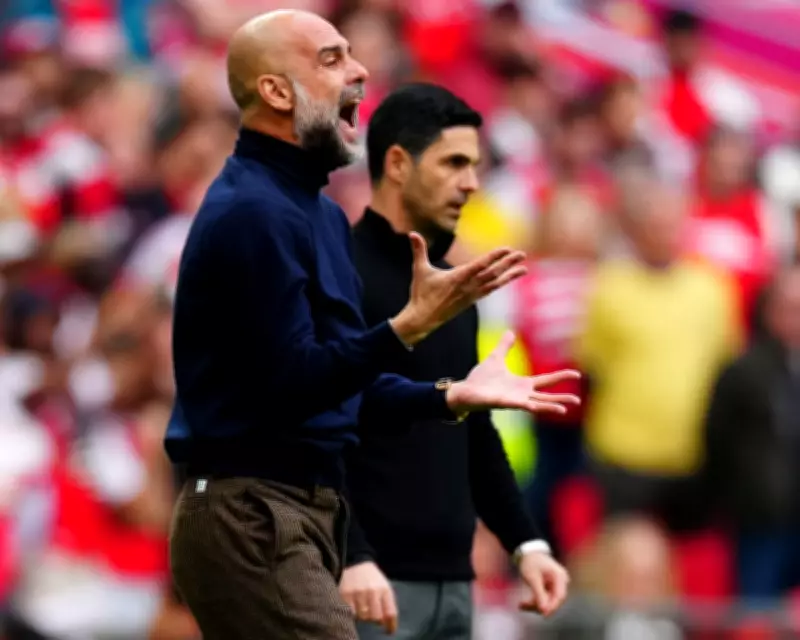
Guardiola's Fearless Philosophy Versus Arteta's Nervous Arsenal
Pep Guardiola has consistently demonstrated a preference for being the hunter rather than the hunted in Premier League title races, while Mikel Arteta has witnessed his Arsenal side increasingly paralyzed by pressure and anxiety. This fundamental difference in managerial mindset has become particularly evident as Manchester City chase down Arsenal in the current championship battle.
The Anfield Lesson: Playing With "Big Balls"
Oleksandr Zinchenko's revealing account from his autobiography Believe illustrates Guardiola's distinctive approach. Before Manchester City's crucial 2021 match at Anfield against Liverpool, Guardiola delivered an unconventional instruction to his players: "Guys, let's start from the goal-kick, I want you to make at least three or four touches on the ball." He continued with his now-famous declaration: "Most of the teams come to Anfield and shit themselves. They want to play one touch, two touch. 'Oh, don't give me the ball! Oh you take it!' But you have to play with big balls at Anfield! Big balls! 'Give me the ball!' Demand it!"
This mentality, forged through Guardiola's education in Johan Cruyff's expansive Barcelona tradition, emphasizes creativity, risk-taking, and maintaining possession under pressure. Zinchenko, who has played under both managers, formed the opinion that his City coach was "crazy but right" - a perspective increasingly validated as City appear relaxed and fluid while Arsenal struggle with what psychologists term "outcome pressure."
Statistical Evidence of Diverging Approaches
The contrasting philosophies manifest in tangible performance metrics. Since the turn of the year, Arsenal players have committed 15 errors leading to shots in just 13 league games - nearly double the 8 errors in their previous 19 matches. Meanwhile, Manchester City enter their crucial showdown with Arsenal boasting an unbeaten streak of 14 home league games, scoring at least twice in 12 of those matches.
Perhaps most telling is the "goals from open play" statistic from February: Manchester City ranked first with 83% of their goals coming from open play, while Arsenal languished at 16th with just 58%. This disparity highlights Arteta's increasing reliance on set pieces and functional attacking patterns rather than the free-flowing, creative football both managers learned in Barcelona's youth academy.
The Psychology of Pressure and Risk Aversion
Martin Fairn of Gazing, the company that helped transform the All Blacks' mindset to win the 2011 Rugby World Cup, describes Arsenal's current predicament as classic "outcome pressure." He explains: "Once you start obsessing about the outcome, as Arsenal appear to be, decision making goes awry. Outcome pressure limits our ability to think clearly. Either you over-engage - 'we have to fight to win, to save our lives' - which can flip over into frantic stupidity, or there's passivity, where you just freeze and people disappear."
This psychological phenomenon aligns with Danny Kahneman and Amos Tversky's Nobel prize-winning Prospect Theory, which demonstrates that humans exhibit loss aversion when in favorable positions. Teams in pursuit, like Manchester City, maintain clear targets and greater openness to risk-taking, while leaders like Arsenal become dominated by what they might lose.
Cherki's Creative Freedom Versus Arsenal's Functional Approach
Nothing better illustrates the contrasting mentalities than Rayan Cherki's joyful ball juggling during the Carabao Cup final and Ben White's frustrated reaction, dumping the City player to the ground. Guardiola's willingness to accommodate Cherki's creative idiosyncrasies - including admonishments for rabona crosses and showboating - stands in stark contrast to Arsenal's more rigid, functional forward line.
Guardiola himself compared Cherki to another unconventional player he successfully integrated: Sergio Agüero. "Sergio was not the incredible high-press player but he tried his best and all I ask is that," Guardiola explained. "Do your best and you can do it, because he has another quality. Every player has his own ability." This flexible, player-centric approach has been crucial to City's late-season surge.
Shared Roots, Divergent Paths
The irony of this managerial contrast lies in the shared history between Guardiola and Arteta. Both were products of Barcelona's youth academy, forged in Cruyff's philosophy of risk-taking, possession-dominant football. They later worked together at Manchester City, where Arteta served as Guardiola's assistant. Their connection dates back to 1999, when a 17-year-old Arteta replaced a 28-year-old Guardiola in a preseason friendly, prompting Guardiola to remark: "With Xavi, Iniesta and Arteta, everything suggests Barça won't have problems in this position for the next 20 years."
Yet successive title challenges against Guardiola's dominant City appear to have pushed Arteta toward a more cautious, reductive style - precisely the approach that now threatens to undermine Arsenal's championship aspirations. As the title race reaches its climax, Guardiola's embrace of Cruyffian principles contrasts sharply with Arteta's deviation from their shared philosophical roots, creating one of the most compelling managerial narratives in recent Premier League history.