
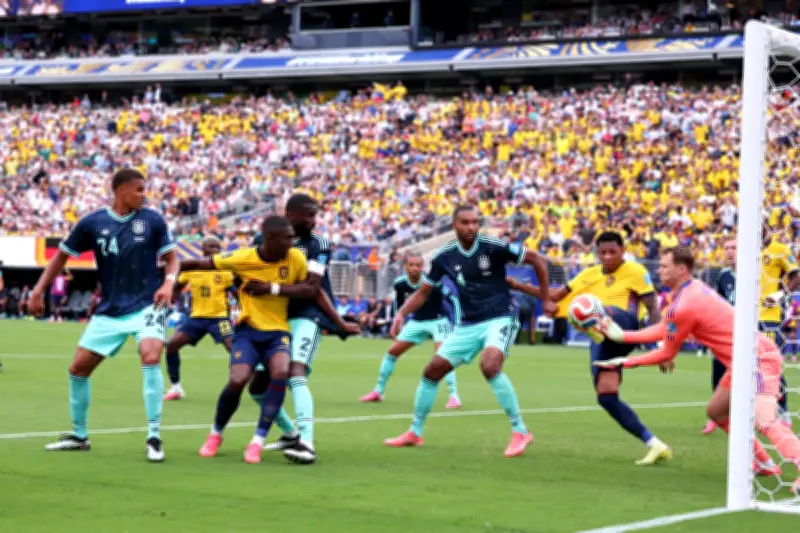
Germany's national football team is caught in a tug-of-war between its glorious past and an uncertain future, leaving coach Julian Nagelsmann to navigate a squad plagued by identity issues and external noise from former legends. After a 2-1 loss to Ecuador in their final World Cup group game—a match that saw Germany already qualified—Nagelsmann clashed with a TV interviewer who suggested Ecuador simply wanted the win more. "They didn't want it more," Nagelsmann snapped. "I cannot tell any of my players that they didn't give it their all. That's far too simplistic."
Yet his players contradicted him publicly. Joshua Kimmich admitted, "The difference today was that the opponent wanted to win more than us," while substitute Deniz Undav echoed, "I had the feeling they wanted it more than us." This minor disagreement encapsulates a team operating on multiple planes, lacking message discipline and harmony.
Germany's World Cup Progress Amid Unrest
Germany emerged from the group stage for the first time since 2014, when they won the trophy, thanks to two wins including a 7-1 thrashing of Curaçao—the tournament's biggest victory. Despite this, the team feels unsettled and unsatisfactory. The malaise is linked to two figures: one inside the camp (Manuel Neuer) and one very much outside (Jürgen Klopp).
Klopp has been highly visible as a pundit on German television, in the stands, and as a brand ambassador. He had to apologize to Nagelsmann for a slip claiming the coach was in charge "for now." It is an open secret that Nagelsmann's job is one of the few that could lure the 59-year-old Klopp back into coaching. Meanwhile, half the 2014 World Cup-winning side—including Thomas Müller, Mats Hummels, Per Mertesacker, Bastian Schweinsteiger, Toni Kroos, and Philipp Lahm—are now media pundits or commentators, critically analyzing the current setup and creating a constant backdrop of noise and nostalgia.
The Ghosts of 2014 Haunt the Present
This nostalgia mirrors the way Manchester United's 'Class of 92' dominated media after retirement, serving as a reminder of past glory. German football has struggled to move on from its imperial era, marked by Bayern Munich and Borussia Dortmund's dominance, Klopp's gegenpressing, and global Bundesliga fan culture. Joachim Löw retained players like Müller and Hummels too long, recalling them after poor results, and survived a humiliating 2018 World Cup exit before leading an uninspiring Euro 2021 campaign. Toni Kroos was persuaded out of retirement for Euro 2024, highlighting the reliance on the 2014 generation as a break-glass option.
Manuel Neuer, the last survivor of that 2014 team at age 40, is no longer best in class. While capable of transcendent moments, he appears more fallible and injury-prone. His error against Real Madrid in the Champions League quarter-final was in character, but his inertia for Ecuador's winning goal revealed a goalkeeper no longer able to control his own six-yard box. Nagelsmann and Neuer gambled by ending two years of international retirement, displacing steady 36-year-old Oliver Baumann, who may never play at a World Cup. So far, that gamble has not paid off.
Nagelsmann's Tough Decisions Ahead
Nagelsmann downplayed dropping Neuer after the Ecuador game and has resisted shifting Kimmich from right-back to central midfield, replacing the declining Leroy Sané, or breaking up the Musiala-Wirtz partnership that excelled at Euro 2024 but has faltered in Germany's last two matches. The team faces an existential angst about its identity, lacking a coherent vision despite talent and wins. The ghosts of 2014 continue to shape the debate, while Klopp reminds everyone of past fun. Among a divided public, there is a sense of loss and decline, a confusion over reasonable expectations.
In the short term, Germany faces Paraguay in Boston on Monday, with France, the Netherlands, and Spain looming. Nagelsmann must shout down the noise and make big calls. Will this team finally lay its baggage to rest, or be remembered as one trapped between past and future—a museum to itself?