
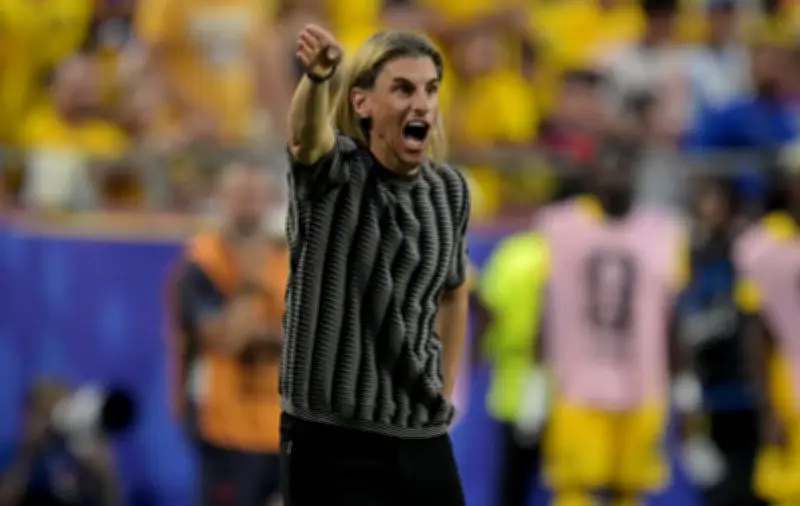
Sebastián Beccacece has guided Ecuador to the knockout stages of the 2026 World Cup, emerging as a cult hero for his manicured energy and Bolivarian liberation rhetoric. The 45-year-old Argentine manager, known for his dirty blond hair, chinstrap stubble, and animated touchline presence, has captivated fans despite his team's modest attacking output.
Ecuador's Journey to the Knockouts
Ecuador entered the tournament as a dark horse with a strong defensive and midfield spine but lacked punch up front. After a last-minute defeat to Côte d'Ivoire and a scoreless draw against Curaçao, Beccacece faced criticism over tactics, selections, and his choice of a knitted gray-and-black top. Facing elimination against Germany, Ecuador fell behind to a controversial Leroy Sané goal. Beccacece's animated protest—pointing at his watch, confronting the third official, and making a telephone gesture—sparked a turnaround. An equalizer followed, and in the 77th minute, Gonzalo Plata scored the winner, sending Ecuador into the round of 32 for only the second time in their history.
Touchline Theatrics and Cultural Impact
Beccacece's celebrations after the victory were heavy metal: he launched himself into the stands to embrace his family and climbed atop staff members to whip the crowd into frenzy. Pogoing on shoulders in his cream knitted top, he resembled a career menswear model. According to reports, the victory over Germany has been hailed as the finest achievement in Ecuadorian football history. Beccacece's style contrasts with the guarded technocratic managers in club football, offering a reminder of the need for big personalities in international management.
Press Conference Poetry and Bolivarian Unity
In his post-match press conference, Beccacece invoked Argentinian rock music, educational road trips across the Andean highlands, and the spirit of Simón Bolívar. He called for Ecuadorian unity, referencing the 1822 Guayaquil Conference between Bolívar and José de San Martín: "I call on all of Ecuador to unite—just as Bolívar dreamed, that unity seen when he met with San Martín. Unity is key." He reflected, "We came to life to feel. Sometimes we feel the pain of defeat but sometimes also the satisfaction of a victory. What is important is to strike a balance. This will not change my life. It will not. But we must indulge ourselves in this joy."
Legacy Beyond Results
Ecuador face Mexico at the Azteca on Tuesday night, a daunting assignment where failure brings no shame. Regardless of the outcome, Beccacece's legend is already written. The tournament has seen managers like Didier Deschamps, Luis de la Fuente, and Carlo Ancelotti, but Beccacece stands out as a dreamer and madman. As one observer noted, "What is the point of managing at sport's greatest show if not to spout beautiful nonsense like this?" Beccacece's journey—from assistant under Jorge Sampaoli with Chile to an unsuccessful stint at Elche—has culminated in this moment. He has channeled the anxiety, fury, and elation of Ecuador's supporters, ensuring his place in World Cup lore.