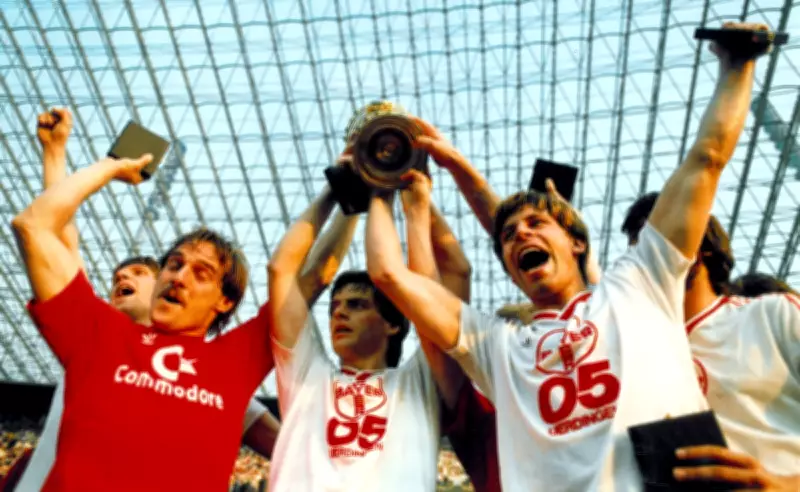
Forty years ago, on a sun-dappled evening at Berlin's Olympic Stadium, Bayer Uerdingen pulled off one of the greatest upsets in German football history. Matthias Herget, flanked by Horst Feilzer and Norbert Brinkmann, lifted the DFB-Pokal trophy after a stunning 2-1 victory over Bayern Munich, the holders. This moment, known as the 'Miracle of Berlin,' remains a seismic inversion of the natural order in a nation accustomed to a handful of major clubs dominating the honour roll.
The Context of the Upset
By 1985, Bayern Munich had won the German Cup seven times since 1953 and secured three consecutive European Cups from 1974 to 1976, placing them among Europe's elite. In contrast, Uerdingen was a modest club from Krefeld, a city of about 300,000 on the north Rhine, often overshadowed by its neighbour Düsseldorf. Backed by the chemicals giant Bayer AG, Uerdingen had only recently been promoted to the Bundesliga and were unheralded underdogs.
The final was the first DFB-Pokal match staged in West Berlin's Olympiastadion since its renovation, drawing 72,000 spectators. Under coach Kalli Feldkamp and chairman Arno Eschler, Uerdingen had already pushed Bayern to a replay in the 1984 cup, but few expected them to win.
The Match
Bayern took an early lead in the eighth minute through Dieter Hoeness. But Uerdingen equalised a minute later via Horst Feilzer. The winner came in the 66th minute when Wolfgang Schäfer scored, and Uerdingen held on for a historic victory. The team lacked household names, featuring the Funkel brothers in midfield, while Bayern boasted Lothar Matthäus and Klaus Augenthaler.
Aftermath and Decline
The victory sparked delirium among fans, with celebrations along the Ku'damm and at the Hotel Intercontinental. Eschler hoped it was not a one-off, and Uerdingen reached the European Cup Winners' Cup semi-finals in 1986, highlighted by the 'Miracle of the Grotenburg'—a dramatic comeback against Dynamo Dresden. They also finished third in the Bundesliga the following season.
However, the club's fortunes faded when Bayer AG withdrew financial support in 1995, focusing on Bayer Leverkusen. Renamed KFC Uerdingen, the club tumbled down the leagues, endured insolvencies, and now plays in the fifth-tier Oberliga. Despite this, the club remains proud and well-supported, celebrating its 120th anniversary in 2024. The Grotenburg Stadium, adjacent to Krefeld's zoo, sees fans enjoy alt beer and currywurst on matchdays.
Under coach Julian Stöhr, Krefeld has shown promise, pressing for promotion until a heavy defeat dented their prospects. Insolvency proceedings were lifted in April 2025, a crucial milestone. Chairman Norbert Philipp remains optimistic, noting the club's ability to attract over 60 sponsors despite past difficulties.
The story of Bayer Uerdingen echoes that of Leicester City, who won the Premier League in 2016 but later fell to League One. Coincidentally, Leicester has been twinned with Krefeld since 1969, linking two cities that experienced fleeting football glory.