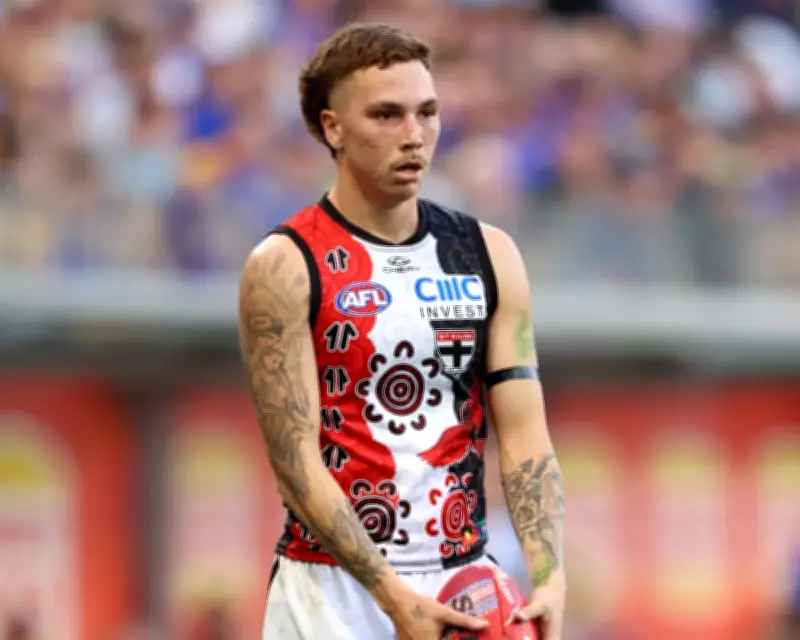
The decision to reduce Lance Collard’s AFL ban is not only disappointing but dangerous, writes Mitch Brown. I can accept the decision and authority of the appeal board, but I cannot accept that racist, sexist and homophobic language is excused as ‘commonplace’ in a ‘highly competitive’ game.
The AFL appeal board’s decision to reduce the penalty handed to Lance Collard for allegedly using a homophobic slur, from nine games to four, is truly bewildering. If there is any positive to take from it, it is that I have never seen an AFL disciplinary hearing’s outcome so universally derided as this one, from all sides of politics and the sport.
Many individuals with a keen interest in the game have already shared their perspectives – including former AFLW player Kate McCarthy and reporter Marnie Vinall – and I echo their sentiments here. The appeal board’s decision leaves so much to be desired, and how Collard could receive a smaller penalty for his second offence than his first is truly bizarre. It is only natural to be disappointed.
I can accept the decision and authority of the AFL appeal board as an independent body, and recognise the need for a fair and impartial judicial process. What I cannot accept however, are the reasons and commentary supplied by the appeal board, and their implications for the AFL and the broader society the sport reflects.
“We observe that football is a hard game. It is highly competitive, particularly at its higher levels. It is commonplace that players can employ language from time to time which is racist, sexist or homophobic whilst on the field,” wrote the appeal board.
There is so much wrong with this statement. It is not only disappointing, but dangerous. Excusing not only homophobic, but racist and sexist comments as an unfortunate but inevitable element of the game, or the result of the stress that players are under, emboldens racist, sexist and homophobic players and fans everywhere. It goes against every piece of work the AFL has undergone in its attempts to eliminate these harmful behaviours from the game, and every statement made that the league has a zero-tolerance policy.
The reasoning is insulting to every worker who faces extreme stress in their job – including nurses, healthcare workers, teachers, emergency services professionals – and yet would never consider uttering a slur as a result of that pressure they are under. Not only would they not consider it, they would be subjected to serious legal repercussions if they went down that path – as those behaviours are outlawed in any other workplace, other than the AFL it seems.
There is something sickly satisfying about this as someone who has been told repeatedly over the years – and especially in the six months since I chose to come out last year – that there is no homophobia problem within the AFL. It’s almost refreshing to have the appeal board say it so plainly – homophobia (and sexism and racism) – are inherent and acceptable parts of our game ‘from time to time’.
While appointed by the AFL, the appeal board sits independently from the executive. There are individuals working within the AFL, many of whom I’ve got to know personally over the last six months, who care deeply and passionately about eradicating these behaviours from the sport and making it safe and inclusive for all. I can’t imagine their despair today, as it feels like years and years of tireless advocacy has been reversed overnight.
In noting their reasons for the decision, the appeal board also included “the fact that the recipient of the remark, [Frankston player Darby] Hipwell, was not offended by the comment”, as a factor in their decision to reduce Collard’s penalty to a four-match ban, with two games suspended.
Again, this comment is ludicrous. It implies that we can use homophobic slurs whenever we like, as long as it’s not directed at a queer person. To even ask Hipwell whether he was “personally offended” by a comment like this, is not too far a leap from asking him to out himself publicly as a member of the LGBTQIA+ community. This is deeply dangerous and problematic. Slurs and hate speech are harmful to anyone who hears them, whether they were the intended recipient or not.
The queer community suffers every time these incidents happen. In particular, the increase in homophobia both online and at games after these incidents and their surrounding media attention is deeply unsettling and traumatising for many of us within the community. This is why the AFL has been right in taking such a strong stance to eradicate homophobia, sexism and racism from the game – until now.
One thing I can’t stop thinking about in the wake of the appeal board’s statement is how perfectly this incident encapsulates how one decision can undo the tireless and gruelling advocacy of hundreds of people, over many years, to make the sport a safer and more inclusive place. Today, my heart is with my fellow members of the queer community, women, people of colour and people from culturally and linguistically diverse backgrounds, anyone within and around the AFL who will undoubtedly be devastated by this result, and every person who has ever been made to feel like they don’t belong in the sport they love.
Mitch Brown is a Melbourne-based writer and former West Coast AFL footballer.