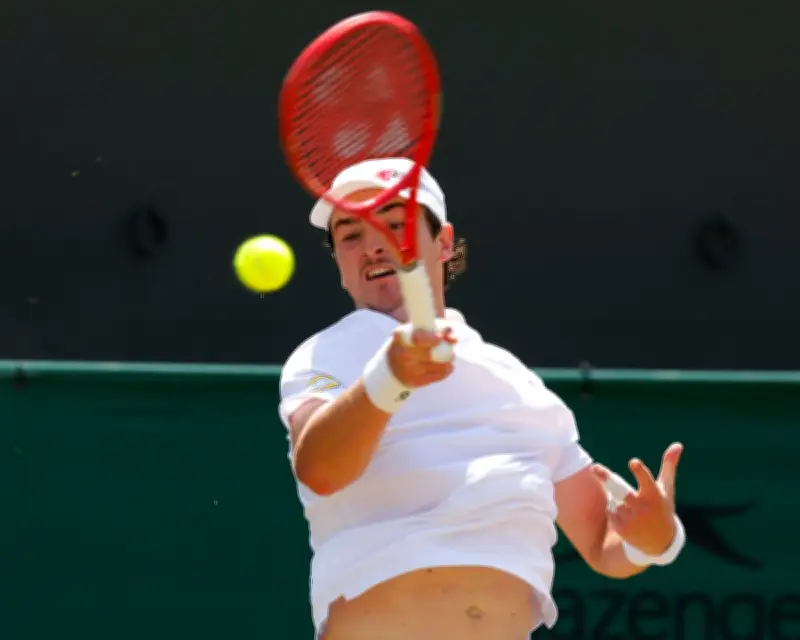
João Fonseca departed Wimbledon with a whimper on Thursday, losing 6-3, 6-3, 6-3 to Roman Safiullin on No 2 Court. But the 19-year-old Brazilian No 24 seed was far from alone: his deafening hype army, known as fonsequismo, roared on, filling the stands with yellow shirts and chants of “FON! SE! CA!” from early morning.
Fonsequismo: A traveling carnival of Brazilian fervor
The first chants started shortly before noon, as Fonseca struggled to find his rhythm against Safiullin, the world No 132 and a Wimbledon quarter-finalist in 2023. Safiullin stood daringly close to the baseline, taking the ball early and teasing with immaculate drop shots. He led 5-3 and served for the first set, but three set points came and went. Right on cue, the aural cavalry made its move.
Ever since early 2024, when Fonseca reached the quarter-finals of his home tournament in Rio de Janeiro at age 17, a kind of madness has built around him. A traveling army of Brazilians and Brazilian expats fills tennis arenas worldwide with the fervour of football terraces. They call it fonsequismo, and from Melbourne to Miami, no court is immune.

“Brazilians are fun-loving people. We like to make people smile,” said Rogerio, a fan in a yellow shirt who traveled from Fortaleza in northeastern Brazil with his family. They couldn't get court tickets, so they stood outside and listened.
Potential and pressure: Fonseca's rise amid expectations
The first real sign that fonsequismo had grown beyond ordinary fandom came last year in Miami, a city of 400,000 expat Brazilians. Thousands packed the stands, chanting during points and barracking opponents, ignoring chair umpires. When Alex de Minaur knocked Fonseca out in the third round, de Minaur found his social media spammed with threats and abuse.
Fonseca is lavishly talented, and his following has risen as Brazil finds itself starved of sporting heroes. The men's football team hasn't won the World Cup since 2002. No Brazilian has won a Formula One race since 2009. No Brazilian has seriously threatened the upper echelons of men's tennis since Gustavo Kuerten was world No 1 a generation ago.
Fonseca has the potential to get there, as he showed when coming back from two sets down to defeat Novak Djokovic in a Roland Garros epic in May. But he is still 19, still learning and honing his craft, particularly on the unfamiliar grass surface.
Help or hindrance? The double-edged sword of fan devotion
On No 2 Court, Safiullin played one of the best matches of his life, forcing Fonseca into rushed strokes and interrupting the big booming backswing from which he generates most of his power. The crowd overwhelmingly willed him on, but the question arises: is the hype army helping or hindering?
After a tempestuous defeat at the Rome Masters in May, Fonseca urged his disciples to wind it in. “Too many interruptions. I love the crowd, but there has to be a small limit,” he complained. Tennis fandom has always had a weirdly devotional quality, and for players carrying the hopes of a whole nation, the pressure can be extreme. Alex Eala of the Philippines is one of the most popular players despite never having been past the second round of a major. Andy Roddick calls them “silos of borderline obsession.”
Safiullin's emotional victory and Fonseca's exit
Safiullin won in straight sets and gave a tearful address, speaking tenderly about the multiple injury crises that almost forced him to quit the sport. Outside, the real action began. A tissue-thin veil of security detail shielded Fonseca as he made his way back to the locker rooms, pursued by a throng of fans and autograph seekers. One family broke the cordon; children approached Fonseca, who signed a flag. The family whooped in delight and marched out. The time was a little after half past one.