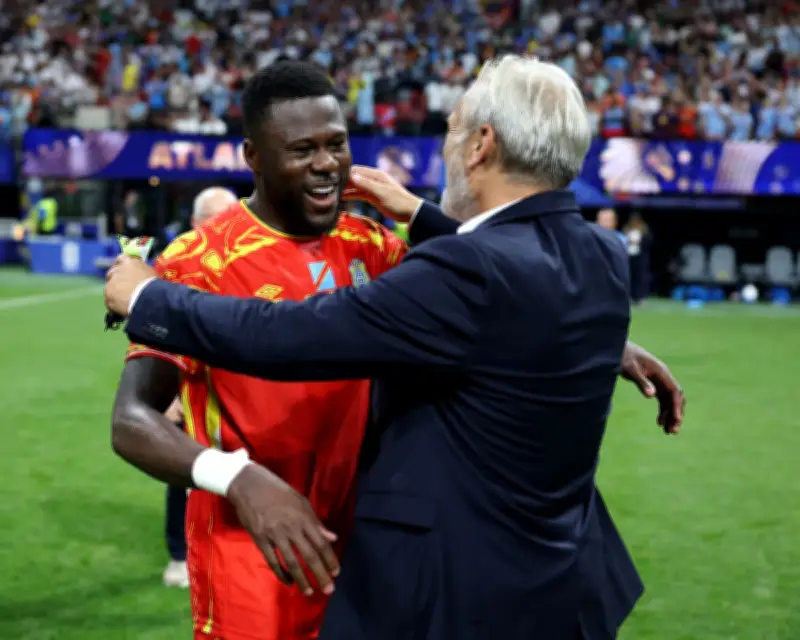
England head into their match against the Democratic Republic of the Congo expecting to win. Opta rates their chances of victory in normal time at 73.9%. Yet the tactics deployed by the DRC manager, Sébastien Desabre, will make it harder than this probability suggests.
Desabre's tactical shift for stronger opponents
Desabre has a clear strategy for facing the stronger teams in this tournament that differs from how he approached qualifying matches. The DRC used a four-man defence in 12 of their 13 games in qualification, retaining a back four in their pre-tournament friendly against Chile. They switched to a back five for a warm-up match with Denmark, using the same 5-3-2 formation for their group-stage games with Portugal and Colombia. A DRC team ranked 65th in the world held sides rated 19th, sixth and 17th respectively to just two goals across these three games.
They did not rely on fortune, either. Denmark generated shots collectively worth 0.74 expected goals according to Opta, with Portugal (0.65 xG) and Colombia (0.98 xG) also struggling to create high-value opportunities. Desabre's side are adept at frustrating opponents, causing them to take low-probability shots from long-range when their attacking moves threaten to break down.

Defensive discipline and low xG conceded
By keeping opposing teams a long way from their goal, the DRC are able to keep the quality of the chance they face low. Where the average non-penalty shot in the group stage was worth 0.10 expected goals, teams facing the DRC averaged just 0.06. Only Spain's defence was better by this measure and they dominated possession to a far greater extent.
The DRC also allowed only four more shots than England in their respective penalty areas during the group stage, an impressive performance given they faced far stronger teams.
Chancel Mbemba, the captain, marshals a well-drilled backline that is not susceptible to making mistakes. He and his colleagues caught 11 opponents offside in the group stage, the joint-third most of any team. They also committed only one error leading directly to an opposition shot in the opinion of Opta, two fewer than England.
Set-piece threat and potential solutions
These teams have never met, though Thomas Tuchel had a taste of how the game may play out in the goalless draw with Ghana. It was the one group-stage match in which England did not score from a set piece, so the manager may view a dead-ball situation as a way to break through against another team utilising a low block. But Tuchel may need a rethink. The DRC allowed the ninth-lowest expected goal total from set plays among the 48 countries in the group stage, and the sixth-lowest from all non-penalty shots.
England will need to unsettle the DRC's largely impenetrable back five. One positive is that their dribbling in advanced areas is improving throughout the tournament; they completed four opposition-half take-ons in the Croatia match, six v Ghana and seven last time out. One from Jude Bellingham helped to win the corner from which he scored the opening goal against Panama.
The task may be as simple as England needing to be more clinical. No team missed more Opta-defined big chances in the group stage (nine), though only Norway (14) had more than England (13) in total. As the DRC have allowed their opponents only two so far, creating them will be the bigger issue.