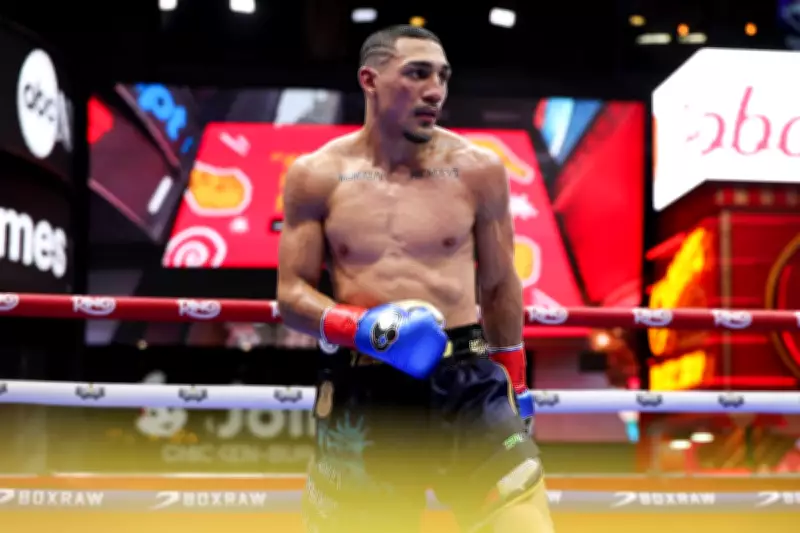
Teófimo López: Embracing Clarity Ahead of Stevenson Showdown
Teófimo López's boxing journey has been a rollercoaster of dramatic highs and unexpected lows, with Madison Square Garden serving as the ultimate stage for his contradictions. This iconic venue witnessed his explosive two-round victory over Richard Commey to claim his first world title at just 22, then saw his momentum stall as a heavy favourite, only to host his triumphant return as an underdog against Josh Taylor, securing his status as a two-division champion. Now, as he prepares to defend his junior welterweight title against Shakur Stevenson this Saturday night, the Garden promises to reveal which version of López will define his legacy.
The Magnitude of the Moment
"It's the magnitude of it all," declares López, one of boxing's most charismatic and unpredictable figures, exuding warmth and trademark third-person bravado during the final days of his training camp in Hollywood, Florida. "Who's going to really set the tone for the sport? You've got Shakur Stevenson, who wants that baton, and you've got Teófimo López who believes he's the better representation for boxing."
He elaborates: "My goal is to make boxing great again and you can only do that by giving the fans what they want. This is the biggest fight you can make today and we both deserve credit for making it happen." While this statement carries a hint of hyperbole, it might well be accurate. Stevenson, a three-weight champion from Newark, New Jersey, is widely regarded as the finest defensive technician of his generation, with an impeccable command of distance and tempo that has left elite opponents looking hesitant rather than hopeful. In contrast, López, the former unified lightweight champion and lineal title-holder at 140 pounds, has built his reputation on thriving in chaotic moments where instinct overrides structure.
A Career of Extremes
This stylistic contrast explains both López's widespread appeal and his inherent unpredictability. Born in Brooklyn to Honduran parents and raised in Florida, he turned professional as a teenager after narrowly missing Olympic qualification for the United States, instead representing Honduras in 2016. His rapid ascent through the lightweight ranks was fueled by concussive power, flamboyant showmanship, and unshakeable self-belief, culminating in a one-punch destruction of Mason Menard at Madison Square Garden in his 11th professional fight.
At 28, López has already experienced multiple career phases within one. His stunning victory over Vasiliy Lomachenko in 2020, then boxing's pound-for-pound king, should have cemented his superstardom. Instead, it ushered in a turbulent period marked by a shocking split-decision loss to George Kambosos Jr after a 407-day layoff, followed by two underwhelming performances at 140 pounds before his dominant return against Taylor. This pattern of oscillating between brilliance and vulnerability has become a defining narrative, though López challenges this perception.
"Of course there are going to be moments where you do look vulnerable," he acknowledges. "That could possibly be from just the mentality point of myself. But my résumé speaks volumes in the sense that I always aim for the tougher opposition." Indeed, when facing elite competition with unmistakable stakes, López's focus typically sharpens rather than frays—a tendency that could prove crucial against Stevenson, where he enters as a significant underdog.
Roots of Volatility and Personal Growth
Much of López's career volatility stems from factors beyond the ring. Raised under the guidance of his father, who serves as both trainer and vocal advocate, López found stability in boxing from an early age, enduring his first gym injury at six years old. He insists that the erratic performances that have characterized his career are now behind him. "I just want to show the consistency that is coming out of Teófimo moving forward," he asserts. "You're not going to see any of these hiccups any more. Anything that has haunted me from the past, I've let all those things go."
This turbulence has frequently spilled outside the ropes, manifesting in controversies ranging from promotional disputes and social media feuds to inflammatory remarks about opponents. Personal challenges, including a protracted divorce and reported management splits, have compounded this instability. Yet López addresses these issues head-on, particularly regarding accusations of racism. "I'm not a racist, all right!" he exclaims with a smile. "I'm not a fucking racist!"
The Stevenson Challenge: Discipline vs Disruption
Stevenson presents a unique test. A 2016 Olympic silver medalist, the 28-year-old southpaw is considered boxing's purest technician today, drawing cautious comparisons to legends like Floyd Mayweather and Terence Crawford. López respects this technical foundation but questions its flexibility. "It's like with construction workers: some things ain't always going to go as the blueprint," he observes. "You've got to be creative in there. You can't just throw the same things over and over. And I don't see that creativity in Shakur, at least not yet."
This belief—that rigid discipline can create its own constraints—lies at the heart of Saturday's encounter. Stevenson's advantage stems from anticipation and control, keeping opponents reactive rather than proactive. López identifies potential vulnerability everywhere in Stevenson's game, attributing their differing approaches to their developmental paths. "I was with Top Rank. We were stablemates. They cherry-picked every opposition for Shakur. Teófimo didn't get that treatment. I had to learn on the job." Rather than resenting this disparity, López frames it as formative, believing his exposure to difficult situations early on will prove decisive.
Fatherhood and Purpose
The past few years have compelled López to confront himself as much as any opponent. He has spoken openly about battles with depression and self-doubt, particularly following his win over Lomachenko amid promotional turmoil and extended inactivity. Becoming a father in 2021 marked a pivotal turning point, providing perspective that now complements his ambition. "Being a father, you already won," he reflects. "Everything else is just adding more water to my cup."
His son, Teófimo López V, now four, has reshaped how he views his public image. "I can't be out here looking like a bad representation," he says. "Not just for him, but for all the other young kids that are looking up to me." This sense of responsibility extends to his broader role in boxing. "I'm really good for the sport," he contends. "I'm good for the next generation that's to come. I don't want this for me. I want this for the ones coming after me."
The Fight's Fundamental Stakes
If López is to defy the odds and retain his title, it will likely stem from his ability to impose his will and disrupt Stevenson's rhythm. Saturday's intrigue lies less in technical superiority than in whether discipline or disruption prevails first. This matchup offers a rare elite-level clash where both fighters can genuinely reveal something fundamental about each other.
When asked what he hopes his son will one day understand about him as a boxer, López's response carries profound gravity, reflecting the philosophy that has shaped his journey and this impending battle. "You've got to fight for what is right," he says. "If you ever get a route to choose easy, choose hard. You get the better experience from choosing hard rather than easy." As he steps into Madison Square Garden this weekend, López carries this ethos with him, ready to determine which version of his career will endure.