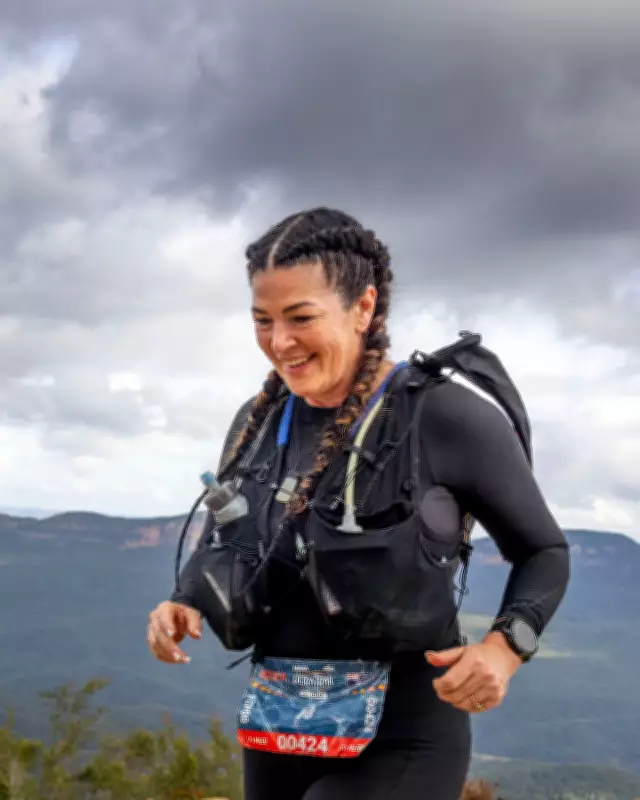
Somewhere before the finish line the body starts to break down, Joanne Walker says. 'The pain starts in your feet but before long it moves up to your knees and eventually you feel like you just can't move your legs any more.' After 30 hours with no sleep, running alone through the cold darkness of the Megalong Valley, the brain can break as well. 'At one point, I did not even know where I was going; I was swerving all over the shop,' she says. 'But I told myself, no matter how much I am struggling, I promised myself I was going to have the best hair out of anyone on the trail.'
Walker is one of more than 8,000 runners across five events who have descended on the Blue Mountains, west of Sydney, to take part in Ultra-Trail Australia, the largest trail running event in the country and one of the most infamously gruelling. Walker is running in what is colloquially known as 'the miler,' short for 100 miles, covering more than 163km and climbing and descending more than 7,000 metres. It's a test that pushes the body and mind well past their limits.
'You start looking for a reason to quit,' Walker says. 'One guy out there told me he hoped another runner might be close to death so he could render assistance and have an excuse to stop running.' Spectators and runners share the same thought: why would anyone choose so much suffering?
Chasing the void
Every runner has a different reason. No one thing pulls people to the starting line. But common themes emerge: nothingness, absence, freedom. Many runners cite the words of Haruki Murakami, who wrote that he runs to 'acquire a void.' 'I think there is a really beautiful simplicity in that, everything just returns to absolute basics,' Walker says.
In the lead-up to the race, she is nervous. 'You start looking at the course map, and the elevation profile, and you start to have impostor syndrome.' These thoughts can creep back in when you are so tired that putting one foot in front of the other becomes a herculean task. 'You just think, no way – no way I can do this.'
The race begins before dawn on Friday at Scenic World in Katoomba. By 11am on Saturday, she has been running for 30 hours. As her GPS watch buzzes, telling her she has just passed the 117km marker, the warm confines of an aid station – a checkpoint providing water and food – awaits.
Her partner, Cam Pond, and her children, Ben, 14, and Sidney, 11, have flown over with her from New Zealand to provide the material and moral support required to take on such an extreme distance. 'I don't sleep much when she is out there running through the night,' Pond says. 'I was up at three in the morning checking her GPS to make sure she was coming through the checkpoint.'
Walker has been running through the cold and rain for more than a day. When she arrives at the Katoomba aquatic centre aid station, she needs the rest. Ben lovingly tilts his mother's head back and puts drops in Walker's eyes. Sidney wipes her face and hands with baby wipes. Ben had laid out everything his mother could need before taking off back down the trail. At one aid station, he hands her baked potatoes. At another, he gives her a cup of chicken soup. In these moments, Walker cuts a figure like Rocky Balboa between bouts in the ring. You can tell by the weary look she wears, the mixture of sweat and dirt in lieu of blood flowing down her face, that the trail has landed a few punches. But, as in the film, the supporters who surround Walker know she will rise again from the stool in the corner. A bit cut up, yes, but plenty of fight left in her to go the distance.
The shuffle
Guardian Australia joins Walker for the next 24km stretch, from the aquatic centre to the aid station at Queen Victoria hospital. Just after the 120km marker, she descends the 1,000 steps into the very real void that makes up the ancient Grand Canyon track. Water trickles down the walls, ferns pop up out of pools of water, and she reaches the ground floor.
'I like to think of it like 'flatlining,'' she says, her voice echoing through the increasingly narrow walls. 'You go through life, and there are ups and downs, bills to pay, things are constantly beeping at you.' But when she runs, 'things just turn into a flat steady hum.' 'You can't think about all the bad things in the world – the wars or the fuel crisis – when everything hurts, and the only thing on your mind is getting to the top of the hill, or to the next aid station.'
The landscape helps erase any trace of the everyday world. Wildflowers puncture the green canvas of the bush with flashes of colour and seem to act as markers along the trail, at times exploding out of the sandstone cliffs as if to guide runners on. Waterfalls provide the soundtrack, gently kissing the foreheads of those who pass beneath them. 'I go a bit bananas if I spend too much time away from nature,' Walker says.
As the last glimmer of sun disappears behind the rock faces, Walker is on her hands and knees, crawling up stairs that disappear into the mountain mist. When she finally reaches the top, doubt creeps in for the first time. 'I'm just having a bit of a pity party in my head,' she says. Every step hurts and her feet are so swollen that the laces of her shoes are cutting deep lines into her skin. 'My feet look like sausages,' she says. Walker's legs buckle and joints grind as she moves forward, causing her to prefer the climbs and dread the descents, as they put less pressure on her knees. Later she says that at times the pain in her legs, along with the mental toll of the trail, became so bad 'my eyes just could not seem to cope with any more stimulation.' 'I just had to close my eyes and lie down on the trail, and it seemed to be enough to allow me to move forward, even if it was just for another five or 10 minutes.'
Walker moves into what she calls 'the shuffle.' Not quite a run, not quite a walk, but just enough to keep covering ground while gritting her teeth through the pain. Deep in a mental cave of anguish, she offers this revelation unprompted: 'Maybe the suffering is the point. Maybe we create these suffer-fests because we have made our lives too easy for ourselves. Maybe there is value in pushing yourself to do something you are not sure you are able to do.'
The final climb
Though runners in this year's Ultra-Trail Australia Miler skewed 82% male, women are having a bit of a moment in trail running. Just weeks ago, Rachel Entrekin beat all-comers in one of the longest and toughest races in the world – the Cocodona 250. When she realised she was leading the pack, Entrekin began to ask herself, 'Why not you, why can't you win this?' – why can't a woman win? Walker has picked up that mantra and run with it. 'I read that and thought, yeah, why not me?'
She says she first got into running 'because I did not want to be a fat bride.' 'Now I think: my body does everything I want it to. Everything I ask of my body, it delivers for me. So why should I be preoccupied with thinness? I feel really proud that is something I get to have conversations about with my daughter. We talk a lot about strength and what it means to be comfortable in your own skin.'
Back in the race, Walker is now running through pure blackness. But she has 140km under her belt and the final aid station before the finish line is only metres away. Cam, Ben and Sidney are there waiting. She will run a further 20km through the night to the finish line. 'If you took my family out of the equation, I am 99% per cent certain I would not have finished,' she says later.
Just after midnight, after tackling the last ascent – a final insult in the form of 951 steps straight up – a medal is placed around her neck. Looking at her watch, Walker sees she has been out on the trail for nearly 44 hours, resting for less than two hours over the course of two days. 'I just grabbed my kids' hands and they ran over the finish line with me,' she says. 'In the really dark moments, I had come to peace with not finishing, so to cross the finish line with my kids made it even sweeter.' This is her achievement. Her legs, her mind and her strength got Walker over the finish line. But no one runs 100 miles alone.