
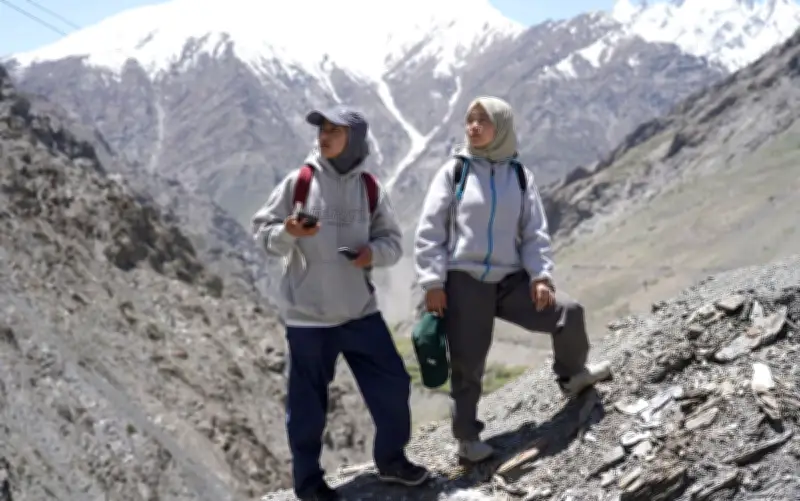
Before sunrise, Mohsina Gufran and her two closest friends pack water bottles, food and biscuits into their backpacks. They put on whatever shoes they have, pull their hijabs tightly against the cold wind, and leave for the mountains above their village in Kargil, in Ladakh – part of Indian-administered Kashmir.
Finding freedom in the mountains
The 23-year-old says the things they usually hear on the trail are birdsong, flowing water and their own laughter echoing through the mountains. That effect of being outside in nature is difficult to explain. In Kargil, young women and girls are expected to study, help with responsibilities at home and live carefully. Daily life feels mechanical, but when she is in the mountains, everything changes.
“I feel alive,” she says. Gufran lives with her parents, four sisters and one brother, and is pursuing her master’s degree in English at the University of Ladakh’s Kargil campus. She grew up in Pashkum, a small village 2,900 metres above sea level and about 10km from the town of Kargil. For the past four years, trekking has become one of the most important parts of her life.
Criticism and perseverance
In Kargil, where hiking is still unusual for young women, some people criticise them for spending so much time outdoors or travelling to remote places. Some relatives question why young women should climb mountains at all. “But once we begin hiking, those voices disappear,” Gufran explains.
The group of three girls does not have professional trekking gear. It is too expensive and difficult to find, so they wear simple trousers, warm jackets, sports shoes and hijabs. Trekking teaches them patience, strength and love for nature. Whenever they complete a difficult climb and finally reach the top, the view makes every difficult step worth it.
A favourite trek
One of Gufran’s favourite treks took almost five hours to complete. They started in Kargil and climbed to a place called Lankerchey Broq through rocky slopes and difficult mountain paths until they could finally see the entire valley below them. “I remember standing there exhausted but happy, looking across the mountains and feeling proud that we had made it,” she says.
The mountains also give them something else: freedom. During hikes, they talk about their future plans in ways they cannot always do elsewhere. They dream about exploring all of Kargil first, then Ladakh, then the rest of India and maybe one day the world.
Changing attitudes
Their friendship has become stronger. Whenever one of them becomes tired during a difficult climb, the others encourage her to keep going. Even now there are people who dislike what they do and make negative comments, but Gufran thinks attitudes are changing. Families are becoming more supportive and more young women and girls are taking an interest in outdoor activities.
Her parents were worried about safety when she first began trekking. They used to ask where she was going and why she needed to travel so far into the mountains. But over time they saw how important trekking became for her. Now they support her.
Independence and confidence
Gufran believes it is important for young women and girls to move freely outdoors because it gives them independence, experience and confidence. “The more you explore, the more you learn about yourself and the world around you,” she says. Before she started trekking, she lacked confidence. The mountains changed that. They taught her to trust herself and keep moving forwards, even during difficult times.
People often underestimate girls from Kargil. They assume they cannot be religious, ambitious and independent at the same time. “But we can,” Gufran asserts. For her, hiking in a hijab means carrying her faith and her passion for adventure together.
Dreams of becoming a mountain guide
She dreams of becoming a mountain guide one day because she wants other people to experience the same peace and beauty that she finds in nature. She wants to show people the mountains where she grew up. “I have never met a female mountain guide,” she notes.
Gufran also hopes to enter public leadership one day. Growing up, she rarely saw women speaking openly about issues affecting young women or representing their concerns publicly. She wants to become someone who listens seriously to people’s problems and works on them honestly, especially issues affecting young women and girls such as safety, freedom and opportunities to move independently.
When she imagines her life 10 years from now, she still sees herself exploring mountains around the world. She wants to continue trekking, mountaineering and exploring new places. And if her future daughter ever reads this, she wants her to know one thing: “She should never be afraid to step outside and see the world for herself.”
As told to Rehan Qayoom Mir