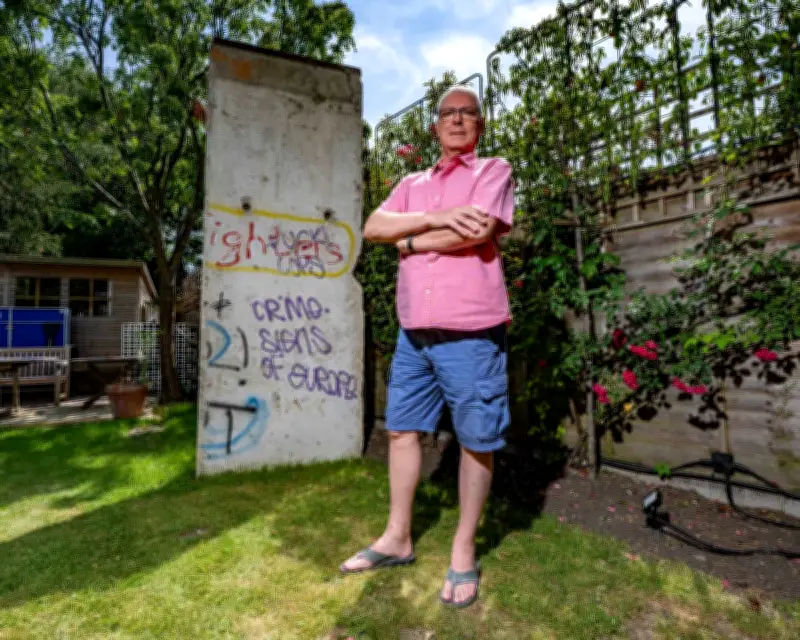
A 65-year-old homeowner in Herne Hill, south London, installed a 2.75-tonne fragment of the Berlin Wall in his garden, sparking a planning dispute with neighbours and the local council. Steven Thorpe, a resident of Herne Hill, acquired the 3.6-metre-tall slab of reinforced concrete as a historical artefact, but neighbours objected due to its height and appearance, leading to an enforcement notice from Southwark council.
Council rules wall is unlawful
Under planning regulations, walls in gardens are limited to 2 metres in height. Thorpe's Berlin Wall slab, which is 3.6 metres tall, exceeds this limit and was erected without planning permission. A planning case officer for Southwark council last week agreed with neighbours, describing the structure as having an “overbearing scale, oppressive sense of enclosure and stark industrial appearance”. The council has ordered its removal.
Owner plans to appeal
Thorpe has stated he will appeal the decision. “They’ve described a large reinforced concrete structure rather than a heritage artefact or sculpture,” he told the Daily Mail. “I think that framing’s important – it underpins their conclusion simply as an unauthorised structure, when I consider it to be a historical artefact.” If he refuses to comply, Thorpe could face a fine of up to £20,000.

Other Berlin Wall fragments in London
Thorpe's slab is not the only piece of the Berlin Wall in London. Lewisham shopping centre, about half an hour from Herne Hill, boasts two slabs of similar size, which are more publicly accessible and lack the graffiti that adorns Thorpe's slab, including the phrase “Fuck Cops”. Other fragments exist in Tallinn, Seoul, and some have even been ground into homeopathic pills.
Historical context and moral
The Berlin Wall, completed in 1961, stretched 155 km and divided East and West Berlin until its fall in 1989. Thorpe's fragment, roughly the width of two people standing shoulder to shoulder, serves as a reminder of the Cold War. The case highlights the importance of checking local planning regulations before installing large structures, even those with historical significance.