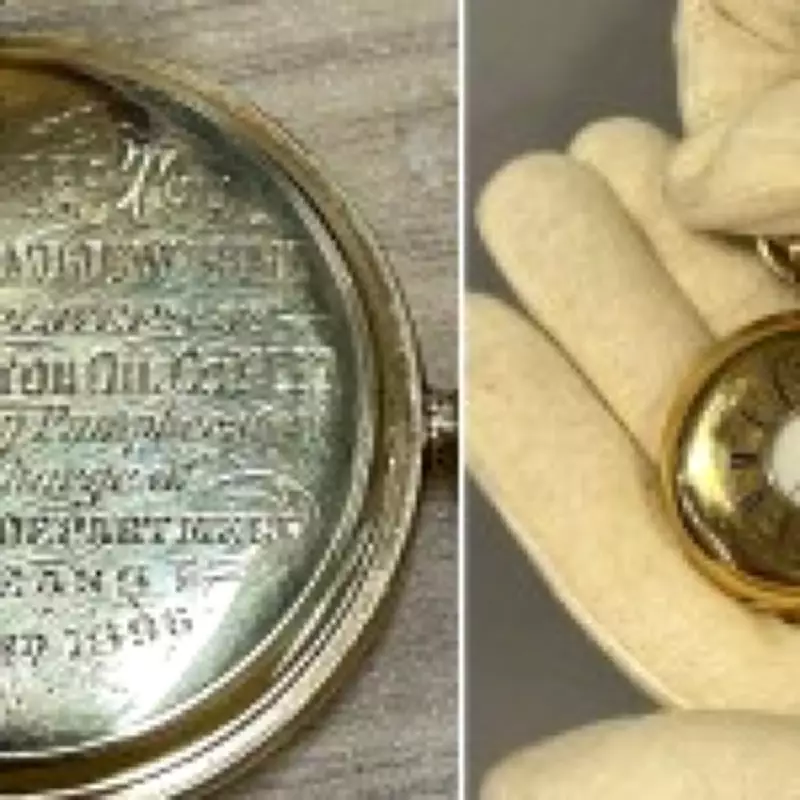
A gold watch rumored to have been used as a bribe to secure a family's place on a Titanic lifeboat is expected to fetch up to £50,000 at auction. The timepiece was handed to a crew member during the sinking of the British ocean liner in 1912, but whether it served as a bribe or a gift of gratitude remains debated.
The Watch and Its History
The 19th-century watch, now up for sale through auctioneers John Nicholson's, is estimated to sell for between £30,000 and £50,000. It is at the center of one of the most controversial tales surrounding the Titanic's disastrous maiden voyage. The ship sank in the early hours of April 15, 1912, five days into its journey from Southampton to New York. Of the 2,208 passengers and crew aboard, around 1,500 perished, making it one of the deadliest peacetime sinkings of a single vessel.
The Caldwell Family Story
The survival of the Caldwell family has been a hotly debated topic since the sinking. The key question is whether Albert Caldwell bribed crew members with his watch to secure a place on a lifeboat. The watch was definitely passed to a crew member, but the Caldwell family, once rescued, disappeared so quickly that they were left off the published list of survivors. They made their way home to Illinois, avoiding an ambulance waiting for Sylvia Caldwell in New York, which had been tasked with assessing her health. The Caldwells arrived on the rescue ship RMS Carpathia and managed to slip away before heading west, where Albert secured a job as a school principal within days.
How the watch changed hands from Albert Caldwell to one of the ship's stokers has never been fully confirmed. Mr. Caldwell himself changed his account of his family's rescue several times throughout his life, between 1885 and 1977. In one recorded interview, he explained that lifeboats were initially lowered only partially full because passengers did not realize the ship was sinking and were reluctant to let their wives and children set off alone. After descending to a lower deck and speaking with stokers, Mr. Caldwell learned the true state of affairs. He claimed that lifeboat number 13, only partially filled, was lowered past their deck, and a stoker shouted to the crew to hold it in position while the stokers and the Caldwell family climbed in. Some have criticized Mr. Caldwell for ending up in the lifeboat as a man, while others hailed him as a hero. A family photograph taken two days before the sinking shows Mr. Caldwell holding ten-month-old Alden on the deck, with his wife standing beside them.
The Watch's Provenance
When the watch was previously sold in 1998, it was assumed that 'Elliot C,' the son of the crewman who signed a letter of provenance, was Elliot C. Everett. However, it is now believed that the signature indicates his surname begins with C, meaning the watch could have been given to one of the engine room crew Albert had befriended. The watch itself, originally the property of another relative before being passed to Mr. Caldwell, is an 18-carat gold-cased keyless half hunter pocket watch by Sutherland & Horne, Edinburgh, circa 1876. It is engraved: 'Presented to James Caldwell by the employees of the Pumpherston Oil Co. Ltd on his leaving to take charge of the Mining Department at Deans, June 3, 1896.'
Whether used as a bribe or a gift, the gold watch is estimated to sell for between £30,000 and £50,000 when it goes under the hammer later this month.