Celestial Spectacle: Venus and Saturn to Converge in Evening Twilight
Astronomy enthusiasts and casual skywatchers alike are in for a treat this week as two of our solar system's most prominent planets, Venus and Saturn, are set to appear to converge in the evening twilight. This rare planetary conjunction, where the two celestial bodies will seem to meet closely in the sky, offers a stunning visual display that requires no special equipment to observe.
Timing and Visibility of the Conjunction
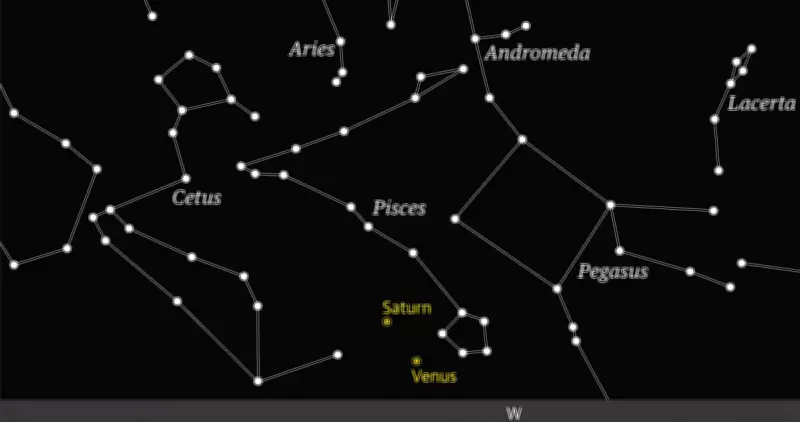
The event is scheduled to occur in the early evening hours, shortly after sunset, when the twilight sky provides a dramatic backdrop. Observers should look towards the western horizon, where Venus, often called the "Evening Star," will shine brightly, with Saturn appearing as a fainter, golden-hued point of light nearby. The planets will be at their closest apparent separation, making them appear as a striking pair in the heavens.
This conjunction is particularly notable because Venus and Saturn are on different orbital paths, with Venus orbiting closer to the Sun and Saturn much farther out. Their alignment from Earth's perspective creates this illusion of proximity, which occurs infrequently due to their distinct orbital periods. Venus takes about 225 Earth days to orbit the Sun, while Saturn's orbit spans approximately 29.5 Earth years, making such conjunctions a special event for skywatchers.

How to Best Observe the Event
For optimal viewing, find a location with a clear, unobstructed view of the western horizon, away from city lights and light pollution. Binoculars or a small telescope can enhance the experience, allowing observers to see Saturn's iconic rings and Venus's crescent phase, but the conjunction will be easily visible to the naked eye. Weather permitting, the spectacle should be accessible across many regions, with clear skies offering the best conditions.
This event serves as a reminder of the dynamic nature of our solar system and the beauty of planetary motions. It also provides an excellent opportunity for educational outreach, as schools and astronomy clubs can use it to engage the public in stargazing activities. Similar conjunctions involving other planets occur periodically, but each offers a unique viewing experience based on the planets involved and their positions relative to Earth.
As the planets drift apart in the following days, observers can continue to track their movements in the evening sky, with Venus remaining a bright fixture and Saturn gradually becoming more prominent as the night deepens. This conjunction highlights the ongoing dance of celestial bodies that has fascinated humans for millennia, offering a moment of cosmic connection in our daily lives.