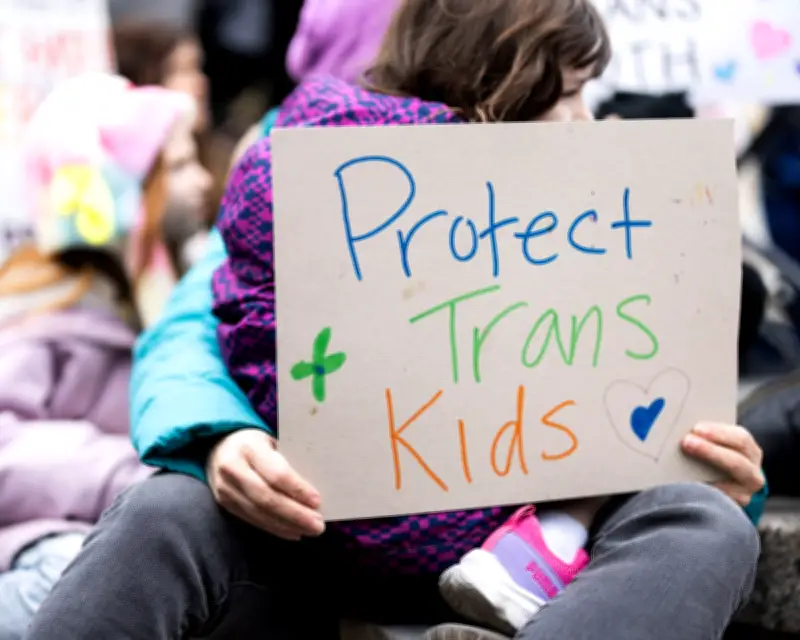
Supreme Court Upholds Bans on Transgender Girls in Women's Sports
The US Supreme Court ruled on Tuesday that West Virginia and Idaho can continue to bar transgender girls from playing on girls' sports teams. While legally narrow, experts and trans rights advocates warn the decision could have far-reaching consequences, likely being weaponized to expand exclusionary policies and leaving the question of trans inclusion in athletics unsettled.
President Donald Trump called the decision a "BIG WIN … against men playing in women's sports," posting on social media: "That takes that ridiculous situation off the table!" The ruling advances a central priority of the Trump administration and anti-trans campaigners: blocking trans girls of all ages from joining women's sports teams.
25 Other States Have Similar Restrictions
There are 25 other states that have passed restrictions on trans youth athletes, and the ruling strengthens those. Arizona's ban on trans female athletes had previously been blocked by courts, but the state's superintendent of public instruction, a Republican, said in an interview on Tuesday that the Supreme Court had paved the way for its enforcement.

Supporters of the bans had hoped the justices would go further and dictate that other states must similarly restrict trans youth athletes. However, the court did not go that far. Twenty-one states, Washington DC, and several territories allow trans youth to play on teams that match their gender, and those policies are not immediately affected by the ruling.
Reactions from Advocates and Legal Experts
"It's a narrow, disappointing result," said Joshua Block, senior counsel for the LGBTQ and HIV project at the American Civil Liberties Union, which represented the trans students before the Supreme Court. The goal of the bans, he said, was to "establish a broad principle that transgender girls shouldn't be treated as girls and that it was perfectly fine to discriminate against them." The court, Block told reporters, did not give anti-trans groups that sweeping victory.
The ruling said barring trans girls from sports specifically was not unconstitutional nor a violation of Title IX, the federal law that prohibits sex discrimination in schools. However, the ruling did not say that trans students were broadly excluded from all Title IX protections, and the justices did not say that under the constitution, discrimination based on trans status is allowed, Block said.
The Trump administration, Block noted, wants to force blue states to adopt bans and assert that federal law mandates this kind of discrimination: "The Supreme Court absolutely did not endorse that argument."
Potential Consequences and State-by-State Battles
"This isn't a national mandate to ban trans athletes everywhere," said Sasha Buchert, senior attorney and director of the non-binary and transgender rights project at Lambda Legal, which has also represented the student athletes. Instead, Buchert said, it sets up a brutal state-by-state, school-by-school fight. "This really says that, sure a state may discriminate, not that they must discriminate," she said.
"There's definitely a toll, and the toll that we're thinking about is for the young trans and non-binary folks who have now spent a huge portion of their lives in the middle of a political fight they didn't start and didn't ask for," said Raquel Willis of Gender Liberation Movement, a group that has supported trans youth and their families and protested outside hospitals and federal buildings over attacks on trans rights.
Fear of Broader Erosion of Trans Rights
LGBTQ+ advocates also fear it will be one more ruling that anti-trans activists cite in continuing efforts to erode trans rights in areas such as education, employment, and healthcare, even though it does not carry immediate consequences outside of sports bans. The decision, they warned, could also be used to directly harass individual trans athletes and people in public life.
"The Supreme Court today empowered this false narrative that trans kids don't deserve respect and safety and are somehow a threat … and we're going to see anti-trans, anti-LGBTQ+ electeds run with that empowerment," said Kanan Durham, director of Pride at the Pier, an Orange County, California-based queer advocacy group.

One mother of a trans youth athlete in California, who requested anonymity to protect her child's privacy, said she feared the ruling would "open the floodgates" to more challenges to inclusive policies, including California's. "Even though our laws still protect our Californian kids, it puts the burden on kids and families to protect our kids and on kids to protect themselves from this kind of onslaught of damage and harassment."
Concerns Over Invasive Testing
Maya Satya Reddy, a former professional golfer and LGBTQ+ sports law and policy consultant, said she was concerned about the invasive "sex testing" that these kinds of bans can encourage or require. "Random adults could be like: 'Hey, you look suspicious. I'm going to subject you to invasive testing.' That is terrifying."
In Utah, for example, there were concerns when officials suggested its ban could be enforced through measurements of physical characteristics, reviews of medical records, and a diagnostic assessment from a doctor. A US appeals court noted that Idaho's law allowed for anyone to question a student's gender, which could lead them to be subject to "unnecessary medical testing and genital inspections."
Reddy said when she played sports in elementary school, she would be mocked for looking like a boy; when she came in last in a girls' cross-country meet, "I was told I came in first for boys," she recalled. "If I was looking like that now … I absolutely would be subjected to sex testing or scrutiny despite being a cis girl … It's obviously going to implicate, disproportionately implicate girls and women of color who don't look like the western white standard of femininity."
Anti-Trans Campaigners Claim Victory
The limited scope from the ruling is not stopping anti-trans campaigners from claiming a far-reaching win. The president of the Alliance Defending Freedom, a Christian legal group behind major anti-LGBTQ+ cases, wrote on social media: "Blue states with boys on girls' podiums … you're next."
Trans youth in states such as California, which have long maintained pro-LGBTQ+ sports policies, have said they will continue playing and fighting for their rights.