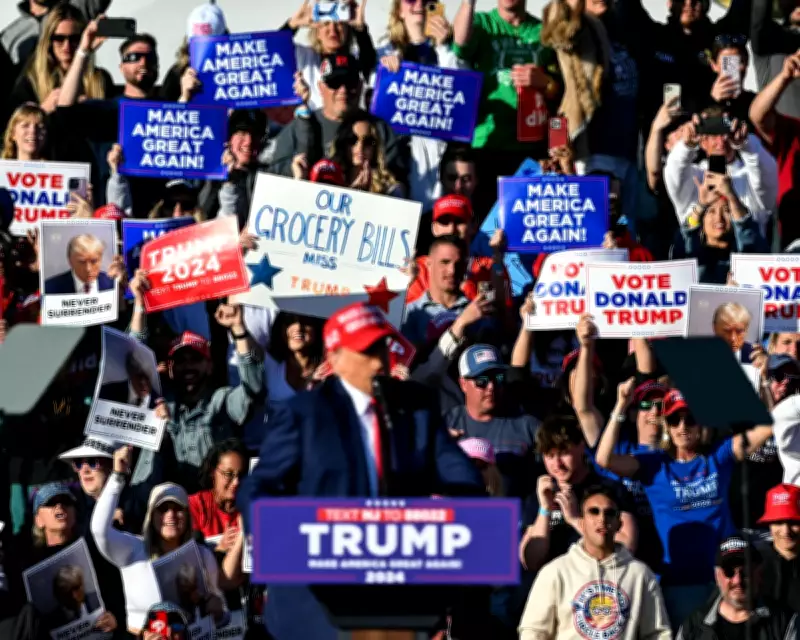
Trump's Coalition Shows Cracks as Working-Class Support Wanes
A recent survey conducted by Jared Abbott and Joan C Williams provides novel insight into the stability of Donald Trump's political coalition. The study, which sampled approximately 1,940 Trump voters from the 2024 election, reveals a significant erosion of support among key demographics, particularly working-class and lower-income voters.
Survey Highlights Voter Discontent
The findings indicate that around 20% of those who supported Trump in 2024 are considering abandoning the Republican party in the 2028 presidential election. This figure rises sharply among specific groups: almost 57% of voters who switched from Biden in 2020 to Trump in 2024 are now wavering in their loyalty. The bulk of this uncertainty stems from the lower end of the class hierarchy, with 31% of the lowest-income Trump voters expressing doubts, compared to just 12.7% of those earning over $200,000 annually.
Education and Income Divide Support
A clear pattern emerges when examining education levels alongside income. Among Trump voters without a high school diploma, 31.8% are uncertain about future Republican support, while 20% of those with less than a college education share this hesitation. In contrast, only 17.6% of voters with at least a four-year college degree are wavering. This data underscores that Trump's coalition is most stable at the top and most fragile at the bottom, highlighting a growing divide within his base.

Immigration: A Key Issue Failing to Resonate
Immigration, often cited as Trump's strongest issue, is not delivering the expected loyalty from working-class voters. The survey shows that while only 13.5% of wavering Trump voters prefer Joe Biden's immigration policies, a significant 50% believe Trump has gone too far on immigration, with just 31.4% supporting his approach. Many blue-collar voters, frustrated by Biden's border handling, did not anticipate the extreme measures implemented under Trump, such as masked ICE agents operating without due process.
Economic Disappointment Drives Discontent
Working-class voters, including self-identified moderates and former Democrats, took a gamble on Trump hoping for economic relief and social stability. One year into his term, they feel let down, as he has not alleviated the economic squeeze and has instead introduced more chaos. Evidence suggests that immigration surges under Biden tempered wage growth in sectors like construction and manufacturing, but Trump's policies have not addressed these concerns effectively.
Democrats Fail to Capitalize on Republican Weakness
Despite the bad news for Republicans, the survey does not paint a rosy picture for Democrats either. Only 3.4% of wavering Trump voters plan to vote for Democratic candidates in 2028, with the majority remaining undecided, considering third parties, or opting to sit out the election altogether. This indicates that neither party's policy positions fully resonate with the needs of working-class voters.
A Wake-Up Call for Populist Politics
The erosion of Trump's working-class base serves as a wake-up call. Voters will not be won over by condescending attitudes or dismissals of their economic concerns. Instead, a genuine populist approach that addresses issues like globalization, the cost of living, and elite power is necessary to reclaim this demographic. Trump's coalition is up for grabs for any candidate brave enough to listen to and act on the grievances of the working class.
This survey, conducted by the Center for Working-Class Politics, underscores the volatile nature of modern political alliances and the urgent need for policies that bridge the gap between elite stability and grassroots fragility.