Trump's AI Jesus Post Tests Religious Right Loyalty Ahead of Midterms
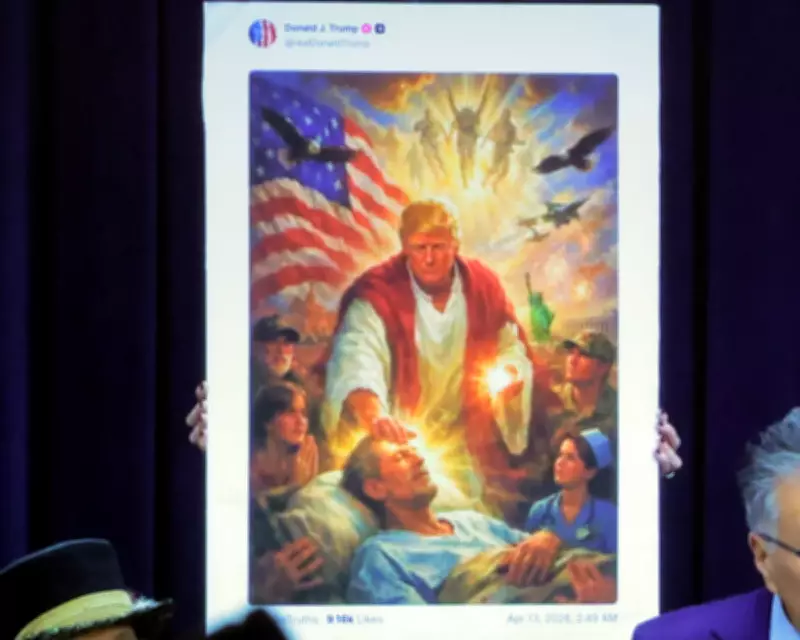
Donald Trump's recent social media post featuring an AI-generated image depicting him as Jesus Christ has sparked immediate condemnation from his Christian conservative supporters, yet political experts suggest their fundamental loyalty to the former president remains largely intact. The controversial post, which showed Trump administering ethereal light to a stricken man's head with translucent figures descending from heaven, was quickly removed from Truth Social after widespread criticism.
Immediate Backlash from Christian Leaders
The president's depiction of himself in messianic terms drew swift rebukes from prominent figures within the religious right. Douglas Wilson, a self-described Christian nationalist and confidant of Defense Secretary Pete Hegseth, labeled the image "blasphemous" and demanded its immediate removal. Christian activist Sean Feucht, who partners with the Trump administration on worship events, declared on social media that "there's no context where this is acceptable."
Despite the initial outrage, Trump's subsequent posting of an AI image showing Jesus Christ embracing him raised questions about the sincerity of his apology. The incident represents what experts describe as a rare moment where Trump appears to have crossed a line with his Christian base, though the political consequences may be limited.

Experts Question Sincerity of Outrage
Kristin Kobes Du Mez, a professor at Calvin University and expert on white American evangelicals, noted the apparent contradiction in the religious right's response. "He did seem to cross a line for some of his Christian supporters," Du Mez observed, pointing out that these same supporters have tolerated numerous other controversies, from the Access Hollywood tape to immigration policies and allegations related to Jeffrey Epstein.
"The fact that it was this AI-generated image that sparked this outcry is worth pondering," Du Mez continued. "I think it felt like it crossed the line for some because it was just so blatant." However, she suggested much of the criticism might be performative, with Christian leaders feeling compelled to publicly disapprove while maintaining their political support behind the scenes.
This theory gained support when Feucht quickly reversed his position, uncritically reposting Trump's explanation that the image represented him as a "doctor" rather than a religious figure. Similarly, anti-trans activist Riley Gaines initially called for more humility from Trump before declaring her continued support for the president later the same day.
Enduring Support Among White Evangelicals
Robert Jones, president of the Public Religion Research Institute, explained why Trump's core religious support remains resilient despite the controversy. "They're just more conservative than Catholics are," Jones said of white evangelicals and Christian nationalists. "They're heavily concentrated in the south, and they're frankly more motivated by racism. So the anti-immigrant, anti-Islam drumbeat is kind of fuelling the Maga movement."
Jones noted that Trump's simultaneous feud with Pope Leo XIV—whom the president has criticized as "wrong on the issues" and "weak on crime"—hasn't significantly damaged his standing with white evangelicals, some of whom have even backed his attacks on the pontiff.
Catholic Voters Could Determine Midterm Outcomes
While white evangelical support appears secure, experts warn that Trump's standing with Catholic voters could prove more consequential in the upcoming midterm elections. According to PRRI data, white Catholics represent a crucial demographic in several swing states where they are overrepresented compared to national averages.
White Catholics constitute 12% of the national population but represent 18% in Pennsylvania, 22% in Wisconsin, and significant percentages in Michigan. A majority of white Catholics supported Trump in the 2024 election, while Hispanic Catholics tended to support Vice President Kamala Harris.
"In these more competitive districts and swing states, if he loses 10 points among white evangelicals, he and Republicans might be able to weather that," Jones explained. "If they lose 10 points among white Catholics, that's going to be game over in many elections in the midterms."

Political Calculations Ahead of November
The incident highlights the complex relationship between Trump and his religious supporters, who have demonstrated remarkable tolerance for behavior that would traditionally conflict with Christian values. While the AI Jesus post generated immediate condemnation, the rapid return to support suggests the religious right's political priorities outweigh their theological concerns.
As midterm elections approach, the Republican party faces the challenge of maintaining support among both its evangelical base and the more moderate Catholic voters who could determine outcomes in competitive districts. The controversy serves as a reminder that while Trump's religious supporters may occasionally express public disapproval, their political allegiance appears deeply entrenched, shaped more by cultural and political identity than by traditional religious values.