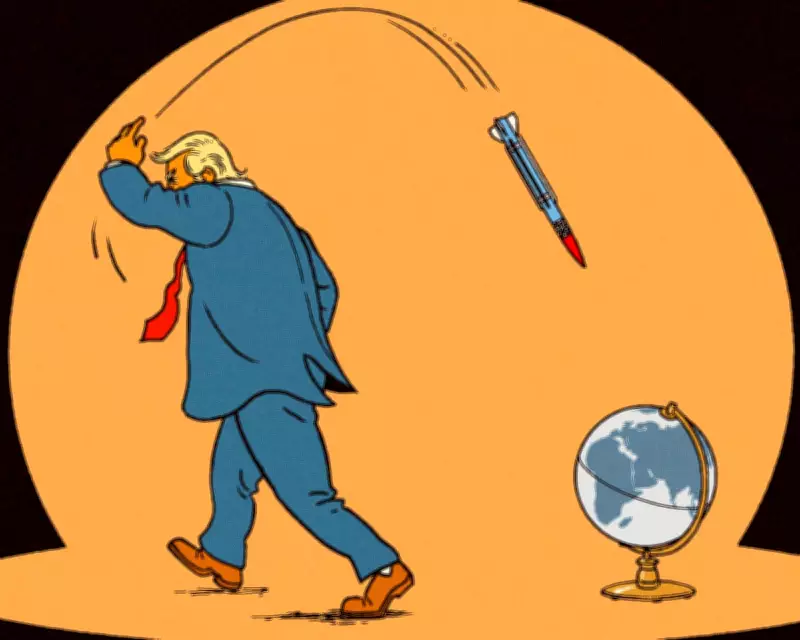
Trump's Presidency: The Absurd Face of Modern Evil and Its Global Carnage
Over recent weeks, a chaotic parade of images has relentlessly flashed through my mind. These mental fragments range from forgotten childhood movie characters to snippets of classic literature and iconic artworks. What unites them all is a portrayal of exaggerated, almost kitschy evil that feels disturbingly relevant today.
The Real Carnage Behind the Imagery
These mental images serve as substitutes for the actual horrors my brain struggles to process: bodies extracted from Gaza's rubble, schools full of young pupils obliterated in Iran, and more than one million people forcibly displaced from their homes in southern Lebanon. The sheer scale of suffering becomes overwhelming, reminiscent of Alex in A Clockwork Orange, eyes forced open, unable to blink away the scorching reality before him.
What proves most bewildering about this widespread cruelty is how casually it has been permitted to unfold. Donald Trump presides over this circus of death and chaos like a malevolent ringmaster. Like Billy, the clown-faced puppet from Saw who raspingly invites victims to "play a game," Trump defies all attempts to rationalize his actions within any coherent strategic framework.

The Dangerous Misreading of Trump's Incoherence
Trump's wars, his indifference to innocent casualties, and his threats against entire civilizations are actively reshaping our world, yet they emerge not from some master plan but from momentary impulses and deep-seated resentments. Many commentators mistakenly interpret his apparent lack of vision or ideology as attributes that somehow render him less dangerous than historical authoritarians who have become our templates for recognizing evil.
The ongoing debate about whether Trump qualifies as "fascist" exemplifies this dangerous misreading. The Wall Street Journal's Barton Swaim argues that "you can't be a fascist without in any way meaning to be one," dismissing Trump as merely inept, inconsistent, and "puzzling and exasperating" rather than genuinely fascist.
The Unconventional Face of Modern Authoritarianism
Trump indeed breaks from the fascist archetype in style and affect: he doesn't conduct mass rallies, wear uniforms, or deliver fiery balcony speeches to flag-waving crowds. He hasn't yet completely overturned the constitution or dismantled democracy entirely. Instead, he presents as an addled comic figure whose soul reveals itself through angry social media outbursts and rambling, self-unaware speeches.
He discusses war with Iran while flanked by a giant Easter bunny, posts images of himself as Jesus, and consistently "chickens out" when confronted. This behavior recalls the Wheeler from 1985's dark fantasy Return to Oz: screeching, giggling, and chasing, then wincing and withdrawing when its quarry strikes back.
Evil as Projection of Smallness and Fear
But isn't this precisely what evil manifests as today? Not an overbearing grand design, but a projection of smallness and fear onto the world? The actual consequences of violence become secondary to the validation derived from inflicting it. Trump's constant self-aggrandizement, his grudges against political adversaries, his fury at press challenges, and his promised revenge against the Iranian regime all serve to erase and avoid what constitutes a permanent terror of humiliation and obsolescence.
This recalls Goya's Saturn, wild-eyed as he devours his own son. It is within that very puniness that insatiable evil resides. Historical parallels abound: in 1931, after Adolf Hitler's Nazi party surged in polls, U.S. reporter Dorothy Thompson interviewed him for Cosmopolitan and within moments judged him as possessing "startling insignificance." Similarly, journalist Barbara Grizzuti Harrison described Mussolini as "jackbooted, lantern-jawed, squeakily bombastic" and a "consummate buffoon," reminding us that "just because something is silly doesn't mean it isn't dangerous."

The Human Difficulty Recognizing Ludicrous Evil
We tend to imbue historical events with a seriousness and coherence that we struggle to apply to present circumstances. This occurs because the human brain finds it difficult to encounter evil in ludicrous form and still recognize it as such. That's precisely how it creeps up on societies. That's why we ask how such crimes were permitted in the past. The answer rarely involves villains arriving with clear intent and identifying hallmarks. Instead, evil arrives through broken individuals whose power stems from an unquenchable desire to make themselves whole, regardless of consequences.
Alongside Trump's absurdity exists the terrifying reality that he possesses access to nuclear annihilation capabilities and demonstrates a sociopathic appetite for escalation. This brings to mind Milton's declaration: "better to reign in Hell than serve in Heaven."
The Composition of Contemporary Evil
Modern evil comprises frivolity, nonchalance, and fragility alongside relentlessness, insatiability, and brutality. Another recollection surfaces from the movie franchise The Purge, where America legalizes all crime for twelve hours annually to purge societal grudges. Yet the population isn't satisfied merely ravaging each other; they dress in elaborate costumes, wear gaudy makeup, fashion masks, and blast music in a ritual of relish.
The film captures a crucial truth: crime proves unsatisfying without performance. The assertion of power comes from approaching grave sins trivially, with the privilege of play. It's not the act itself but the license granted. Similarly, it's insufficient that ICE separates families and uproots lives; the operation must be rendered as celebration, with Trump pictured beside alligators wearing ICE caps beside the line "Alligator Alcatraz" in movie poster font.
The Urgent Need for Recognition and Resistance
No amount of cajoling or humoring this jubilant wickedness will convince Trump to spare his quaking allies. Minimizing it as non-ideological or strategically purposeless, and therefore manageable, constitutes a fatal error. The unbridled cruelty and violence he unleashes and enables both domestically and abroad draw upon all historical precedents. This menace can only be fiercely fought with utmost urgency, or it will consume everything in its path.
This recalls Patrick Bateman from American Psycho: "My pain is constant and sharp and I do not hope for a better world for anyone. In fact, I want my pain to be inflicted on others. I want no one to escape." The time for recognizing absurd evil has arrived, and the necessity for resistance has never been more critical.