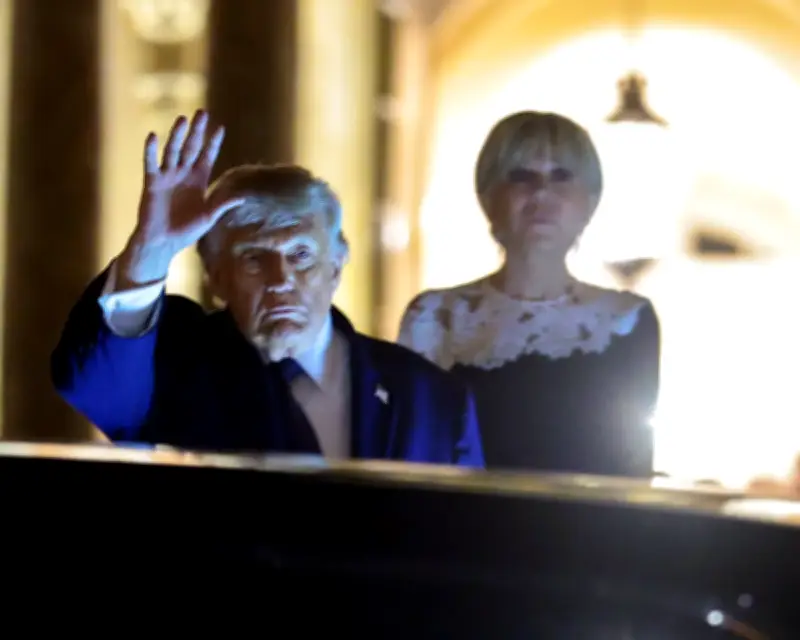
President Donald Trump waves as he departs a dinner with Emmanuel and Brigitte Macron at Chateau de Versailles on Wednesday at the end of the G7 summit where he signed a memorandum of understanding on the Iran deal. Photograph: Anna Moneymaker/Getty Images
Donald Trump's Iran deal has been met with anger, relief, and incredulity. G7 leaders and mediator Pakistan hailed the release of the memorandum of understanding, views that were not widely shared in Israel and among US Republicans.
Pakistan's Mediation Role
Pakistan's prime minister has hailed the "peaceful resolution" of the conflict between the US and Iran, congratulating both countries for signing an agreement that he claimed would immediately reopen the Strait of Hormuz. But amid celebrations from Shehbaz Sharif, who served as mediator, the release of the memorandum of understanding (MOU) that initiates 60 days of negotiations between Iran and the US has proven divisive, eliciting outrage, bewilderment, and relief.

G7 Leaders Welcome the Deal
In France, G7 leaders welcomed the deal, calling it a "historic opportunity to prevent Iran from acquiring any nuclear weapon." European leaders, largely sidelined from negotiations, expressed relief that the Strait of Hormuz would reopen, allowing oil flow to resume. Emmanuel Macron said it would end a "situation of great instability that had terrible consequences for our economies."
Israeli Skepticism
In Israel, the agreement has been greeted with less optimism. Mark Regev, a former senior adviser to Prime Minister Benjamin Netanyahu, questioned how seriously Iran would approach nuclear negotiations now that America has removed economic and military "pressure." Under the MOU, Iran will reopen the Strait of Hormuz in return for waivers on US sanctions for crude oil exports, petroleum products, and banking services. They will then negotiate over their nuclear program and highly enriched uranium stock.
"The straits are open, and the Iranians can start exporting oil, so they get money coming in. You've taken away the economic pressure," said Regev, adding, "Maybe Trump will get a great deal, but at the moment I don't see that. I see America having given Iran's regime a return to life."
Yair Lapid, leader of Israel's opposition, said, "Netanyahu promised us a historic victory – and we got a crisis with the Americans, Hormuz open to the Iranians, money for the Revolutionary Guards, ballistic missiles aimed at Israel, and Israel waiting in the corridor like a scolded child." With Israel set to hold elections before October, Lapid and coalition partner Naftali Bennett seek to capitalize on brewing anger over the US-Iran agreement.
David Horovitz, founding editor of the Times of Israel, wrote that the US-Israel war on Iran was lost due to "US presidential weakness" among other issues. "It will come back to bite America. It leaves Israel more vulnerable than before the war began, with a new US-Iran ceasefire agreement that aims to deny Israel the freedom to protect itself."
Netanyahu's Likud party, aware of cooling views on Trump, has reportedly scrapped plans to highlight the prime minister's close ties with Trump in its upcoming election campaign. However, Danny Citrinowicz, a former head of the Iran branch of Israeli military intelligence, said the deal showed reality had "finally returned to US policy on Iran," with the administration stepping back from maximalist objectives to a more measured approach.
US Reactions
Those splits were reflected in the US. Senator Lindsey Graham, a key Trump ally, softened his view after a "very lengthy and productive" conversation with US special envoy Steve Witkoff. "After this discussion, it is my opinion that signing the MOU will be beneficial to the United States, as the Strait of Hormuz will begin to open and hostilities with Iran will stop," Graham wrote. "Whether the US can reach an acceptable, verifiable deal with Iran is yet to be determined, but I see little downside to trying."

Other Senate Republicans were more critical. Bill Cassidy said, "Iran's nuclear ambitions were not curbed, and they have learned that threatening the Strait of Hormuz works and will leverage it in the future." Senator Ted Cruz said the president was getting "very poor advice." Susan Rice called it "the biggest national security blunder in decades," while Senator Adam Schiff said it was "hard to imagine a more thorough capitulation. Iran gets sanctions relief, frozen funds, oil export ability, and a $300 billion reconstruction fund. The US gets a vague promise Iran won't develop a nuke."
Trump's Perspective
Trump hailed the agreement as a "major win" for the US, while Iran's chief negotiator, Mohammad Ghalibaf, called it "a record of US failure." Trump signed the MOU during a dinner with Macron at the Palace of Versailles, site of the 1919 agreement ending World War I, which was short-lived as Europe was again consumed by war 20 years later.