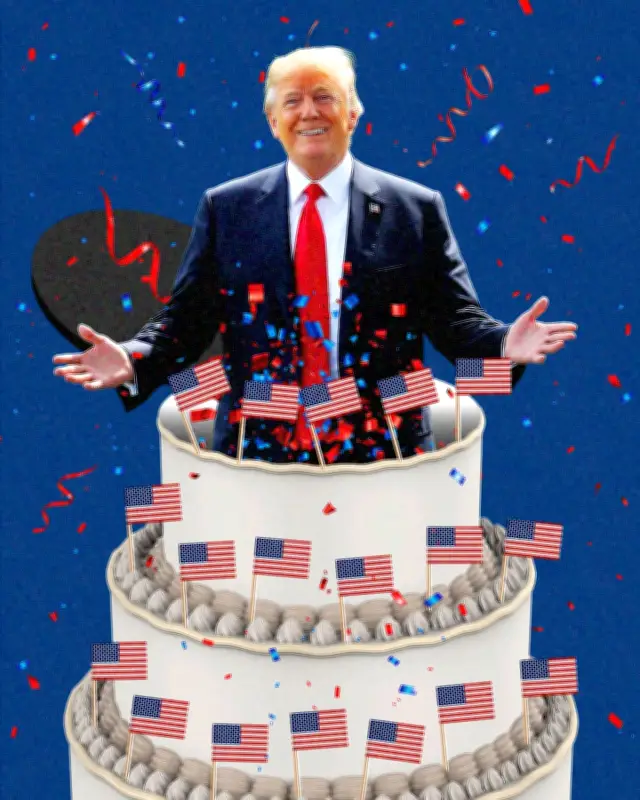
Donald Trump has hijacked America's 250th anniversary, turning the semiquincentennial into a 'theatre of the absurd' that lays siege to freedoms and truth itself, according to historians and critics. The milestone birthday, which should be a unifying celebration, has become a source of division and existential angst under Trump's leadership.
Trump's Takeover of the Semiquincentennial
Trump, who has hyped the anniversary for years and expressed glee that it falls in his second term, launched a project to beautify Washington DC, including scrubbing statues clean of graffiti and restoring long-neglected fountains. He even plans to build a triumphal arch that would dwarf the Arc de Triomphe in Paris. However, a $14.7 million renovation of the Lincoln Memorial reflecting pool ended in embarrassment when an algae bloom turned the water bright green and the 'American flag blue' coating began to peel off. Trump blamed vandals and threatened them with jail time.
The tone was set earlier this month when Trump hosted brutal Ultimate Fighting Championship cage matches on the White House South Lawn for his 80th birthday. He followed up with the Great American State Fair on the National Mall, described as a Trump rally with military jets, after previously announced artists withdrew over the event's partisan nature. The fair features no Democrats and culminated with Trump's 'Make America great again' battle cry and a dance to YMCA by the US Marine Band.

Criticism from Historians and the Public
David Blight, a professor of American history at Yale University, said: 'I don't feel celebratory at all. I don't know how to explain [Trump's] vanity projects any better than anybody else. This is who he is. He's not unlike Mussolini, who wanted to leave his mark all over Rome. It's like theatre of the absurd.'
According to a Reuters/Ipsos poll, 38% of respondents do not believe the US will exist as a single country 250 years from now, and nearly two in three Americans agree that their democracy is in danger of failing. Even among conservatives, there is a sense of mourning for what could have been. Bill Whalen of the Hoover Institution said: 'Ideally, the celebration should be the equivalent of the Christmas truce of World War I, where people put down their weapons and got together.'
Contrast with the Bicentennial of 1976
Historians draw a contrast with the bicentennial of 1976, which featured a floating parade of tall ships, the opening of the Smithsonian National Air and Space Museum, and a president who did not make the celebration about himself. Jill Lepore, a Harvard historian, noted that other gestures at the semiquincentennial seem muted because 'to be doing something is somehow to seem as if you're supporting Trump to some people, which is ridiculous.'
Ideological Underpinnings and Resistance
Observers perceive a conscious effort to rewrite the American narrative into an exclusionary myth of white, male Christian triumph. A fleet of six 'Freedom Trucks' travel the country telling a relentlessly positive story that downplays slavery, culminating with a video of Trump. An executive order directed the removal of 'improper, divisive or anti-American ideology' from the Smithsonian Institution. A federal court filing alleges that the president ordered removal of materials from at least 37 National Park Service sites that 'disparage Americans.'
Despite this, cultural institutions are engaging in quiet resistance. The Museum of the American Revolution in Philadelphia features 'The Declaration's Journey,' an exhibition mapping the declaration's influence on freedom movements worldwide. Tyler Putman, the museum's manager of gallery interpretation, highlighted how Martin Luther King Jr. quoted the declaration in his 'Letter from Birmingham Jail,' written on a jail cell bench now displayed next to Jefferson's chair.
At Independence Hall, visitors still come. Kim Wilson from Raleigh, North Carolina, said: 'It was so wonderful to be in the room where so many people took such courage to do things that were very difficult. I feel like we've lost a lot of courage to do very difficult things as a people.' Dimitrios Dimoulas, a Brazilian immigrant who became a US citizen in 1976, insisted the malaise will pass: 'No matter who you are and what you are, you've got to listen and learn. Sooner or later, this is going to pass.'