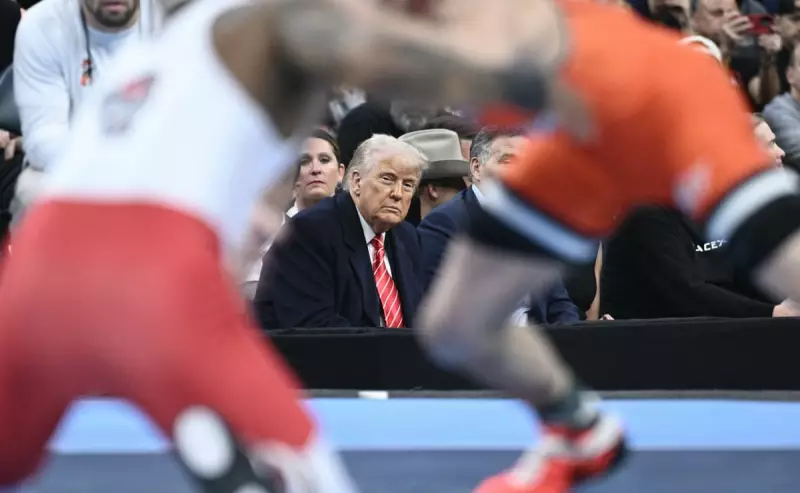
In 2025, the figure of Donald Trump became an inescapable presence across the American sporting landscape, transforming stadiums and arenas into extensions of his political theatre. As he embarks on a second term, the US president has leveraged everything from the Super Bowl to the US Open as platforms for visibility, blending spectacle with strategy in a manner unprecedented for an American leader. The coming year, headlined by the 2026 FIFA World Cup in the United States, promises an even more profound merger of sport and statecraft.
The 2025 Sporting Crawl: From Super Bowl to Centre Stage
The campaign began swiftly after his second inauguration. In February, Trump made history as the first sitting president to attend the Super Bowl. This was swiftly followed by a dramatic appearance at the Daytona 500, where Air Force One performed a low flyover before his armoured limousine, 'The Beast', led the field on pace laps.
This set the pattern for a year-long tour. He was a conspicuous guest at the NCAA wrestling championships in Philadelphia and received rapturous welcomes at UFC events in Miami and New Jersey. At July's FIFA Club World Cup final at New Jersey's MetLife Stadium, he commandeered the spotlight, refusing to cede space during Chelsea's trophy lift in what was interpreted as a stark assertion of dominance.

Further appearances included the hyper-patriotic Ryder Cup at Bethpage, a LIV Golf event at his own Doral resort, and the US Open men's final, where broadcasters were reportedly asked to censor crowd reactions to his presence. By the time he surfaced at MLB and NFL games and the Army-Navy football classic, it was clear these were not casual outings but a coordinated element of his presidency.
More Than Spectacle: The Backstage Machinery and Cultural Warfare
Trump utilises these walk-ins as ultra-efficient, distilled rallies. A mere thirty seconds of arena visibility is enough to saturate social media feeds, with the reaction—whether cheers or boos—serving as valuable 'heat', a pro-wrestling term he effectively trades in. The venues are carefully chosen: supportive crowds at NASCAR or UFC events bolster his image of strength, while jeers from tennis patrons can be framed as elitist disdain.
Yet the real business often occurs out of view. These events function as exclusive networking chambers where league commissioners, team owners, promoters, and billionaire donors mingle. Figures like Miriam Adelson, majority owner of the Dallas Mavericks, who contributed roughly $100 million to Trump's 2024 campaign, exemplify the high-stakes alliances forged in these settings.
Beneath the theatrics lies a potent cultural strategy. Trump has demonstrated a knack for repurposing sporting debates into political accelerants. During the 2024 campaign, he elevated the niche issue of transgender participation in women's sports into a powerful cultural wedge, mobilising his base. This tactic continues, illustrating how sport serves as a proxy battlefield in America's ongoing culture wars.
2026 and Beyond: The World Cup Stage and a Historical Playbook
If 2025 was a dress rehearsal, 2026 is set to be the main performance. The United States will host the men's FIFA World Cup, a month-long global festival offering the international validation Trump has long sought. His chummy relationship with FIFA President Gianni Infantino positions him to claim a central role in the narrative.
The spectacle will reach a surreal peak just days into the tournament, when Trump plans to celebrate his 80th birthday from a VIP box at a UFC event scheduled for the White House South Lawn. This move underscores a presidency that increasingly prefers the role of ringmaster to that of a traditional head of state.
This fusion of sport and political power is not novel historically. The article draws parallels with strongmen throughout history, from Roman emperors using public games to display authority, to Mussolini's 1934 World Cup and Hitler's 1936 Olympics, which aimed to launder fascism with prestige. More recent examples include Franco's embrace of Real Madrid and the sporting investments of leaders like Vladimir Putin and Mohammed bin Salman.

In its current hyper-commercialised, media-saturated form, modern sport is exquisitely suited to Trump's needs. It provides the crowds, the cameras, the ritual patriotism, and the mythologies of struggle and victory. It offers stadiums that convert instantly into rallies and VIP corridors that double as donor summits. As the 2026 World Cup and the 2028 Los Angeles Olympics loom, the president is poised to take even more from the world of sport, ensuring his image remains inextricably linked with the American sporting dreamscape.