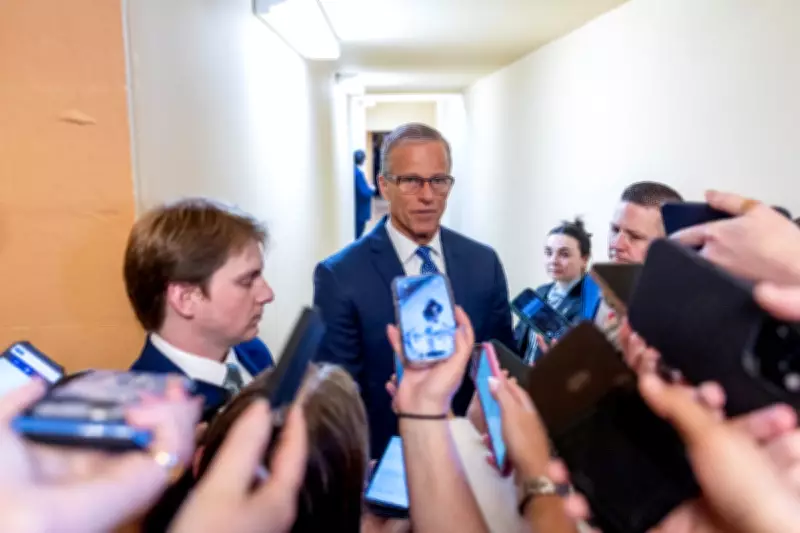
Trump Demands Action from GOP Senate Leader on Voting Bill
Former President Donald Trump has launched a direct confrontation with Republican Senate Majority Leader John Thune over the stalled Save America Act, a comprehensive piece of legislation that would dramatically reshape American election processes. Trump issued a stark ultimatum on Wednesday, declaring he would refuse to sign any other legislation until the controversial bill reaches his desk for approval.
Filibuster Rules Create Legislative Impasse
The political standoff centers on procedural obstacles in the Senate, where the Save America Act lacks the necessary 60 votes to overcome filibuster rules and advance to a final vote. Despite House approval of a version of the legislation, Thune acknowledged the mathematical reality that he cannot muster sufficient support in his chamber.
"We don't have the votes, either to proceed to a talking filibuster nor to sustain one if we got one," Thune stated during a Tuesday press conference. "That's just a function of math. There isn't anything I can do about that."

The South Dakota senator described himself as a "clear-eyed realist" about the bill's prospects, promising to bring it to the floor for debate and a vote next week while acknowledging the likely outcome would be failure.
Trump's Demands and Republican Divisions
Trump responded with characteristic bluntness, telling reporters outside the White House: "He's got to be a leader." The former president insisted Thune must "get them" regardless of the vote count, referring to the additional support needed to pass the legislation.
Complicating matters further, Trump has demanded significant additions to the House-passed version, including:
- A complete ban on mail-in voting
- Prohibition of gender-affirming surgeries for minors
- Restrictions preventing transgender women from participating in women's sports
These proposed amendments have exposed fractures within Republican ranks. Senator Thom Tillis of North Carolina publicly opposed the mail voting ban, stating: "I don't want the federal government telling me that I can't have mail-in voting or absentee ballot voting. There's nothing wrong with mail-in voting if you have the right standards in place."
Contentious Provisions of the Save America Act
The legislation contains numerous provisions that voting rights advocates warn would create substantial barriers to participation:
- Documented proof of U.S. citizenship required for voter registration
- Mandatory voter identification for casting ballots
- Prohibition on automatic voter registration without documentation
- Requirements for states to verify citizenship status of registered voters
- Federal access to state voter rolls
- Private legal action against election officials for registration violations
Critics note that only approximately half of Americans possess valid U.S. passports, and documents like birth certificates may not reflect name changes due to marriage or other circumstances. The legislation could particularly impact married women whose identification documents haven't been updated to reflect name changes.
Midterm Election Implications
The timing of this legislative battle coincides with ongoing midterm elections, with several states having already conducted primary voting. Conservative activists have expressed frustration with Thune and other Republicans who haven't cleared procedural hurdles for the bill.
In a notable shift, Texas Senator John Cornyn reversed his previous support for filibuster rules to endorse the Save America Act, potentially seeking Trump's endorsement for his reelection campaign against state Attorney General Ken Paxton. Cornyn accused Democrats of "weaponizing the Senate's rules" to block the legislation.
Trump continues to champion the bill on his Truth Social platform, claiming it represents "the most popular Bill of its kind ever put before Congress!" while repeating unsubstantiated claims about election integrity.

The Save America Act debate highlights deepening divisions within the Republican Party between procedural traditionalists and those willing to alter Senate rules to advance controversial legislation, with midterm elections amplifying the political stakes of this confrontation.