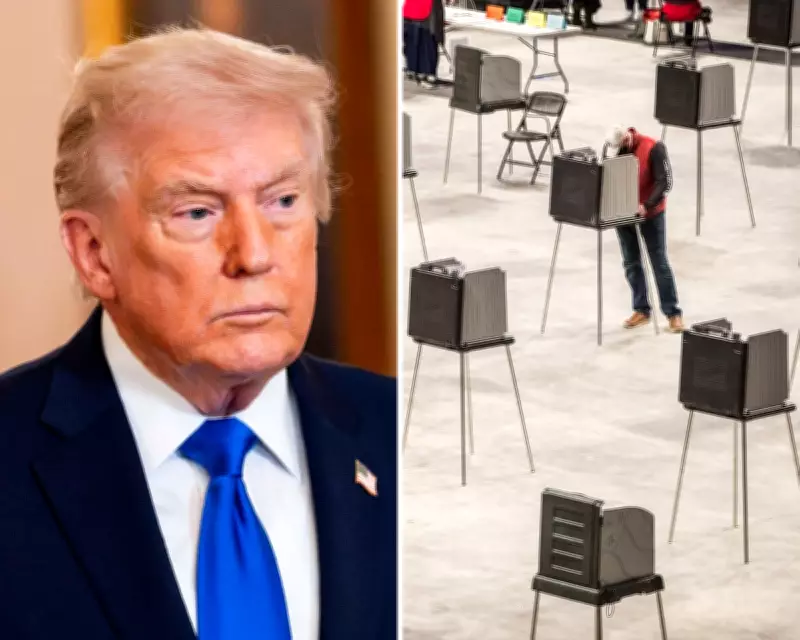
Trump's Election Machine Seizure Threat Looms Over 2026 Midterms
State election leaders across the United States have been raising urgent concerns about the intent behind Donald Trump's recent aggressive moves targeting election infrastructure. These actions include the FBI's seizure of election materials from Fulton County and an investigation into Puerto Rico's voting machines, pointing toward a disturbing possibility that Democratic voters have until now only contemplated: the federal government seizing voting machines nationwide in a way that could severely disrupt voting in the 2026 midterm elections.
Recent Actions and Escalating Threats
Following the FBI's raid on Fulton County's election office last month, Donald Trump returned to his repeatedly debunked claim that he defeated Joe Biden in Georgia during the 2020 presidential election. In a podcast interview with former FBI staffer Dan Bongino earlier this month, Trump declared, "The Republicans should say, 'We want to take over.' We should take over the voting in at least – many – 15 places. The Republicans ought to nationalize the voting."
Later that same week, it was revealed that Director of National Intelligence Tulsi Gabbard, who was present during the Fulton County raid, had led an investigation into Puerto Rico's voting machines in May. Her office took some machines for examination to identify what they described as potential vulnerabilities in the island's electronic voting systems.

Potential Disruption Scenarios
If the federal government were to declare certain digital voting machines off-limits at the last minute before an election, it would trigger a chain of emergency court hearings. This would leave election directors scrambling to find alternative methods to print and count ballots while legal cases remained unresolved. Early voting could collapse entirely, Election Day voting could be significantly curtailed, and final results might not be available for weeks or even months.
Historically, midterm elections tend to favor the party opposing a newly-elected president, a pattern Trump has acknowledged. The president's efforts to thwart this political reality have been evident across his administration. Last year, he directed Republican-controlled states to gerrymander congressional districts to limit Democratic opportunities to win seats. Meanwhile, the civil rights division of the Department of Justice has backed challenges to voting rights laws, which advocates describe as attempts to maintain Republican control of additional seats.
Connected Pattern of Election Interference
Bruce Spiva, senior vice-president of the voting rights group Campaign Legal Center, emphasized that all these moves are interconnected. "The FBI is seizing ballots from the 2020 election, President Trump is calling for our elections to be 'nationalized,' and the US Department of Justice is suing more than 20 states to get access to voters' private data. This is not a coincidence," he stated.
State election officials have expressed particular concern following the publication of an executive order in March that would have forced the Election Assistance Commission to decertify voting machines. The order would have allowed the Department of Homeland Security to access voter registration information and required citizens to produce passports or similar documents to register to vote. Although a federal judge permanently blocked this executive order in October, noting that the Constitution vests control over voting with individual states, other concerning moves continue.
Puerto Rico Investigation Details
The investigation into Puerto Rico's voting systems appears to represent an early, significant step in a wide-ranging examination of election security and potential foreign interference led by Director Gabbard. Puerto Rico, a US territory that elects a non-voting representative to Congress but doesn't participate in presidential elections, began implementing electronic voting machines purchased from Dominion Voting Systems in 2020 to replace outdated paper ballots.

The 2020 primary elections in Puerto Rico experienced substantial delays and technical issues. A software problem caused Dominion-supplied machines to incorrectly calculate vote totals, with machine-reported counts sometimes lower than paper counts, reversed totals, or zero votes reported for certain candidates. The territory terminated its contract with Dominion in 2024 and transitioned to a paper ballot system.
Gabbard's Controversial Background and Current Role
Tulsi Gabbard brings a controversial history to her position as Director of National Intelligence, having previously peddled conspiracy theories and maintained positions unusually aligned with former Syrian president Bashar al-Assad and Russian president Vladimir Putin. Her fellow Democrats in Congress openly questioned in 2018 whether it was safe to have confidential witnesses appear before her, and the TSA placed her on a watch list due to her travel patterns.
Despite this background, Gabbard was confirmed as director in February and appears to have almost immediately begun investigating election interference claims. The Office of the Director of National Intelligence denies seeking evidence of a hack by Venezuela's government, a claim circulating in right-wing circles. Federal investigators asked Puerto Rico to voluntarily turn over voting machines and software images for analysis as part of a joint FBI-ODNI investigation.
Technical Vulnerabilities and Legal Authorities
ODNI cited vulnerabilities exposed by the Def Con Voting Machine Hacking Village, an event at an annual hacker conference in Las Vegas that found many widely used voting machines could be easily attacked through insecure hardware, exposed ports, weak protections, and the ability to run unauthorized code. Among specific vulnerabilities, researchers discovered that hackers could potentially use USB devices called "Bash Bunnies" to infect voting machines and scramble their tallying capabilities.
Experts worry that Gabbard's investigation represents part of a broader, disruptive effort to curtail digital voting machine use, similar to Trump's attempted executive order last year that federal judges swiftly blocked. In a letter to Congress about her presence in Fulton County, Gabbard cited numerous statutes and executive orders, including Executive Order 13848, "Imposing Certain Sanctions in the Event of Foreign Interference in a United States Election," and the International Emergency Economic Powers Act.
Legal Challenges and Expert Skepticism
Miles Taylor, former chief of staff of the Department of Homeland Security, who helped draft Executive Order 13848 in 2018 in response to Russian election interference investigations, expressed skepticism about the administration's motivations. "I don't even for a second believe the administration's justification that what they're doing in Puerto Rico and what they're doing in Fulton County, Georgia, has anything to do whatsoever with active foreign interference in our elections or some previously unknown foreign interference in our elections," Taylor stated.
Former White House counsel Bob Bauer predicted legal challenges would succeed against any attempt to use executive orders as basis for blocking voting machines, undermining state mail voting laws, or building nationalized voter rolls to falsely allege widespread fraud. "If the Trump administration is aiming to use the executive order as the basis for blocking the use of voting machines, undermining state law mailing voting laws, or building 'nationalized' voter rolls to falsely allege widespread fraud, it will meet with immediate legal challenges, and those challenges will be successful," Bauer asserted.
Despite these potential legal obstacles, the combination of Trump's public statements calling for election nationalization, Gabbard's investigations into voting systems, and the administration's broader pattern of election-related actions has created genuine concern among election officials and democracy advocates about potential disruption to the 2026 midterm electoral process.