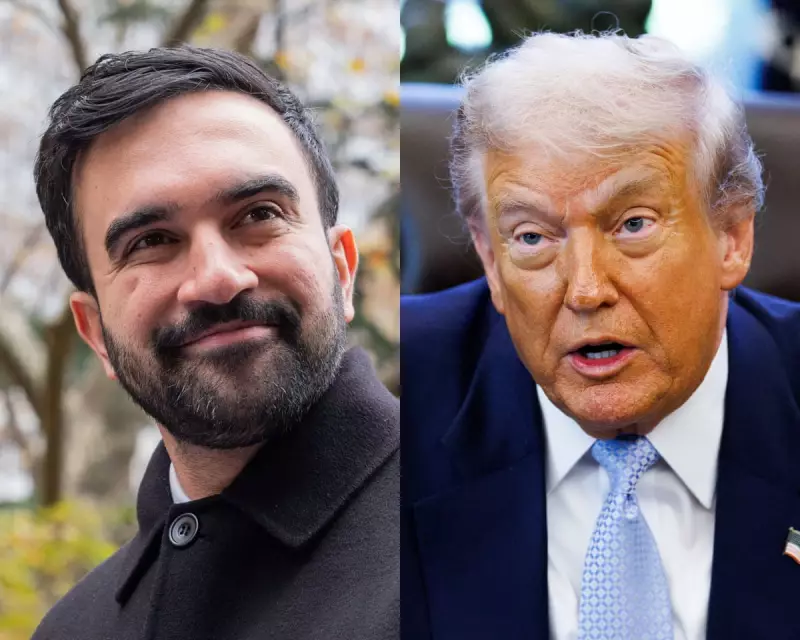
In a highly anticipated political encounter, US President Donald Trump is scheduled to meet New York City Mayor-elect Zohran Mamdani at the White House this afternoon. This first face-to-face discussion brings together two fiercely ideological opponents with dramatically conflicting visions for America's largest metropolis.
A Meeting of Opposites
The meeting represents a significant moment in US politics, pitting the combative Republican president against the defiant democratic socialist who secured a commanding electoral victory last month with over 50% of the vote. This encounter comes after months of public sparring, with Trump having recently labelled Mamdani a "communist lunatic" while the incoming mayor pledged to "Trump-proof" New York City and accused the administration of pursuing policies designed to punish the urban centre.
For Mamdani, a leftwing state assemblymember until his shock primary victory, this sit-down presents an early test of his ability to negotiate with a president who controls vast federal resources that the city depends upon. Interestingly, Mamdani's team made the first move in reaching out for a meeting, even as Trump earlier threatened to withhold federal funding from New York if Mamdani took office.
Pre-Meeting Tensions and Strategies
The Trump administration has deployed multiple pressure tactics ahead of the high-stakes meeting. Immigration and Customs Enforcement officials have signalled plans to escalate operations in New York City, while several rightwing Congressional Republicans suggested investigating whether Mamdani's citizenship is valid, despite his naturalisation in 2018 after immigrating from Uganda as a child.
Mamdani's team spent Thursday preparing extensively for the encounter through strategic calls with:
- Kathy Hochul, New York's governor
- Chuck Schumer, the Senate minority leader
- Hakeem Jeffries, the House minority leader
- Civil rights leader Al Sharpton
- Robert Wolf, former chief executive of UBS Americas and known Barack Obama ally
When questioned on Thursday about whether he feared receiving hostile treatment similar to Trump's contentious Oval Office meeting with Ukrainian President Volodymyr Zelenskyy - where Trump accused Zelenskyy of "gambling with world war III" - Mamdani brushed aside concerns. "I'll stand up for New Yorkers every single day," he firmly replied.
Policy Visions and Political Realities
The incoming mayor has framed this White House meeting as an opportunity to advance his central campaign platform: making New York more affordable. His ambitious promises include:
- Free public buses
- Government-run grocery stores
- Rent freezes for over one million stabilized units
- The city's first universal childcare program
"I view this meeting as an opportunity for me to make my case," Mamdani stated on Thursday. "It behooves me to ensure that I leave no stone unturned in looking to make this city more affordable."
Karoline Leavitt, the White House press secretary, presented Trump's willingness to meet as evidence of his openness to dialogue across political divides. "President Trump is willing to meet with anyone and talk to anyone and to try to do what's right on behalf of the American people, whether they live in blue states or red states, or blue cities," Leavitt remarked.
However, the underlying tensions remain unmistakable. Trump directly involved himself in the mayoral election, dismissing the candidate from his own party, Curtis Sliwa, as a lightweight while instead endorsing Andrew Cuomo, the Independent, formerly Democratic governor. The Trump administration also yanked federal aid for critical infrastructure projects - including the Gateway Tunnel between New York and New Jersey and the Second Avenue subway line - during budget negotiations.
Among New York voters, CNN's exit polling from the mayoral election showed Trump garnered only 27% approval compared with 70% disapproval. Yet in a surprising twist, 10% of Trump's 2024 voters also cast ballots for Mamdani, suggesting there is indeed overlap in their populist economic messaging, despite their vast ideological differences.