
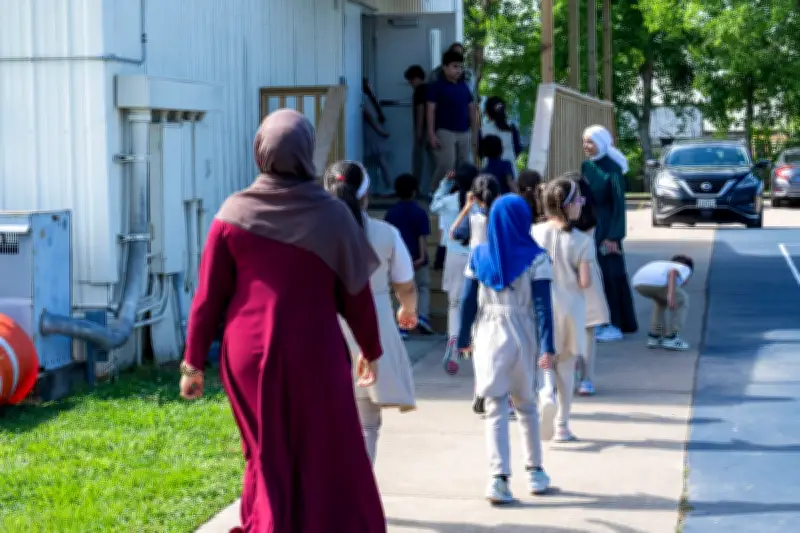
Muslims in Texas are bearing the brunt of escalating anti-Islamic rhetoric as Republican politicians mainstream hate, making everyday life increasingly difficult and dangerous. Following a brutal Republican primary runoff where Islamophobia took center stage, anti-Muslim hatred has spilled into public life across the state.
Everyday encounters with hate
Texans report that hate speech from elected officials is being echoed in daily interactions—at schools, stores, parks, and universities. In one incident, students at the University of Houston were praying when a man approached and burned a Qur'an. Others have been verbally attacked for wearing traditional garments.
“It definitely trickles down,” said Naila Syed, a Dallas resident and member of the Islamic Center of North America Council for Social Justice. Syed said her two young daughters have been confronted with anti-Islam “talking points” at school, including a fellow student asking if they knew that followers of Islam treated women poorly. “To have a kid who has these points ready and memorized like this is just very concerning as a parent,” Syed said.
Threats and intimidation
Multiple individuals said the hatred has made them uncomfortable leaving home alone. Some requested pseudonyms due to threats and online harassment. At the official Texas GOP convention, Muslim attendees—including delegates—were told to convert to Christianity or leave the country. Around the same time, a woman was filmed verbally accosting two Muslim women in a grocery store, saying, “Islam is a terrorist organization, not a religion. This is not a Muslim country; this is a Christian country.”
A fundraiser for the woman who made the comments has raised nearly $145,000 and drawn support from Republican congresswoman Nancy Mace. Mace and fellow Republican Brandon Gill, who represents Texas’s 26th congressional district, have repeatedly cast Europe as a cautionary tale about immigration from Muslim-majority countries. Gill introduced legislation to bar or suspend immigration from countries like Somalia and sent a constituent email titled “Stop Islamic Immigration Now or Our Children Will Pay the Price”.
“I represent DFW,” Gill wrote, referring to Dallas-Fort Worth. “I have watched these communities transform in real time. I know what the trend line looks like, and it does not end well if we do nothing.” In a Fox News interview, he said of immigration from Muslim-majority countries, “This is something that if we don’t stop now, it’s going to be my daughter and daughters across the country who are going to public schools wearing burqas.”
Official platform embraces bigotry
Similar vitriol has become part of the Texas Republican party’s official platform. At the party’s convention in June, one legislative priority was “Don’t Sharia Our Texas”, effectively calling for the criminalization of sharia law. Experts have repeatedly pointed out that no individual or institution has been trying to implement sharia law in Texas. Sharia refers to a moral code derived from the Qur’an, not just law. As one convention attendee noted, he was practicing sharia at that very moment.
One Muslim attendee, using the pseudonym Omar, previously spoke about being singled out for his religion. He requested anonymity after being attacked online by strangers. Omar said he does not harbor resentment toward all of the Texas GOP because several people stood up for him, but he was rattled by being called a terrorist and told to leave the country. “We care about the issues that every single American cares about,” Omar said. “We are family people, we are fathers, we are husbands, we are employees, we are employers. This is not the America I believe in, but I’m not leaving. I’m not going anywhere.”
Political representation and fear
Shehla Faizi, a Green party candidate for state comptroller, said the bigotry at the GOP convention was unsurprising. “It was only a matter of time before something like this happened to a Muslim who always backed Republican,” she said. Faizi is running as a third-party candidate because neither major party has done enough to stand up to hatred. She was also motivated by the lack of Muslim representation—Texas has only two Muslim legislators. “These are the things that inspire fear and anxiety for Muslims running for positions of power,” she said. Racism, she added, “causes people to shrink themselves in a sense in their everyday lives. It’s a psychological suppression.”
Education under threat
Syed recently experienced similar bigotry at a state board of Education hearing in Austin, where board members debated sweeping revisions to Texas social studies standards. The proposed rewrite would emphasize American exceptionalism and Judeo-Christian influences while reducing lessons on slavery, segregation, and civil rights, and scaling back instruction on world cultures and religions. In a room of about 50, Syed saw at least half a dozen speakers object to lessons about Muslim civilizations. A speaker misconstrued a passage from the Qur’an, and women seated next to Syed nodded and softly clapped. “I was just in shock,” she recalled. “I would just look at them and be like, ‘Hello, I’m right here. I’m a visible Muslim. I wear the hijab.’”
Shortly after, the Republican-controlled board advanced the proposed rewrite, trimming civil rights and slavery lessons. Syed worries for students’ education and sees a dangerous trend: “It starts with demonizing one group, and then it moves on to another group, another minority group, and so on.”
Calls for dialogue
Syed has tried to secure a meeting with Representative Keith Self, who helped found Congress’s “Sharia-Free America” caucus, but has been unsuccessful. Self did not respond to requests for comment. If a meeting happens, Syed wants to explain what sharia actually is and open a respectful dialogue. Yet Syed and Faizi said Muslims alone shouldn’t be tasked with addressing the racism they face.
Dr. Suleman Lalani, one of Texas’s two Muslim legislators, founded the state house’s interfaith caucus in response to politicians using religion as a weapon. On June 23, he hosted a panel on “the politicization of faith” with imams, rabbis, and reverends. “Ignorance leads to fear, and fear leads to hate,” Lalani told the audience. “When we engage with one another, we learn from each other, raise awareness, unite, and make progress.”
Others were more blunt. “We are all being used as a tool,” said Christian Manuel, a Democratic state house representative from southeast Texas. “They are weaponizing people’s ignorance.”




