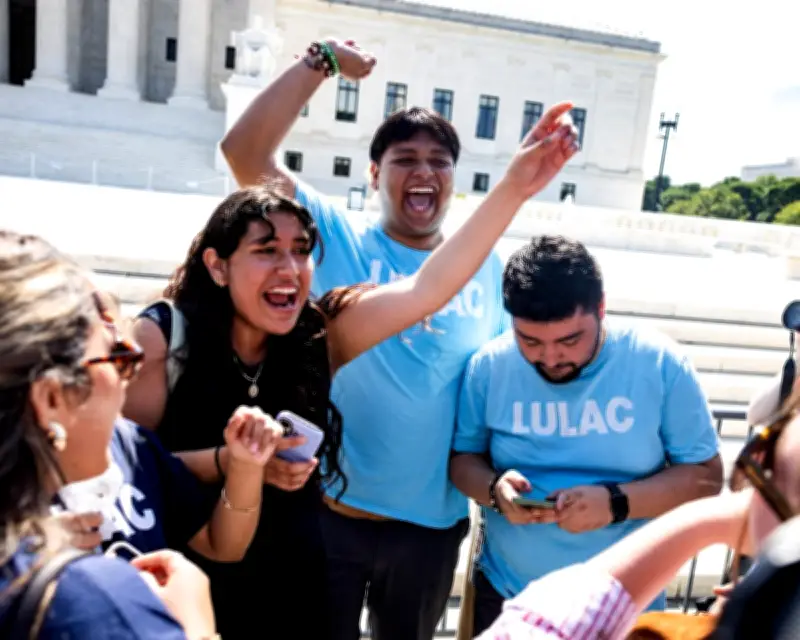
The US Supreme Court has upheld the constitutional guarantee of birthright citizenship, affirming that nearly all people born on US soil are American citizens and rejecting a central pillar of Donald Trump's anti-immigrant agenda.
Court Ruling and Majority Opinion
Chief Justice John Roberts wrote for the majority that the executive order violated the 14th Amendment. “Citizenship, then and now, was the right to have rights – to freely participate in our political community,” Roberts wrote. “The Framers of the Fourteenth Amendment extended that promise to ‘every free-born person in this land.’ We keep that promise today.”
Roberts was joined by liberal justices Sonia Sotomayor, Elena Kagan, and Ketanji Brown Jackson, and conservative justice Amy Coney Barrett. Justice Brett Kavanaugh concurred in part, arguing the order violated federal law but not the Constitution. Dissenting were Clarence Thomas, Samuel Alito, and Neil Gorsuch. The ruling spans 194 pages, with Thomas writing nearly 90 pages in dissent, his longest on the court.

Trump's Reaction and Legislative Push
Trump called the ruling “too bad for our Country” but urged Congress to act legislatively. “No long and unwieldy Constitutional Amendment is necessary! Congress should start TODAY to work on ending expensive and unfair to our Country, Birthright Citizenship,” Trump wrote on Truth Social. “They will have my Complete and Total Support!”
Civil Rights Groups Celebrate
The American Civil Liberties Union celebrated the ruling as a “major victory.” Its national legal director, Cecillia Wang, who argued the case, said: “The court's decision reaffirms a fundamental American promise – if you are born here, you are a citizen. A president cannot change the constitution by executive fiat.”
House Democratic leader Hakeem Jeffries noted that the 14th Amendment “withstood the unconstitutional attack launched by Donald Trump and his most sycophantic and xenophobic enablers.” He added: “On the eve of America's 250th birthday, the far-right Maga conservatives have failed in their quest to remake the United States, and American values have prevailed.”
Historical Context and Dissenting Views
The majority opinion traced citizenship from English common law through slavery and emancipation, rejecting the “odious” Dred Scott decision. Roberts wrote that children born in the US to parents unlawfully or temporarily present are “subject to the jurisdiction” of the US and are citizens at birth under the Citizenship Clause.
Justice Jackson wrote in concurrence that the 14th Amendment's “universalist aims should forever be the death knell for this kind of claim – one that seeks to make bloodline the marker of birthright.”
In dissent, Thomas argued that Black people were entitled to citizenship because they had “no other homeland,” but that is not true for “the children of foreign temporary visitors.” Alito called the decision “one of the most important” but a “serious mistake,” suggesting Congress address the issue.
Legal Arguments and Domicile
The Trump administration argued that “subject to the jurisdiction thereof” excludes children born to parents not lawfully present, relying on the concept of “domicile.” However, Roberts wrote that “the Court exhaustively canvassed the text and history of the Citizenship Clause and at no point identified any evidence that the ratifiers thought themselves to be imposing a domicile limitation.” He dismissed the government's claims as “dramatically revisionist.”
Trump attended oral arguments in person, the first sitting president to do so. The executive order would have affected hundreds of thousands of babies annually starting February 19, 2025.
Reactions from Capitol Hill
House Speaker Mike Johnson expressed disappointment, saying birthright citizenship “has been grossly abused in recent years.” He claimed that people “just come on to the soil and have your child, and then they're able to avail themselves of the welfare state and everything else.”
The ruling is seen as a major victory for civil rights and a reaffirmation of the promise of America, with legal scholars noting that overturning a constitutional amendment requires a two-thirds majority in Congress or a convention of states.