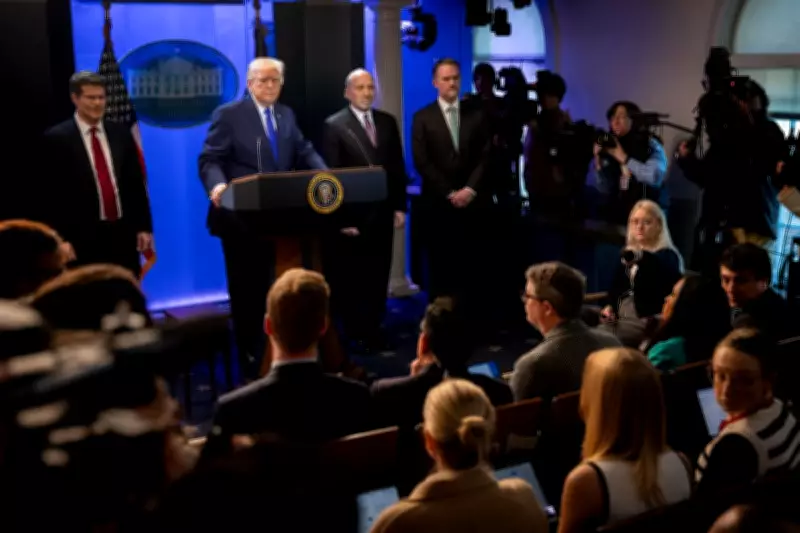
Supreme Court Delivers Stunning Rebuke to Trump Over Tariffs Authority
In a landmark decision that has sent shockwaves through Washington, the US Supreme Court has ruled that former President Donald Trump's expansive tariffs are unlawful. This ruling represents a pivotal moment, as the conservative-heavy court has largely supported Trump's agenda until now. The judgment, issued on Friday, forcefully reasserts the constitutional separation of powers, stripping Trump of a key tool he has used aggressively against both allies and adversaries globally.
A Judicial Check on Presidential Overreach
For over a year, the Supreme Court has faced criticism for standing by while Trump appeared to disregard constitutional boundaries. However, this latest ruling signals a clear shift. The court declared that Trump's invocation of the International Emergency Economic Powers Act (IEEPA) to justify global tariffs was invalid. Emphatically, the ruling states that tariffs are taxes, and the power to tax rests solely with Congress, as the guardian of the national purse.
Legal experts have hailed the decision as a crucial victory for democratic principles. Barb McQuade, a law professor at the University of Michigan, exclaimed, "At last," noting that the court has remembered "that Congress is a separate and co-equal branch of government. One of Trump's favorite levers is removed from the arsenal of extortion."

Trump's Fury and the Court's Unusual Alliance
Trump responded to the ruling with characteristic fury, launching a blistering attack on social media. In an all-caps tirade, he denounced the justices, calling the three liberal-leaning members of the majority "FOOLS" and "LAPDOGS," while praising the dissenting conservatives for their "strength, wisdom, and love of our Country." This public outburst underscores the personal vitriol that has defined his approach to judicial setbacks.
What makes this ruling particularly significant is the voting composition. Chief Justice John Roberts, authoring the opinion, forged an unexpected 6-3 majority. This was not the usual conservative-liberal split; instead, Roberts was joined by two fellow conservatives—Justices Neil Gorsuch and Amy Coney Barrett, both Trump appointees—alongside the three liberal-leaning justices. This alliance delivered a collective "bloody nose" to Trump, as analysts have described it.
Implications for Trump's Agenda and Future Legal Battles
The ruling has immediate political ramifications, with midterm elections just nine months away. Trump has been deprived of a potent weapon in his political arsenal, potentially weakening his stance on trade and foreign policy. Moreover, the decision sets a precedent that could challenge other controversial actions by Trump, such as attempts to undermine birthright citizenship under the 14th Amendment.
However, experts caution against over-optimism. Lisa Graves, an authority on the rightwing legal movement, noted, "This ruling is not judicial courage. This is the Roberts court doing the bare minimum to rein in Trump's abuse of power." The court's history of favoring Trump in previous cases, including the grant of absolute immunity for official acts in Trump v. US, suggests that this ruling may be an exception rather than a new norm.
Analyzing the Justices' Motivations
Justice Barrett's vote aligns with her emerging independent streak, having sided with liberals on several occasions. In contrast, Justice Gorsuch's decision is more surprising, given his reliably conservative record. In his concurring opinion, Gorsuch emphasized that Congress did not clearly surrender tariff authority to the president, highlighting his commitment to originalist constitutional interpretation.
This ruling puts Trump on clear notice that there are limits to presidential power, even as he immediately announced new tariffs under different legislative authority. The Supreme Court has drawn a line, but the broader battle over executive overreach and judicial restraint continues to unfold in a deeply polarized political landscape.