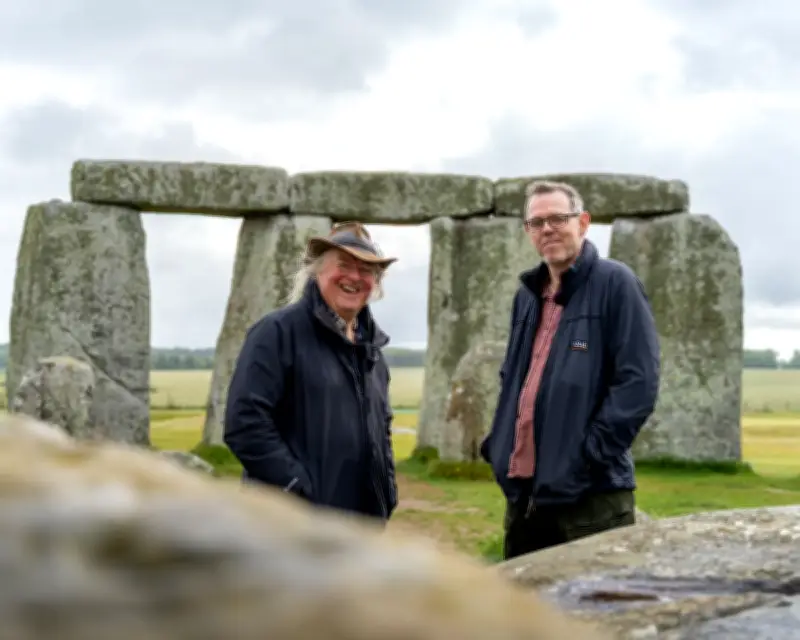
Archaeologists have discovered a 5,000-year-old monument aligned with the summer and winter solstices near Stonehenge, which they believe may have served as a prototype for the later solar alignment at the world-famous site. The find, described as a "once in a lifetime" discovery, was made at Bulford, just 5 kilometers (3 miles) from the World Heritage Site in Wiltshire.
Carbon Dating Reveals Ancient Origins
The structure has been carbon dated to around 3000 BC, coinciding with the earliest phase of construction at Stonehenge. This predates by 500 years the placement of the massive trilithon stones that were carefully aligned with the midsummer and midwinter sun. Experts say it is the earliest solstice-aligned structure in the Wiltshire landscape and one of the first in Britain.
Phil Harding, the archaeologist who led the dig on behalf of Wessex Archaeology before the construction of new Ministry of Defence housing, said the discovery was "one of the greatest finds of my career." However, Harding nearly missed it entirely. Unlike Stonehenge, whose towering sarsen boulders remain standing after 4,500 years, the Bulford monument consisted of two wooden poles set 120 meters apart, leaving only two large post pits in the ground surrounded by smaller rubbish pits.

Recognition Through Analysis
Harding, a former presenter on Channel 4's Time Team, admitted that at first, he and his colleagues did not recognize what they had found. It was only during later analysis of the site plan, when he drew a line with a pencil and ruler between the two anomalous larger postholes, that he realized the solstice alignment. "The thing that struck me as soon as I saw that was that [the line was] about 50 degrees off the direct north, which was pretty much the line of the midsummer sunrise. And so I got really, really excited about that," he said.
Further analysis by Fabio Silva, a "skyscape archaeologist" and expert in ancient astronomical mapping, confirmed that the two wooden poles accurately aligned with the midsummer sunrise and midwinter sunset in 2950 BC, the date determined by extensive radiocarbon analysis.
Structure and Artifacts
Based on the 1-meter depth of the post pits, the team believes the wooden poles stood 3-4 meters high and would have acted like a "gunsight" aligned with the solstice sunrise and sunset. A smaller pit, also aligned with the poles, contained a rare disc-shaped flint knife, which archaeologists suggest may have been shaped to represent the sun.
Matt Leivers, the senior research manager at Wessex Archaeology, said: "What we're seeing here is the religion of the stone age made manifest in the ground. Obviously we have no understanding of precisely what any of it meant, but the fact that time and again, over thousands of years, people are coming back to [the Stonehenge landscape] to build and rebuild and mark and remark this set of substantial events – it gives us an indication that this is religion. This is how they are understanding their place in the cosmos, how the universe works, what their deities are."
Leivers added: "We don't know what the sun meant to them. We don't know whether they personified it as a deity. But the amount of effort that's directed toward marking it and its movements leaves us in no doubt at all that this is a major religious event that's inscribed over the whole landscape over millennia."
Connection to Stonehenge
Leivers said it was "inconceivable" that those commemorating the solstices at Bulford would have been unaware of similar activities at Stonehenge, and they may have been the same people. "If you had a time machine and went back, I wouldn't be at all surprised if what we have found is one of the campsites of the builders of the first phase of Stonehenge. I think that's entirely plausible," he said.
Harding reflected on the significance of the find: "Sites like this come along once in a lifetime, sometimes they don't come along at all. It doesn't matter whether you are a resident of Wiltshire or a resident of the Earth – everybody knows about Stonehenge. And to be able to contribute something to expanding our knowledge of Stonehenge is an incredible privilege."