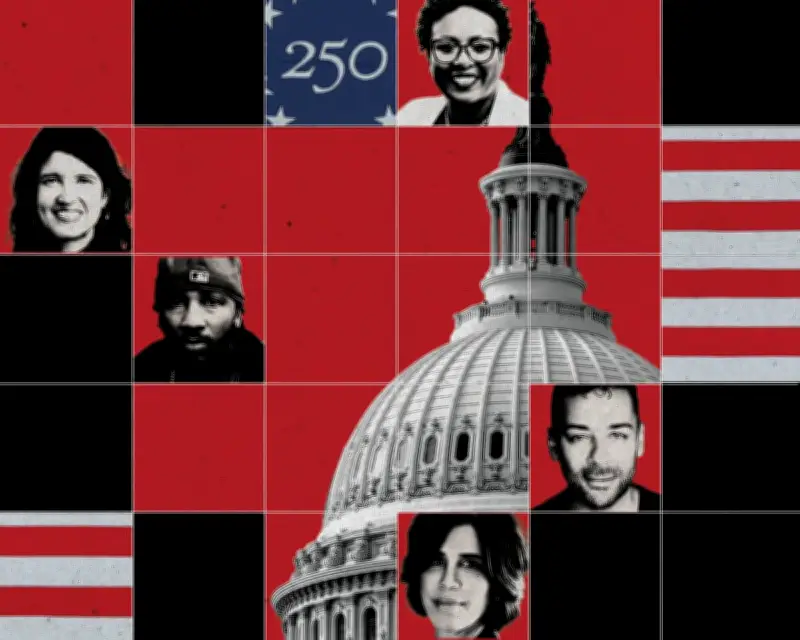
As the United States marks 250 years since the Declaration of Independence, activists and advocates describe this moment as both a crisis and an opening to reimagine the promises of freedom and democracy. The semiquincentennial arrives amid sustained attacks on voting rights, civil rights, and democratic institutions, challenges that organizers say are taking the country back generations.
“We can still build the democracy we all deserve – not the one we inherited, but the one we have the power to create,” said Kristen Clarke, general counsel at the National Association for the Advancement of Colored People (NAACP).
Many of the voices shaping this reckoning are not in traditional halls of power but on picket lines, in classrooms and courtrooms, and in philanthropic circles and grassroots organizations. They include workers fired for unionizing, lawyers fighting the rollback of basic liberties, and Indigenous land stewards whose communities have fought for recognition since long before 1776.

Escape the two-party plantation
Chris Smalls, workers’ rights activist and former president of the Amazon Labor Union, said: “The majority of these 250 years is not a history to celebrate. But I do believe we have an opportunity right now to rewrite that history and change our future for generations to come.” Smalls urged Americans to “escape the two-party plantation,” arguing that voting for Democrats or Republicans for decades has led to a system not working for the majority. He pointed to multiparty governments abroad with higher union density and called for sacrifice for the greater good.
Reform the nation’s highest court
Kristen Clarke emphasized the need for an affirmative right to vote enshrined in the Constitution. “This Supreme Court has moved at lightning speed – not only bringing about the death of the Voting Rights Act, but hollowing out the original meaning and purpose of the 14th and 15th amendments,” she said. She called for Supreme Court reform, including term limits, meaningful ethics requirements, and a ban on the shadow docket, to restore integrity and public confidence.
Despite the dark moment, Clarke expressed hope, citing protests against racial gerrymandering, turnout at state capitals, and attention to midterm elections. “The people are still in motion,” she said.
Eliminate limited gender expectations
Eliel Cruz, co-founder of the Gender Liberation Movement, envisions a United States that reckons with its history and dismantles oppressive systems. “I want to see a world where all people, especially LGBTQ+ young people, are safe from harm and have everything they need to live long, fulfilling lives,” Cruz said, calling for an end to limited gender expectations that harm both cis and trans people.
Build a genuine culture of free expression for all
Summer Lopez, co-chief executive officer of PEN America, highlighted threats to free expression, including unprecedented book bans, state laws restricting classroom teaching, and federal attempts to ban words from government documents. “These are textbook authoritarian tactics,” she said. Lopez urged seizing the 250th anniversary to build a culture of free expression by defending attacked voices, dismantling barriers, and engaging with those we disagree with.
Stand up for our neighbors
Yasmin Cader, deputy executive director for program, strategy and culture at the ACLU, connected the criminal legal system to racial subordination. She noted a growing willingness to confront that history honestly. “Most of the great advances in American democracy did not begin inside government. They began with the people insisting that the country live up to its promises,” she said. Cader emphasized organizing, building coalitions, and holding leaders accountable as strategies still available today.
Evolve democracy, not just preserve it
Celina Stewart, chief executive officer of the League of Women Voters, said trust has been eroded, with promises unmet and inhumanity toward immigrant communities. “Our hope is not just to preserve democracy, but to evolve it – to make it more representative, more inclusive, and, above all, more resilient,” she said. Stewart called for modernizing systems, protecting against disinformation, and fostering a culture of shared participation.

Ensure no one’s wellbeing is traded for another’s wealth
Edgar Villanueva, founder of the Decolonizing Wealth Project, criticized the nation’s treatment of land as a commodity. He noted progress: last year, his organization supported the return of more than 25,000 acres of land. “The land remembers how to heal itself. It only needs us to stop standing in the way,” he said. Villanueva described a “spiritual famine” but cited research showing 82% of Americans care for others without expecting anything in return. He advocated shifting money toward repair and restoration, calling it an obligation.