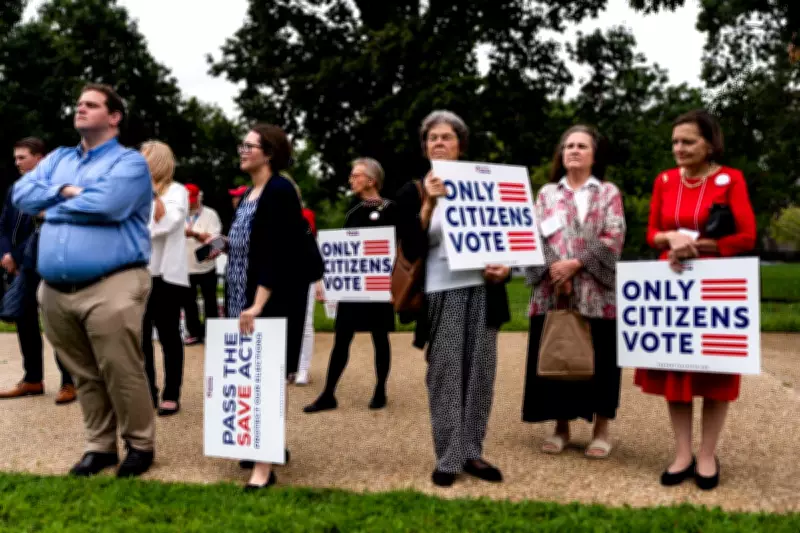
Senate Launches Debate on Controversial Save America Act Voting Legislation
In a significant political development, the United States Senate voted on Tuesday to initiate formal debate on the sweeping and restrictive Save America Act voting bill. The chamber approved the motion by a narrow margin of 51-48, setting the stage for what promises to be a contentious and prolonged legislative battle over election rules and voter eligibility requirements.
Legislative Background and Political Context
The Save America Act represents a rebranded version of the previously circulated Safeguard American Voter Eligibility Act, commonly known as the Save Act. This legislation has been moving through various iterations in Congress for more than two years, reflecting ongoing partisan divisions over election security and access. While the US House of Representatives passed the bill earlier this year, it now faces substantial procedural hurdles in the Senate, where it would require 60 votes to overcome filibuster rules and advance to final passage.
Republican leadership, including Senate Majority Leader John Thune, has faced intense lobbying pressure to potentially modify or lift filibuster rules specifically to advance this legislation. However, Thune has publicly acknowledged that he currently lacks the necessary votes to pursue such procedural changes, creating a significant obstacle for the bill's proponents.

Key Provisions and Controversial Requirements
The core provisions of the Save America Act would impose strict new requirements on voter registration and participation in federal elections. Most notably, the legislation would mandate that all new voters provide documented proof of US citizenship when registering to vote. Additionally, voters would be required to present approved identification when casting ballots at polling places.
These requirements come despite existing federal law that already stipulates voters in national elections must be US citizens. Proponents argue the new documentation requirements are necessary to ensure election integrity, while opponents contend they would create unnecessary barriers that could disenfranchise millions of legitimate American voters.
Political Dynamics and Partisan Positions
Democratic senators have uniformly declared their opposition to the legislation and are expected to block its passage through the Senate. They argue that the bill's documentation requirements would disproportionately affect voters who may not have immediate access to birth certificates or other citizenship documents, potentially disenfranchising both Republican and Democratic voters newly registering to participate in elections.
Republican leadership, meanwhile, has framed the extended debate as an opportunity to highlight what they characterize as election security concerns and to force Democratic senators to take public positions on the legislation. "This debate allows us to put Democrats on the record regarding election integrity," stated Majority Leader Thune, indicating the political strategy behind the prolonged legislative discussion.
Trump's Influence and Expanded Demands
Former President Donald Trump has emerged as the most vocal and influential advocate for the legislation, using his social media platform Truth Social to rally support among lawmakers. In a post on Tuesday morning, Trump declared the Save America Act "one of the most IMPORTANT & CONSEQUENTIAL pieces of legislation in the history of Congress" and issued stark warnings to legislators who might oppose it.
Trump has repeatedly made unsubstantiated claims about widespread voting by undocumented individuals in federal elections, assertions that election experts and researchers have consistently found to be extremely rare occurrences. Beyond the core voting provisions, Trump has advocated for an amended version of the bill that would include additional controversial measures, such as:
- A comprehensive ban on mail-in voting systems
- Prohibitions on transgender individuals participating in women's sports
- Restrictions on gender-affirming medical procedures for minors
These expanded demands further complicate the legislative prospects, as any Senate-approved version containing these provisions would need to return to the House for additional consideration and approval.

Procedural Challenges and Legislative Outlook
The Senate debate is expected to extend over multiple days, reflecting both the complexity of the legislation and the political significance attached to it by both parties. The 60-vote threshold required to overcome filibuster rules presents a substantial obstacle, given the current partisan composition of the chamber and unified Democratic opposition.
Last week, Trump escalated pressure on Congress by threatening to withhold approval of other legislation until the Save America Act receives consideration and approval. This tactic underscores the high-stakes nature of the debate and the former president's determination to see the legislation advance despite significant procedural and political challenges.
As the debate unfolds, political observers note that the legislation serves as both a substantive policy proposal and a political messaging vehicle, allowing Republicans to emphasize election security concerns while forcing Democrats to defend their opposition to measures framed as protecting electoral integrity. The outcome will likely have significant implications for voting rights, election administration, and the broader political landscape as the nation approaches future election cycles.