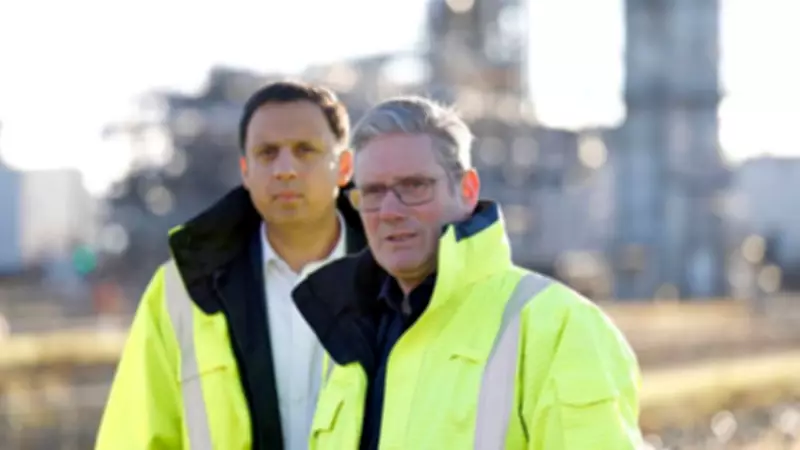
Scottish Labour Leader Reveals Communication Breakdown With Prime Minister
Scottish Labour leader Anas Sarwar has disclosed that he has not engaged in direct conversation with Prime Minister Sir Keir Starmer since the week in February when he publicly urged the premier to step down from his position. Sarwar confirmed this significant development during an interview with Sky News political editor Beth Rigby, while simultaneously affirming that he stands firmly by his controversial stance regarding the leadership of the UK Labour government.
Details of the February Fallout
Mr Sarwar elaborated that he communicated with Sir Keir on a "couple of occasions" during that pivotal week in February, coinciding with his public declaration at a news conference that the prime minister should resign. "I've not spoken to him since that week," Sarwar stated unequivocally. However, he was quick to add that despite this personal communication hiatus, their respective political teams continue to maintain regular dialogue, and he himself remains in contact with various members of the cabinet.
The Scottish Labour leader acknowledged that Sir Keir was understandably displeased with his public denouncement. "Of course he was going to be taking it negatively, of course he was going to be angry," Sarwar conceded. He emphasized, though, that this personal friction has not completely severed political discourse. "But I think in fairness to him and to other members of the cabinet that hasn't meant the dialogue has stopped. We still have very positive conversations about what's right for Scotland and how we can make sure a UK Labour government is delivering for Scotland," he explained.

Denial of Involvement in Leadership Plot
Addressing swirling rumors that he had consulted with senior Labour figures such as Health Secretary Wes Streeting and former deputy leader Angela Rayner prior to his call for Sir Keir's resignation, Sarwar firmly denied any involvement in a coordinated effort to oust the prime minister. He noted that the cabinet swiftly unified in support of Sir Keir following his intervention.
"To be honest, it didn't surprise me because I'm not part of any coup. I wasn't part of any plot," Sarwar asserted. "I wasn't interested in what it meant for Westminster. I'm only interested in what it means for Scotland." When questioned about potential regrets over his very public demand for the prime minister's resignation, he responded resolutely, "I've stated my position, I stand by it, I don't recount or recoil from that." He further described the current UK Labour administration as "an unpopular UK Labour government" with "an unpopular prime minister," characterizing these assessments as statements of fact.
Personal Difficulties Amid Political Stance
Despite the political rift, Sarwar expressed personal admiration for Sir Keir, describing him as a friend. He admitted that while it was "politically hard" to call for his resignation, the personal dimension made it even more challenging. "That was because Keir Starmer is someone that I know, someone that I like, someone that I call a friend and someone who I have spent a lot of time with," he revealed. "I know he is a good, decent man that wants to do the best by this country. So that was a very, very difficult position for me."
Upcoming Elections as Critical Juncture
Looking ahead, Sarwar identified the series of elections scheduled for 7 May—including those for the Scottish Parliament, Welsh Senedd, English mayoral positions, and local councils—as an "absolutely" crucial moment for the Labour Party. He aligned himself with Angela Rayner's concern that the party is "running out of time" to regain public trust.

"I think she'll have a similar frustration to me, that many people don't know the good things the Labour government has done," Sarwar commented. He acknowledged "far too many missteps" but highlighted a divergent temporal focus: "when Westminster politicians like Angela talk about time, they're talking about the next three years. I'm interested in the next 50 days." This statement underscores the immediate pressure and high stakes surrounding the impending electoral contests, which Sarwar views as a pivotal test for Labour's viability and public perception.