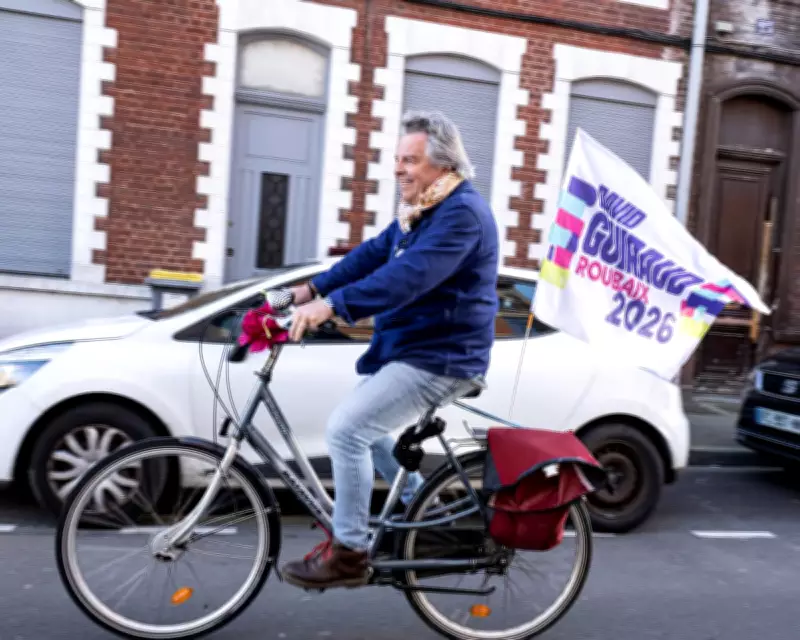
Radical Left Poised for Historic Victory in French Industrial Town
In the northern French town of Roubaix, a former textile industry powerhouse now grappling with deep poverty, Jean-Luc Mélenchon's radical left party La France Insoumise (LFI) stands on the brink of a significant local election victory this weekend. This development comes as a crucial test of political sentiment before next year's pivotal presidential race, when Emmanuel Macron's two terms conclude and Marine Le Pen's far-right National Rally party maintains strong national polling numbers.
A Town of Stark Contrasts and Deep Symbolism
Roubaix, nestled between Lille and the Belgian border with a rich history of immigration, presents a microcosm of France's economic divides. Once rivaling Manchester in industrial output, approximately 46% of its 100,000 residents now live below the poverty line. Youth unemployment reaches 50% in the poorest neighborhoods, with hundreds of families enduring dilapidated housing conditions often controlled by slum landlords.
Yet this struggling town also boasts surprising contrasts. It maintains a vibrant arts scene and striking industrial architecture alongside pockets of affluence. Most notably, Roubaix serves as the birthplace of Bernard Arnault, France's wealthiest individual and luxury goods magnate behind brands like Louis Vuitton and Dior, who began his career in his father's local building firm.

Grassroots Campaign Amid National Controversy
David Guiraud, the 33-year-old LFI mayoral candidate and current MP for Roubaix since 2022, has led a grassroots campaign under the banner "Proud of Roubaix!" focusing intently on local issues from street-cleaning to housing and policing. His campaign materials notably omit the LFI logo, and his positions sometimes diverge from party lines, such as on armed municipal police.
"Rebuilding close contact between residents and their elected representatives is the most important thing," Guiraud emphasized while distributing leaflets this week, as passing drivers honked horns in support. "Many people living here, even in more affluent neighborhoods, never see their representatives... We'll bring local democracy."
Resilience Despite Recent Scandals
The potential victory carries particular significance as it follows weeks of intense criticism directed at Mélenchon nationally. The Socialist party recently accused him of "intolerable antisemitic comments" and "caricature conspiracy theories" after public rallies where he appeared to stumble over Jewish names. Mélenchon apologized on social media, denying any antisemitic intent while acknowledging the hurt caused.
Guiraud himself faced legal proceedings after a 2024 confrontation with French-Israeli MP Meyer Habib regarding Gaza, though a court found him not guilty of antisemitism in January. "Our results across France in these local elections show that the blows levelled at LFI, and in particular at Jean-Luc Mélenchon, don't work," Guiraud asserted. "We're a force on the left, we're anchored locally and nationally, and we have no intention of keeping our head down."
Electoral Implications and Voter Sentiment
Political science professor Rémi Lefebvre from the University of Lille noted the significance of LFI's strong showing: "After weeks of accusations against Mélenchon, many observers might have thought the LFI leader would be weakened. But in fact he is not at all weakened. And you have to remember that barely three weeks ago he was a total pariah."
In the first election round, Guiraud secured over 46% support, though voter turnout remained below 38%. The current right-wing administration has been tarnished by the conviction of former mayor Guillaume Delbar for tax fraud late last year. "We need a breath of fresh air now," remarked Saïd, a 38-year-old town hall employee.
Yet skepticism persists among some residents. Karim Amrouni, an orthodontist running as a center-left candidate, criticized LFI for making "promises" to instantly solve the town's problems, noting "people will realise magic doesn't exist in politics." Meanwhile, Stéphanie, a 48-year-old unemployed carer, expressed disillusionment: "Why would I vote, what will it change? It's so hard to find a job here... It feels like we're abandoned."

Broader Political Landscape
This local election serves as a critical barometer for France's polarized political environment ahead of next year's presidential contest. While Mélenchon aims to position himself as a key opponent to the far right and seeks to reach the presidential runoff (falling just 400,000 votes short in 2022), Professor Lefebvre cautioned that "the wider electorate's high feeling of antipathy towards him would prevent him from winning."
Nevertheless, LFI's performance in Roubaix—alongside strong showings in Saint-Denis near Paris and Toulouse in the southwest—demonstrates the party's resilient electoral base among young people and multicultural urban communities. As France approaches a consequential political transition, this industrial town's choice may signal broader shifts in the nation's political alignment.